Category: Uncategorized

  • Holy Cow!  My Daugther is Autistic!

    Holy Cow! My Daugther is Autistic!

    E. Marmer | Free to Navel Gaze

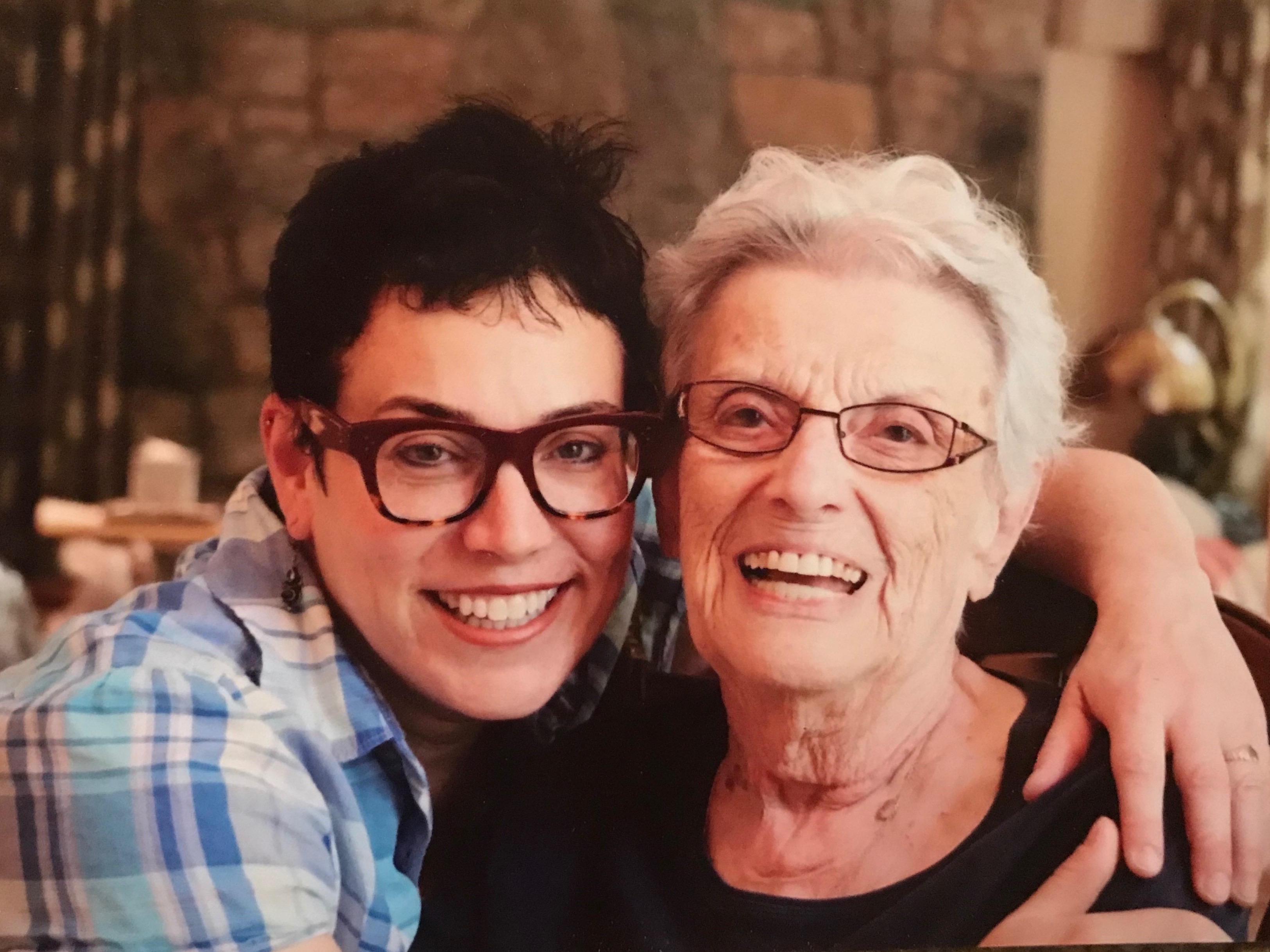
    A few days ago, I learned that my 28-year-old daughter Sophie is autistic, and I’ve been walking around semi-stunned ever since. Not because the diagnosis changes any of the facts on the ground- my daughter is who she is and I’ve observed her social and emotional difficulties, and some cognitive processing problems as well, over her entire life. I’m stunned because a vital and previously absent piece of information has now been revealed to us, and the impact of that information is enormous. It is ground-shifting, for my daughter of course, because now everything that she struggles with and has over her childhood, adolescence and young adulthood makes sense to her, but also for me. I have a different lens in place now, and the consequences are profound.

    peterdarcy.com.au

    My Sophie is many things. She is passionate, she is sensitive. She is extremely intelligent, diligent, observant, loyal, funny, talented and loving. She is also a monopolizer of conversation and attention, brusque, loud, emotionally volatile, quick to anger or upset, preoccupied with how she is being judged, easily overwhelmed or distressed, and afflicted by several mental illnesses, among these, bi-polar disorder, borderline personality, anxiety, an eating disorder, OCD and PTSD. As her mother I quite understandably have dedicated much of my emotional energy to trying to understand her, support her, soothe her, navigate her abrupt reactions and changes in mood, and even “fix” her, just so she would have an easier path in life. I also continually asked myself what I was doing wrong. When she was a child and was unable to connect with peers, when she had a tantrum, when she lashed out and when she withdrew, I always quavered internally with the worry that I was blowing it. Did I not model correctly, did I not teach properly, did I not counsel or discipline or comfort the way I should have?

    photogallery.indiatimes.com

    These are questions that plagued me over the decades, to the point where I was often frozen with uncertainty, and incapable of any action or meaningful contribution in a variety of contexts. Ironically, and sadly, my uncertainty and sheer confusion, my feelings of deep concern for her and my fear of inadequacy as her mother, often led me to do harm during her childhood. I said unhelpful or even hurtful things in my floundering. I focused and lectured on the extremity of her responses instead of addressing the underlying feelings which produced them, which left Sophie feeling unseen and unheard, and moreover conveyed the idea that she was different, or “wrong”. I remained silent when I should have spoken and left her feeling alone in her experience of the world or in her own family. But perhaps the worst thing I did was broadcast through my eyes and facial expressions my heavy and helpless worry that she would not be able find her way in this world. Sophie saw and felt that concern there every day and took it to mean, as any child would, that she was somehow causing me pain. That is a terrible thing to show a daughter who knows she is different but doesn’t know why or how to change.

    I know that I couldn’t have known she is autistic. The field just hadn’t advanced enough and only now is exploding with greater understanding of what autism is, and what are its symptoms. People now know that autism is not a linear spectrum, but more like a pie with sections which are filled in differently according to areas of deficit, which is why autism presents differently in different individuals. There has been a reckoning, moreover, with the failure to recognize symptoms of autism in female-presenting individuals, who are taught from an early age to be social, to fit in and please others and thus possibly are more motivated or skilled to mask the ways in which they are different. When an autistic person masks many aspects of their autism while still displaying others, it presents a perplexing tangle of seemingly erratic and confusing behaviors or tendencies that can create problems with family and peers, but which are all the more difficult to comprehend. It’s like looking at half a picture.

    So, intellectually I know that I shouldn’t blame myself for many of the mistakes I made. And yet, I still feel great sorrow at having made them as there is no question that they had an impact, and contributed a great deal to my daughter’s suffering. Perhaps she wouldn’t have struggled with so much anger and insecurity throughout her life, or carried the resulting scars, if I had simply understood that a lot of her behaviors were not within her control or resulted from different cognitive wiring. These are things I cannot now change.

    Going forward, however, this new lens brings tremendous clarity and a grounding for a positive future. My daughter burst into tears of relief when she received her diagnosis, and I wasn’t far behind. The central piece of a puzzle has been put into place. Even her other mental illnesses make more sense, because, as we’ve learned, they are very often present with autism, and indeed even directly related. Sophie, (and I) now know that she doesn’t need to change, that there is an explanation for how she is configured, and that the world is catching up to understanding and making room for people with autism. I plan to read all that I can about autism, and hopefully will be able to support my wonderful, complicated daughter in whatever ways I can with a greater understanding and an even greater appreciation of all her amazing qualities, her dedication to getting to the bottom of her unique emotional and mental makeup and her daily struggle to make sense of a society set up by the neurotypical majority. I’m so proud of her.

    E. Marmer | Free to Navel Gaze

  • Smitten

    Smitten

    This is a confession.  I have to face facts and stand in judgment.  Please be merciful for I have become that which I once held in ridicule. That most tiresome and clueless imposer of …. things about my cat. 

    E. Marmer | Free to Navel Gaze

    Thus far (for the most part), I have resisted, while in a constant stream of unrestrained pet joy, the impulses to post photos of my cat doing cute things… this essay being the exception that proves the rule of course. I can still recall the tut, tut, tut judgment (mine included) of all those subjected to a dizzying array of cats doing this and cats doing that.  This has given me the brake, which thus far has tamed my wildly beating breast.   

    But make no mistake.  What I am not posting I am nonetheless constantly calling out in utter delirium to anyone who happens to be nearby:  Look!  Look! Look! Look! Isn’t she cuuuute?? Look at how she curls her little paw! Look at how she rolls over when she wants to play!  Isn’t it adorable how she pounces on her toy! Listen to that cute little questioning chirp that sounds like “Huh?” 

    E. Marmer | Free to Navel Gaze Her Royal Kitten Highness

    My family and best friend have thus borne the brunt of my giddy outbursts.  I have to gush somewhere.  It is a constant struggle to zip it, and most days I just give in.  After all, they’re my inner circle, right?  They have to listen.

    Yes, I am smitten.  With a creature who has done nothing to warrant my devotion but be cute and utterly dependent on me, though she tries to feign otherwise.  How did this happen? 

    E. Marmer | Free to Navel Gaze A Minor Inconvenience

    I think it’s a parental thing.  My theory: it’s the unconditional love, the spoiling, the besotted pride of the parent for his or her infant. Even though my cat technically is no longer a kitten, she will always be my baby. Her need of me stirs that instinct, that crazy love. What else could explain why I refer to myself as “Mommy” when I talk to her? (Yikes!)  

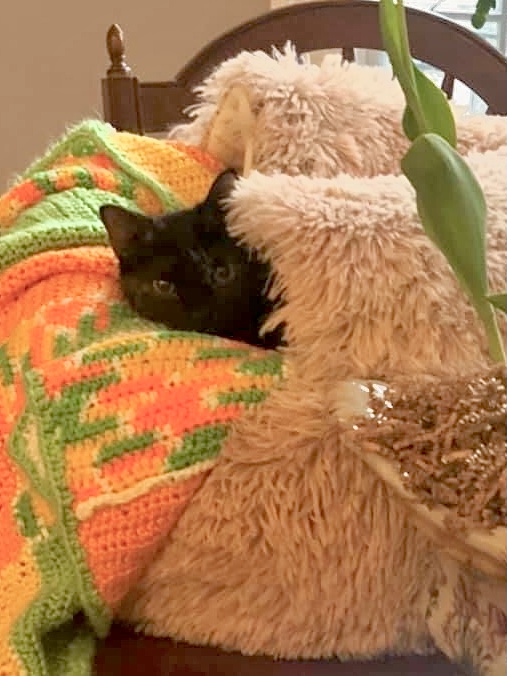
    My cat, my Esme, a tortoiseshell, mixed- breed rescue (Can you see how she is part Oriental?? Look at that bone structure!  Do you see her grace?), struts around in importance and yet starts at the slightest sudden noise, looking to me for reassurance. She instantly relaxes her tightly coiled body at my calm and loving energy directed at her:  yes, my love, everything is okay, you are safe.  No matter how merely tolerant she tries to seem of my petting, we both know she’d be lost without me.  Hardly a trip to the bathroom goes by without her mewing pitifully at my closed door.  Never a night goes by without her curled up on my bed. And when she has lost the trail of me in our house, suddenly unsure of where I am, calling out in a desperate wail, and I respond with a loud and cheerful call, never a time goes by where she does not bound to where I am, trilling in excitement, relief and happiness.  Who wouldn’t melt?

    E. Marmer | Free to Navel Gaze Could You Not?

    But maybe it’s more than that. Maybe it’s that a cat is an uncomplicated, indeed primal being (waaay more primal than a dog, as any cat owner knows!), who responds to a person’s most elemental essence.  Esme loves me like my children did before they lost blind faith in me, before I didn’t handle something well, before we had to navigate complex situations.  It feels good and is easy to tell myself that Esme is a barometer of my most basic goodness. 

    This feline carnivorous prowler that slinks around my house, that grabs her scratching posts (and occasionally the furniture) with sharp claws and sometimes her teeth, this actual creature in my house that looks like a giant rat from the back when she is sitting and a strange monkey when she balances up on her hind legs begging for a treat, brings me the joy of her attachment and complete trust.  Not a lap cat at all, and completely disinterested, if not affirmatively abhorrent of being held, Esme’s idea of showing her positive assessment of me is to allow me to provide her the pleasure of having her neck massaged. Not for more than a minute, mind you, which, is all I need, so we both win.  

    E. Marmer | Free to Navel Gaze My Slinky Girl
    E. Marmer | Free to Navel Gaze Trying To Blend

    So, now, I am much more inclined to view pet photos online with a generous heart. For what are they but sweet celebration of an uncomplicated relationship, a perpetual two-way street of positive regard. Pet pictures are happy declarations that we get to adore a simple companion, who will not one day talk back to us or make choices that challenge our peace of mind. They express our delight in being trusted by a primitive beast whose fight or flight system has adjudged us as benevolent. 

    Still, I’ll try to keep my cat pics to a minimum. But oh, oh, oh! Did I tell you about the time she dragged her wand toy up to my bedside as I was settling down for the night, and then mewed at me to play with her? Isn’t that a-DOR-able?

    E. Marmer | Free to Navel Gaze Esme
  • When She Was Here

    When She Was Here

    E. Marmer | Free to Navel Gaze

    When she was here, my mother would lie on her bed after I helped her shower, on top of the long white towel she insisted I put down so the bed wouldn’t get wet. But I thought of that towel as part of her cocoon, the one I made by putting another long white towel on top of her, and one small one for under her feet because the main towel wasn’t long enough, and one for under her head of course, because I wanted her hair to dry, but in her mind it was there to prevent the pillow from absorbing all that wetness from her hair, always so careful, my mother. Then I’d put her comforter over this sandwich in which she was the filling, and tuck her in.

    With her arms and legs immobilized inside this wrapping, by weakness more than by swaddling, and her now small head peeking out over the cover, she seemed to me almost like my child. She pulled forth from me all the same sweet painful love I had only known for my children, with almost but not quite the same targeted piercing as I felt when my breast milk came in.  My mother in my care, so completely, so willingly and with utter belief in her security – it was just the same as with my children. And the sensation, this belief I felt from her, made me love her in a new old way. And when I bent down to kiss her just as I would have my child who was going down for a nap, I was even able to nuzzle her neck in a tickling way that made her giggle, then look into her laughing eyes with my loving ones. 

    I’d announce that I’d come back into her room in ten or fifteen minutes to check if she were dry and ready to dress, but we both knew I meant I’d really be back in as many as thirty minutes because I’d be trying to get something done in the kitchen and on top of that I had no sense of time.  That she knew it and knew that I knew she knew, made her love me in a new way as well.  I’d like to think so, anyway.  We also both knew that she needed more than 10 or 15 minutes anyhow to recover from the exertion the shower required, but that didn’t make either of us love more or differently, it just made us sad.

    My mother had pancreatic cancer, diagnosed at least when she was 85, in some sort of merciful grace by an unseen god. On the other hand, for a woman determined to live into her nineties, it still sucked.  She didn’t want to leave; she hadn’t stopped enjoying us all, and the small pleasures that came with her every day. Such a modest woman, she didn’t ask for much and was more than delighted by all that she nevertheless received:  our attentions, her comfort and independence, the joys of watching her grandchildren and great grandchildren metamorphizing, the familiarity of the signs on her neighborhood roads, her simple routine just the way she liked it.  And so, aware that she might not live into her nineties after all, she determined instead to live as long as she could, and fight against the cancer as hard as an 85-year-old with, well, with pancreatic cancer, can.  As she had also lost almost 40 pounds in two months of intermittent hospitalizations which included recovery from a life-threatening surgical accident, leaving her so weak that she was unable to perform even daily living tasks, this made the effort required absurdly difficult, but she was not deterred. 

    My sisters and I decided that as the daughter with the best layout for her limited strength and mobility, the most unstructured, uncommitted time available, and an observed impressive endurance for those small irritations that can build and build with continuous exposure to one’s mother, sick or no, I would be the one to take her in and see to her care.  I think they knew, though, that it was what I wanted. I’d go to the mat for it. My sisters would come for wonderful long visits with our mother, and I would be able to leave for the occasional social engagement, or my own doctor appointments, but always I returned to her without the weight of obligation.  I carried instead a kind of gratitude, even a shameful pride, that I could make sure my mother’s existence was the most comfortable one possible in her condition. 

    She knew this.  She knew I was compelled to be the one, driven by devotion or some perceived claim. It could have been because I spent the least time with her, called her least of any of us over the preceding ten years or so, and I felt I had to make that up; or maybe it was because I carried the knowledge that I had spent much of my adult life working through the not always so hidden sorrows and insecurities I developed in part as a result of emotional barriers she erected, which I knew, of course, were the result of her own sorrows and insecurities as a child. . . and so perhaps I felt I had to make our last months (or what I hoped would be years) together as intimate and rid of shadows as they could be. It was true that, due to reckonings with my own daughter, and my fuller appreciation of all the ways I had fallen short for her, indeed due to the understanding I acquired over the years of so many things, I was primed to show my mother a new kind of unadulterated love.  

    But maybe it was because I needed to show her that I loved her desperately as no other could, as much as when I was child, and I wanted her favor and undivided attention as I did then.  As the third child coming into a busy working class household, I never really felt I had the individual attention from her that I wanted. And dammit I was gonna get it! I was going to have it, have her, all to myself. . . It’s this last possibility that disturbs me.  And yet, even to the extent it may have been true, my mother silently understood all of this. All the reasons, whether noble or pathetic, she accepted as originating from a pure place (as did my sisters, loving and generous souls that they are). Perhaps on some level my mother even recognized that my troubled relationship with my daughter mirrored somewhat the one she had had with me, in that I too had been the unhappy, solemn, and lonely child whom my mother cherished but did not know how to help; though neither of us needed to speak of that – she, because she did not like to reveal herself or reflect on the past, and I because I had already forgiven her so thoroughly that I wouldn’t even think to bring it up. 

    When I returned to my mother’s room, she usually reported that she was ready for the rest of our post shower ritual, which included dressing of course, but always began with the drying of her toes.  This precise operation, developed in response to her complaints that previous toweling had not sufficiently done the job, entailed my softly running the narrow edge of a dry washcloth between her toes. And it is the drying of the toes that I think of now, this small activity that somehow was the perfect expression of our momentary happiness, away from her cancer, away from the end, in being mother and daughter.  I was the one providing the care this time, but it could just has well have been her, when I was in her care, before memory even, running a dry washcloth through my toes in the same way.  We were back all the way to that space, before the barriers had time to click into place. Adoring caretaker and trusting receiver, both feeling safe in having their attachment truly known. 

    If dressing exhausted her further, she’d tell me she needed to remain in bed for a little while longer, perhaps a half hour, for a little nap.  She knew that I’d let her sleep for longer than that, because I’d be trying to accomplish some mundane administrative task, or even perhaps get back to a poem I was writing; and I knew she secretly was relieved by my anticipated imprecise adherence to the clock, because she had not yet gathered the will to rise, to make her slow way down the hall to her chair in the family room.  But sometimes, before leaving her to rest, I’d lie down next to her, alongside her freshly made cocoon of sheet and comforter, and quietly sing her a song she had once sung to me: This is the story of two little babes who were left in their uncle’s care… This didn’t rankle. We both knew it was my way of telling her that I felt how much she had loved me, and that I carried it still. Sometimes she would join me, sometimes she would just listen and remember.

    E. Marmer | Free to Navel Gaze
  • Warrior

    Warrior

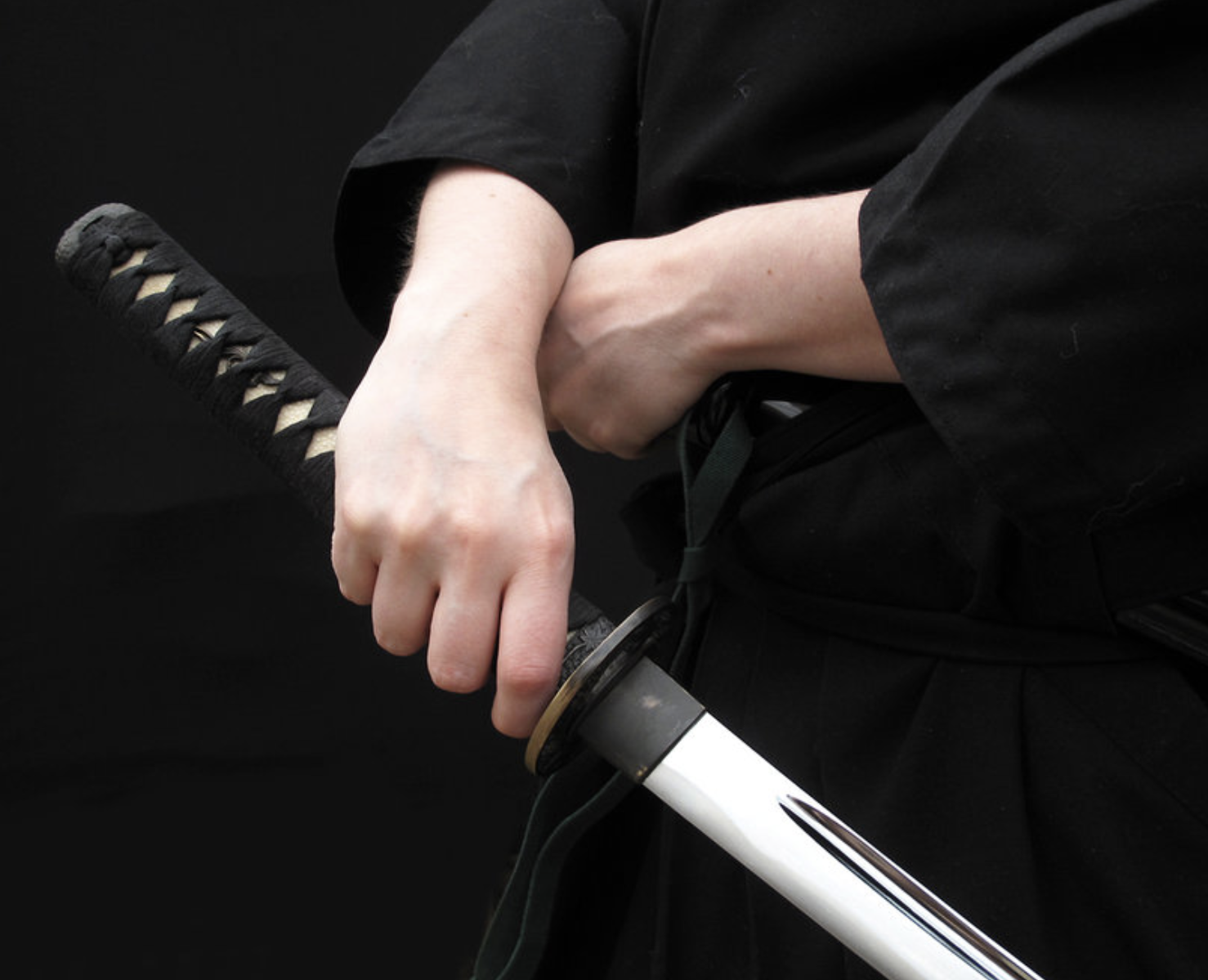
    https://www.deviantart.com/astro-stock/art/Katana-57-offensive-cutting-255883318

    At the tender age of fourteen or fifteen, too soon after entering that nebulous stew of adolescence that would carry him from childhood to manhood, my son Jeremy stood ready for battle. He woke me at around two a.m., weapon in hand, with the kind of strained whisper that always wakes a mother. My eyes and ears struggled to comprehend the scene. The words “I hear something downstairs” pierced the dark fuzzy sleep-womb I had been enjoying only seconds earlier, and I was instantly alert.  The short hulking form standing over me was my son. He was wielding a samurai sword that we had gotten him a few birthdays ago. 

    megaknife.com

    Many thoughts came at once. Not generally inclined to panic, my brain leaped first, believe it or not, to something having to do with adorableness. The sword was part of a thrilling but tellingly inexpensive set we gave him as a nod to his achievements in the martial arts, junior style.  Though the blade had never been sharpened, its edge barely even forming a V, and I suspected that any significant force on it would cause it to snap shamefully (it was, after all, a factory-made ornament for a growing market of proud suburban parents), my son didn’t know any of that. In his mind, we had trusted him with a deadly weapon, and he was armed from baby face down to as yet hairless legs. He was ready to protect us.  He was ready to protect me. My heart swelled.

    I have to confess, my second train of thought dwelt briefly on the absurdity of the tableau.  I don’t think my son considered the potential for shock and fear I might have had waking up to someone holding a long sword a few feet from my face, and I found myself mentally slapping a head to my forehead. And my knowledge of the sword’s inherent qualities, or lack thereof, made it seem like a ridiculous choice for taking on a prowler.  But this element of absurdity only enhanced his adorableness.  It seemed that my mind had no interest in going to fear or protection, only wanting to stay on my brave, unseasoned son. 

    found at https://www.kisspng.com/png-bicycle-theft-robbery-security-alarms-systems-copy-3865517/download-png.html

    Still, I had to consider the possibility that the sounds he heard were more than the usual sounds our house made in the wee hours, such as the heat kicking on, or the filter back-washing. And the dead seriousness of my little man’s face necessitated that I display not a hint of the love and amusement I was experiencing.  “Let me get my baseball bat,” I said, retrieving the wooden slugger I had kept from my twenties, a sort of affectionate souvenir of my own silly bravado, when I actually believed that it, along with a steak knife in my pocket, could protect me from attack on the night streets of Providence in the early 80’s. (Why I was foolish enough to be on the streets of downtown Providence at two in the morning is another story altogether).  On some level, I must have felt that the bat was the appropriate companion to the sword.

    found at https://i.pinimg.com/736x/8d/ed/16/8ded16ea807d3e861c3d74a369802b6e.jpg

    My son and I stealthily walked along the upstairs hall, and down the stairs.  Peering around every corner, we soundlessly investigated every room, opened closets on signal and even ventured into the basement after we felt confident that we had not missed a lurking horror which could close in behind us. Finally satisfied that we would not be murdered in our sleep (and disregarding the fact that our foray only made it all the more likely that we would meet a bad end), we returned to our respective rooms.  Lying in my bed, I had a few more moments of reflection before I drifted back to sleep.

    It was not lost on me that Jeremy came to my side of the bed. My husband lay right beside me and remained peacefully asleep throughout this entire incident.  I knew this was testament to something unspoken but indisputable.  My son understood on a gut level: Mom was the parent in charge.   My husband was many wonderful things – brilliant, reliable, principled, committed, tenacious when inspired – but the last thing he was in our home was in charge.  Too, there was always the possibility that my son knew my husband’s tendency toward cynicism (and perhaps even inertia) would have made him the poor choice to awaken for this particular occasion.  But either way, my son came to me, and, in the dark of my room, I silently thanked him for this acknowledgment, which only made me love him more, and was more than enough payment for my briefly elevated heart rate. I also noted that when we embarked as a commando team, my son let me take the lead. Whether this was in deference to my badass abilities and leadership or, instead, a recognition of his own inexperience and diminutive bearing, I do not know, but, in any event, it greatly reassured me.  My son, it seems, was not being foolish at all. 

    Just the other day, I reminded Jeremy of how he came into my room with his samurai sword so many years ago. I pointed out that the sword may not have been up to the task.  Sensing the little bit of mirth in my tone and my affection for his callow boyishness, he retorted with arch assurance mixed with the gentlest of chiding. “Well, a prowler in the dark wouldn’t have known that, and I think I could have down some real damage with it. It was a long pointy thing, after all!”  Even now, his bravado remains intact.  For that, I am immensely proud and grateful.  And with his now conspicuous size and the tempering of his steel, I have no doubt that these days he would be leading the commandos.

    found at http://loeilenmarche.blogspot.com/2011/12/les-samourais-du-quai-branly.html
  • Meeting the Hudson

    Meeting the Hudson

    E. Marmer | Free to Navel Gaze

    I was personally introduced to the Hudson River this past autumn.  Not down by New York City, where a personal introduction to that expansive maw, that sparkling, churning, briny phenomenon bristling with industry, transport and technology, is not possible; but up by the Hudson Highlands, where the river narrows to a manageable, gorgeous, natural body, breathtaking and accessible. Not suspecting I had been missing out on a beautiful friendship, I discovered her spirit hiding in plain sight.  The Gemini in me recognized her immediately: a spirit both wild and calming, unpredictable and reassuring, changeable and constant.  You can meet her too.  Just go kayaking.

    Though I have been on sailboats, motorboats, cruise ships, rowboats and canoes, nothing prepared me for kayaking on the Hudson.  First there is the sheer boldness of it, which only really hits you when it becomes a reality: that a slim plastic or fiberglass craft and one’s own sense of balance and rhythm (hopefully, in working order) are all that carry a suddenly very tiny you along on this famous waterway.  Next comes the congratulatory realization that an act of agency brought you to this moment, as in Wow!  Aren’t I awesome for thinking of doing this? I’m a do-er!  Then, ultimately comes the humbling power of being so close to the river’s surface, for there I was at the water line, with legs inside my craft halfway below the water, and hands occasionally dipping in along with the paddle. I was touching the Hudson, and all the fish, snakes, algae, and disintegrated or rotted forms that had ever passed through her. For most of my life I had seen the Hudson on a weekly basis, taking the river for granted, yet now was wholly transformed by simply being in it. I was no longer me, but an organism, a water bug, an air molecule, a floating stick, a native of Earth, feeling all of life flow around me and through me, and knowing that, whatever I was, all that I was mutely and reverently experiencing had been there, witnessed and not witnessed, for millennia.

    Having never kayaked before, nor placed myself quite so vulnerably on a powerful, moving river, I had the sense to join a tour with a friend for this experience, out of Cold Spring, New York, led by Hudson River Expeditions.  Our guides, Brian and Ken, were expert kayakers who brought an easy energy to their task, commenting and coaching when it was needed but leaving a wide berth when it was wanted.  My fellow kayakers were always in view, but I had so much welcome space around me to take it all in, to thrill to the perfectly unformed rocky cliffs, the woodland tinged with just a hint here and there of the fall colors to come, the occasional bald eagle and the clean, hard blue sky.  And when the change to the conditions came, unexpectedly, in the last 20 minutes of the tour, our guides were right there to see us safely back.  As badass as I liked to believe I was, out there in the gathering darkness, battling the wind coming right against me, and the now very choppy waves sloshing right into my kayak, in truth my usual assumptive I-can-do-this attitude was being sorely tested.  I understood that while I was likely to be fine, I’d be damned lucky to get to shore without capsizing. And there, thankfully, was Brian, alongside me suddenly, telling me how to adjust my paddle to get more power, and then stroking with me, giving me wordless but essential support, the way a Lamaze partner breathes you through birth.  With about fifty feet to go, I was back to feeling like an Amazon. Yes!!  I CAN do this!  It’s one of my favorite feelings.

    As we pulled our kayaks out of the water, Brian expressly acknowledged the challenge, saying “Well, you’ve just experienced every water condition there is.”  Despite trembling slightly with wet and chill, my inner Amazon happily flexed her muscles and beamed with triumph. And now that I know what it’s all about, I can’t wait for the spring when I can go back for more.  Having made the Hudson’s acquaintance in this more intimate way, I now find myself wondering… would we recognize each other down by Manhattan? Would she be cordial at least to my tiny speck of a vessel, where she could so easily remain hidden, anonymous?

    Anyway, get thee to a kayak. It’s bewitching to meet the river.  She brings you right in.


    E. Marmer | Free to Navel Gaze
  • The Button Drawer

    The Button Drawer

    Oh, round crusty moon

    You remind me of the oyster 

    dappled one we found 

    in that drawer 

    that held such magic

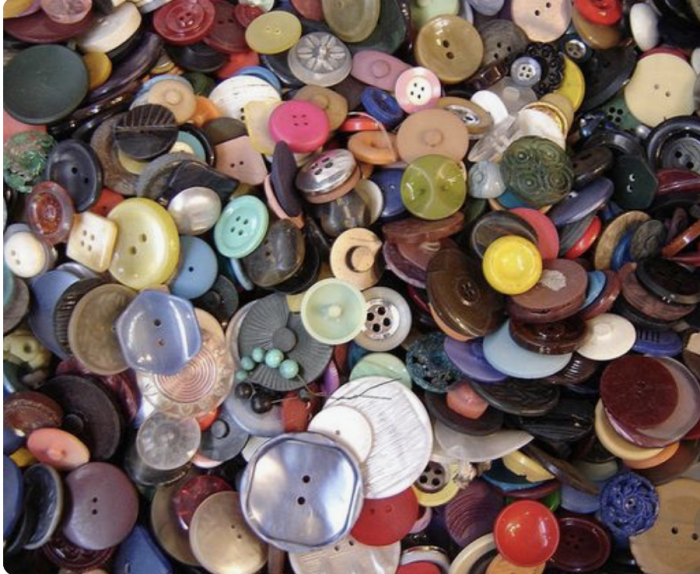
    Juana Morens on flickr.com Juana Morens on flickr.com


    Sisters sifting through 

    hundreds of colored buttons

    Two or four eyes or golden looped

    Some wrapped in leather 

    The sound 

    that sounded like 

    slippery freedom

    Fingers foraging, 

    picking and coveting

    So many tokens of

    stories past and new tales spun

    Looking for the most special 

    among them

    Sitting on bended knees

    Like goddesses peering down

    into the world

    Clicking, clinking, clapping,

    the sound

    That muffled grandma’s calling

    Oh, round distant moon


  • Gimme A Break


    Charles Schultz


    you like to say you’re Charlie Brown

    the unappreciated

    hapless shlemazel

    the unfailingly benign

    well-meaning soul

    always harangued by demeaning women

    but Charlie wasn’t tone deaf

    or worse purposefully snide

    he wasn’t an archer

    an overbearing pedant

    quick to judge

    to wound

    it was you who planted the ball

    told me to bring it

    said you weren’t afraid wouldn’t flinch

    and when you yanked it away

    you blamed the blinding sun

    and my poor timing

    you didn’t even scoop me up

    for it turns out

    despite your declaration

    you don’t know how to do that either

    you just huffed away

    petulant and revealed

  • Wide Open

    Wide Open

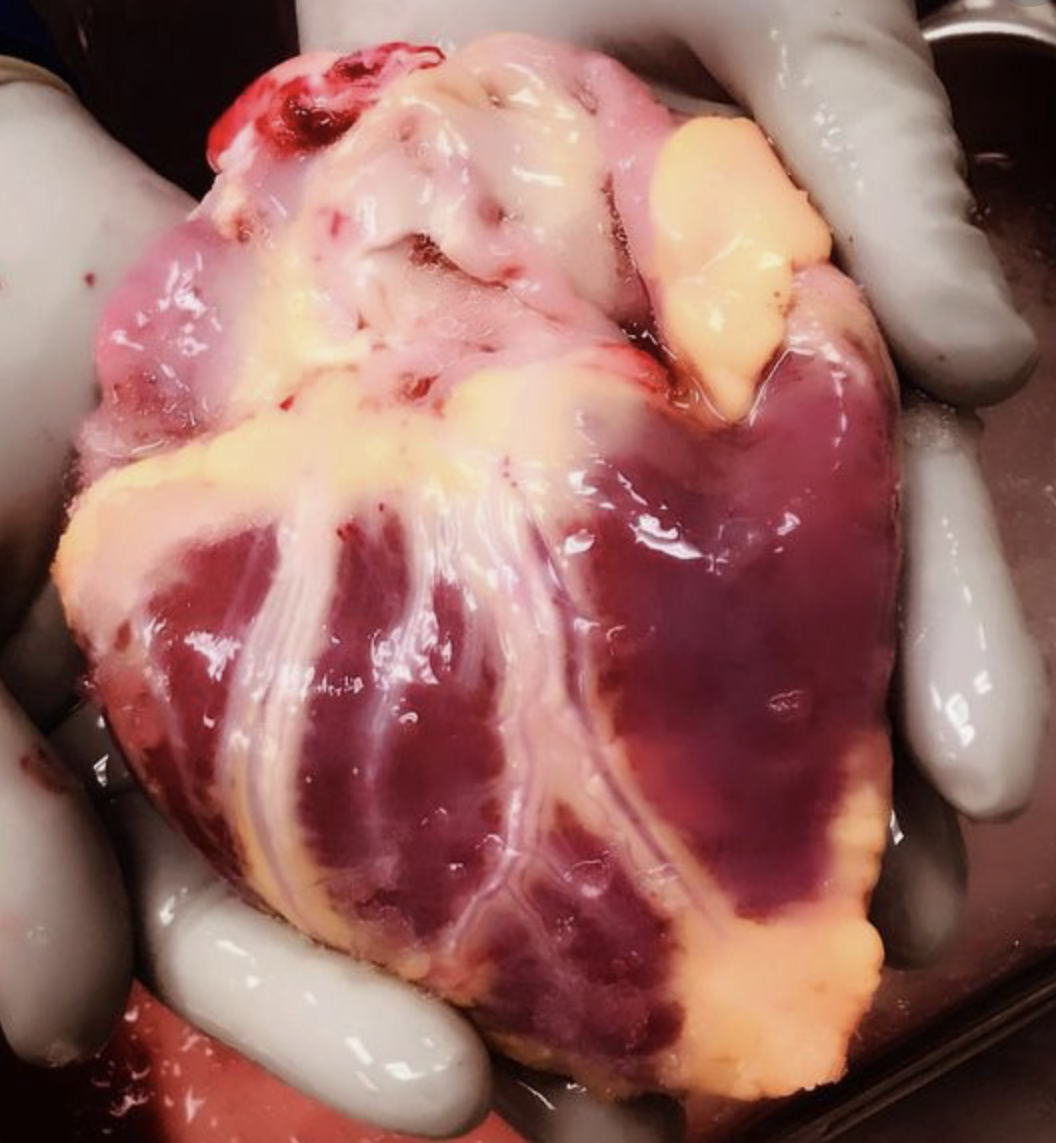
    instagram.com@medicaltalks

    Recently, someone I know suggested that my last blog entry, “Message in a Bottle” was “oversharing.”  He went on further to ask whether I wrote it to be stroked and praised as a person of great understanding. He stated his concern that it might indicate a form of vanity. This very same person had often expressed to me his wish that I could open up more readily to people other than the handful in my very closest circle and be utterly myself (outspoken, natural and unguarded).


    I dismissed all validity to his remarks about vanity – I know the personal essay is an established art form, and that for centuries our civilization has been reading the personal thoughts, yearnings and epiphanies of writers –  but they stung nevertheless. They stung because 1) I respect his opinion and care about his approval; and 2) I’m by nature inclined to question myself constantly (which is why I haven’t historically been fully at ease or fully myself, although I’ve been making great strides of late).  Did I engage in vanity?  I had to ask myself.  And, because I’m still working to convince myself that my personality actually is a pretty good one, and that most of my actions and instincts are guided by purer motives, surely not one of the seven deadly sins, I had to think long and hard about it.

    Starting with my very first blog post, every single time I hit “Publish” I have worried, “Is this too far?  Is this too personal?  Is this too exposed and does this reveal what a weirdo or overly sensitive person I am?”  And after a minute or two, I calm my worry by remembering that this was why I began writing my blog in the first place.  The real, real reason, beneath wanting to write, and wanting to find out if I could write well, I now understand was that I was giving myself my own sort of therapy for becoming emotionally brave and comfortable in my own skin.  A total emersion therapy, like jumping into and swimming across the cold, old quarry lake.

    https://www.flickr.com/photos/toshofosho/7416482810

    One day, and I will never stop being grateful for that day, I found myself writing an essay, addressed to no one in particular, and, if that weren’t surprising enough, actually creating a blog to publish it.  Who was this person going boldly where she had never gone before? I suspected I had things to say that would connect with people, and I gave a swift kick in the ass to that inner editor, who has lived in my head for most of my life, always telling me I best keep my mouth shut, that I was awkward, an irritant, someone who had to learn to blend and had nothing worthy to contribute.  I will never forget the rush of fear, and the exhilaration when I overcame it and let my first work fly out.  I will never forget it, for I experience it anew each and every time. Is this worthy? I ask, filled simultaneously with dread that it isn’t and astonishment that I sent it out anyway.

    After doing this strange exercise several times I learned a few things, which you think would have enabled me to nix the dread, but no, I haven’t learned that particular lesson yet. I learned, though, that most people react well to my being so open.  That they value my honesty, my proof that they are not alone in having similar feelings.  They value the opportunity to think about something they hadn’t considered before, and a different perspective. And there developed a secondary reason for my blog, which has far overtaken the initial one. I write as an offering. I offer my experience, my growth and my mistakes for examination.  I offer myself.

    https://i.pinimg.com/originals/36/38/ad/3638aded791c87aa39a126d520ba2348.jpg


    And every great artist, thinker, creator has done the same to one extent or another.  Believe me, I humbly know I haven’t a fraction of their talents, but by golly I have their bravery, if not their unquestioning nerve.  I tell myself, “this is worthy,” and I put it out there, quivering in my nakedness, praying that it is.  Do I congratulate myself for that?  You’re damned right I do.


  • How Can Some Individuals Bring Themselves To Mow Strangers Down With Assault Rifles Like They’re Nothing

    How Can Some Individuals Bring Themselves To Mow Strangers Down With Assault Rifles Like They’re Nothing

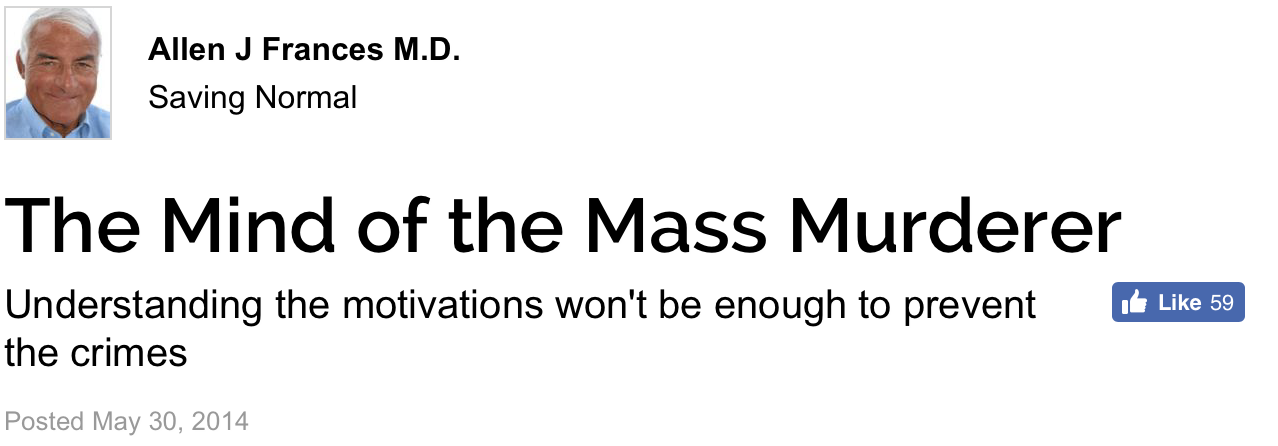
    The massacre in Las Vegas may well be the event that finally shakes Congress into action to curb gun violence, even if in just some small way. Perhaps the prevalence of defective people who are capable of using guns in this way is finally sinking into our collective consciousness and will persuade paranoid Americans that having access to guns to make them safer from a suddenly metastasizing government or American hunters and gun enthusiasts that holding an assault rifle to feel a surge of power, are simply not important enough to make all of us sitting ducks. I suddenly needed to understand how it is that someone could mow down strangers with assault rifles.  How could a human simply cease to consider other humans as… humans? How can a person turn strangers into ciphers with no value, no history, no soul, so that they are expendable?  I searched the internet in my quest for an answer, and came across this very interesting article by Dr. Allen J. Francis, published in Psychology Today in 2014.  It’s worth a read, in this age when mass murders seem to have become a ghastly, permanent blight. Despite understanding the phenomenon through the words of Dr. Frances, I can’t help but wonder if at bottom it simply indicates our failure as a species to have evolved far enough from the brutes we once were, or, even more sadly, signals our decay.


  • Message in a Bottle

    Message in a Bottle

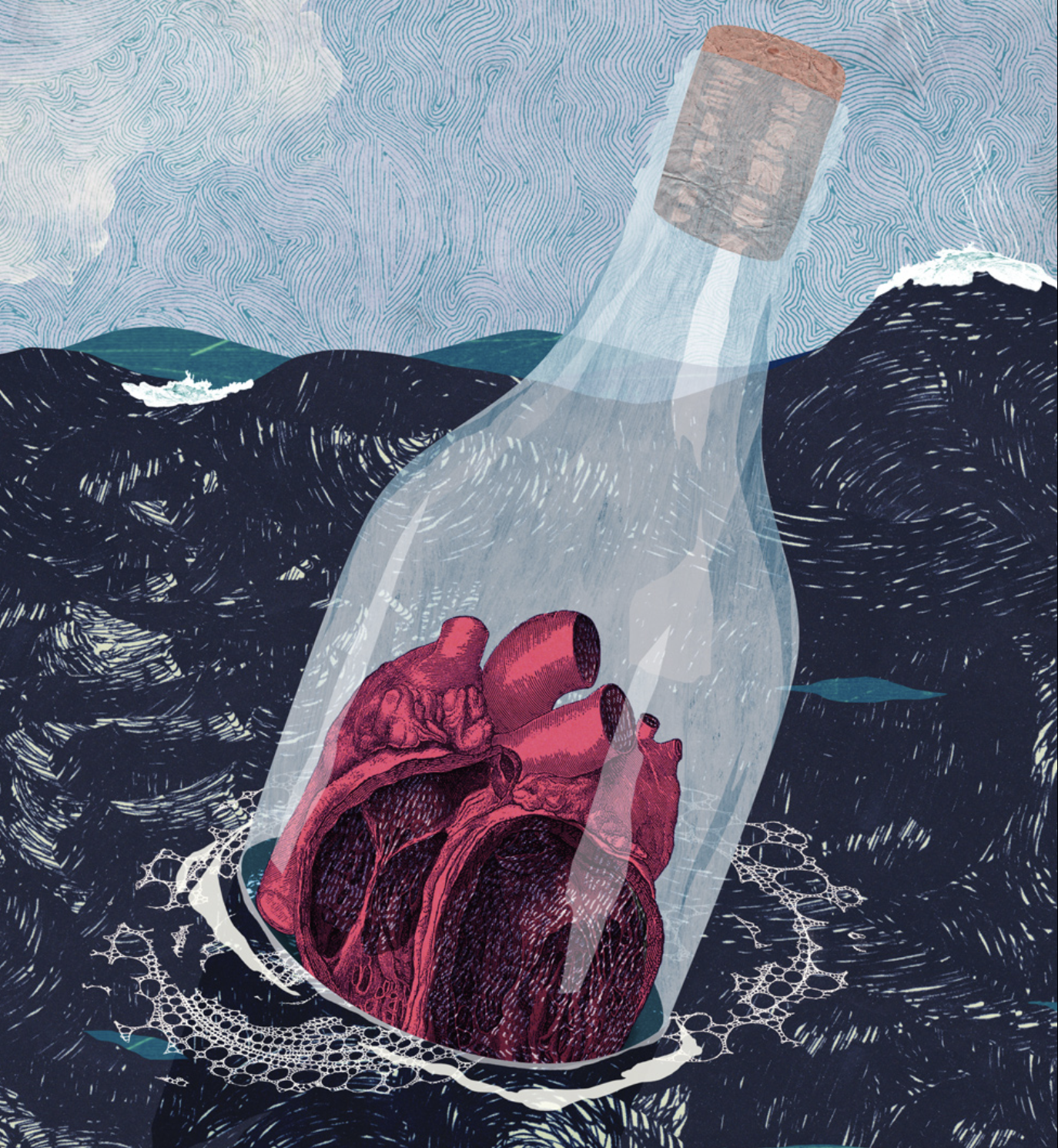
    Emma Hanquist, Artisit

    My daughter carries a heavy load of emotional scars. They come in part, of course, from all the regular wounds that all sensitive people endure, whether inflicted by others, or by one’s own hand, or received upon the usual stumbles and falls that plague all such sensitive souls during childhood, adolescence and early adulthood.   But in addition, some of my daughter’s scars come from uniquely devastating experiences. And some of them come from her unfortunate luck of being born with overactive or underactive brain chemicals, giving her a distorting fun house mirror to work with, and making navigation through the ordinary pitfalls of life and complications of connecting with others all the more treacherous.

    From “Wink Space” by Masakazu Shirane and Saya Miyazaki

    My dear beautiful daughter has been working for her entire life to shatter that mirror, or at least to recognize its distortions and learn to navigate despite them.

    I know that many of her scars came from wounds I inflicted as well, unintentional as they were. Time has given me sight: I can see where I said and did the wrong thing, got drawn into an unhealthy pattern, came up short, missed the mark and even communicated judgment and disapproval. I could take refuge behind that well worn excuse, true as it may be, that all mothers are destined to screw up to varying degrees (because despite the most ardent wishes of their children and themselves, they are indeed flawed, bumbling human creatures like everyone else), but I won’t. I regret all the wounds I inflicted on my daughter. I wish I could take them all back. I can’t, obviously, but I can do one thing at least. I can let her know that never once, in all our years together, regardless of whatever sparring, frustrations, heartaches, mistreatment and misunderstandings we encountered or caused relating to each other, regardless of whatever sorrow I conveyed to her about her struggles and my inability or, in some cases, incompetence to make them go away, that never once was it a sorrow that she was, is, my daughter. From the moment I fell in love with her, looking down at her in my arms, I have rejoiced in being the one lucky enough to get her and have never stopped. When I fretted over how she was handling or not handling a situation, or felt the sting from one of our unhappy exchanges, I was also, always, exalting in how goddamned unique, and irreplaceable she is, how spirited and emotionally complex, how tender-hearted, how brilliantly glowing, how much a gift I didn’t deserve, for who could deserve such a prize as my Sophie. Through it all, and even now at 23, she remains as adored, as treasured, as zealously and jealously held, as much a wonder and a miracle as she was in my arms all those years ago. I wish she could feel exactly what is in my heart, my darling daughter.

    E. Marmer | Free to Navel Gaze

    If she could she’d know what I felt when she fit like a small football against my chest, for that feeling has never left.

    I don’t expect that my saying all this will magically make some small portion of her scars disappear, though of course I pray every day for her happiness, and it’s no secret from either of us that I wish I did indeed have the bottle of magic balm, the potion to drip into her scars and free her heart from the past, even the many parts of her past that do not relate to me. (I carry that irrational wish despite how she well she has been making some of her scars disappear on her own, with no help from me – she has been achieving so much self-healing, that strong and capable woman.) But if it does anything, I hope this message in a bottle, poor substitute for any magic balm in a bottle though it may be, makes her feel, know, believe, accept that she has made my life meaningful in ways I could never have dreamed of, and that knowing her and being her mother has been one of the greatest joys I have been blessed to receive.