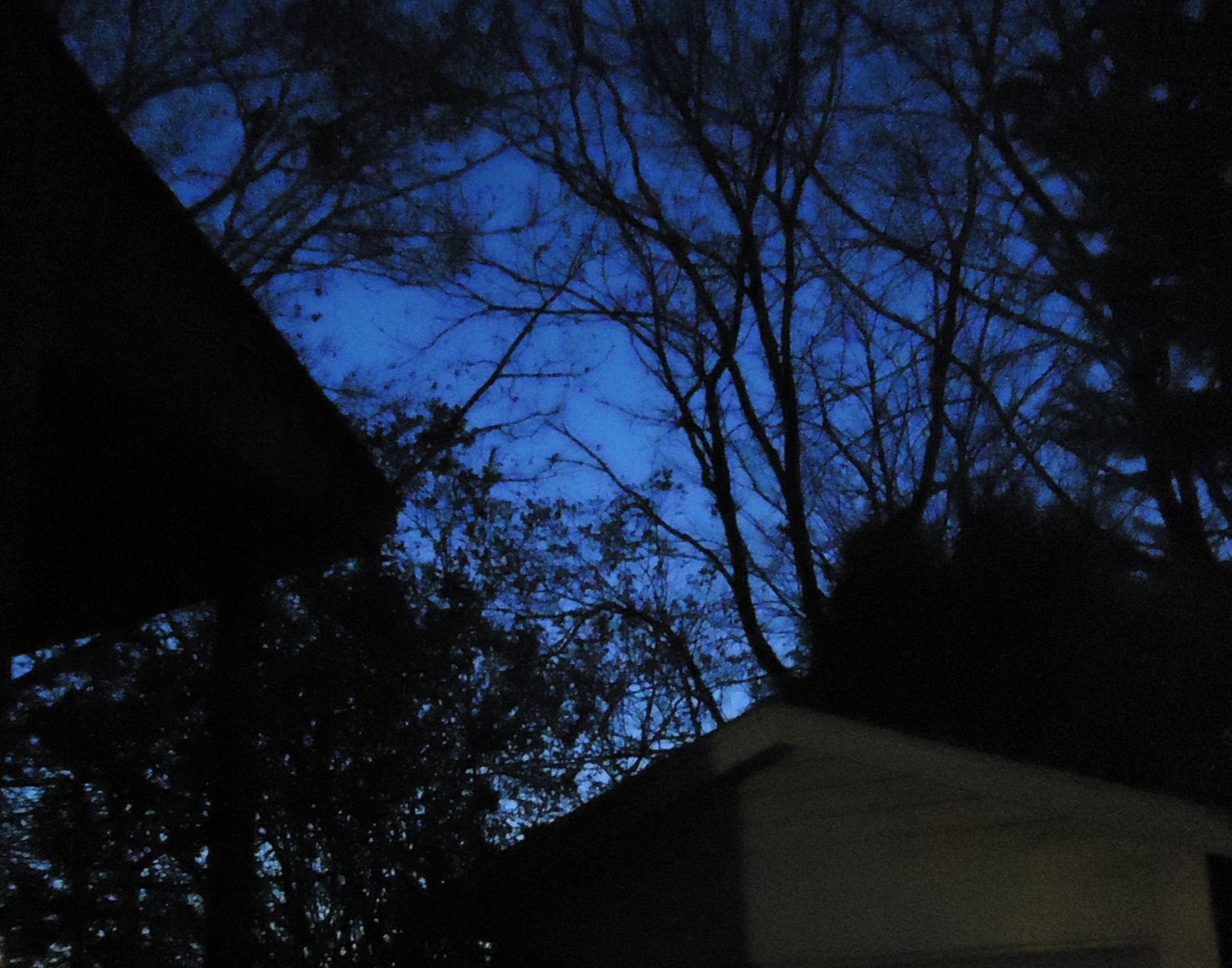
Yesterday, I was treated to one of July’s lovely, long lasting twilights. I had earlier in the day overseen what I considered some dramatic changes to our garden by a landscaping crew: some pretty ground cover in a once barren area, additional flowers strategically placed in several spotty garden beds, and some new rose bushes and a pink dogwood tree by our little storage shed. In the hours after the men left, I wandered around taking in the colors, the fragrances, the cool grass on my feet and that magical, magical dusk that allows the blue of the sky to deepen and glow in final ambient minutes before gently fading into purplish and indigo shadows.
I am a carnal creature, highly susceptible to my physical environment, as my husband always likes to tease. He named my instant reactivity to external elements my “boat to Venice” response, recalling how, on the public boat from the mainland to Venice, I was so affected by the heat and the crowd, the body odor and fuel exhaust, that I started grumbling and complaining, crabbing about how we shouldn’t have bothered going to Venice if this is what we could expect, completely losing sight of the fact that we were going to Venice, for godssake. Ten minutes later, actually in Venice, I began oohing and aahing, and it was as if the boat ride never happened.
But back to the garden last evening– I was transformed into a bewitiched elf, drugged on loveliness.
Photo by Sudhir Sharma
It’s funny how certain experiences stay with you. I’m not talking about stories that we savor and retell frequently, but about those small moments that live on in your mind because they affected you profoundly without you even knowing at the time that they would be special. For me it seems, a July twilight is a key that opens my memory to some delicious moments.
And so, I recall.
I recall being a young girl living in the Bronx with my family on the 10th floor of a pink brick apartment building, sharing a bedroom with my two older sisters. I went from a crib to a bed in that bedroom. Seven years of togetherness, more for my sisters. By the time we moved from that apartment to a house where we each had our own bedroom, my eldest sister was turning 13 and probably desperately wanted some privacy, but I loved our time in that apartment bedroom.
We all went to bed at the same time. We all wore matching pajamas. We made up games that inevitably involved jumping from bed to bed, a feat made possible by the fact that the beds were only about eighteen inches apart if that. And on summer nights, we all saw the same twilit sky from our two open windows, felt the small, hopeful breeze stirring, and heard the summer sounds from the neighborhood floating up to us.
And I recall summer nights at the age of 10 or 11, when I was free to wander in the streets of my remarkably safe suburban neighborhood, looking up at the trees dark in their silhouettes against that compelling, cooling, translucent sky. The lights in the neighbors’ houses, and my own, were warm yellow rectangles, jewels strung for my enjoyment, and the steam of the day melted into a hush, full of possibilities. Unhurried, lost in a dream, I drank it all in, beliving I was the sole invitee to a secret ritual and feeling my freedom, until it became too dark and the ritual was over. My mother never once called me in, always knowing I’d return at the right time, like our cat.
I have been so fortunate. Despite heartaches, despite losses, tragedies and chronic stressors. I have been treated to so many wonderful moments, so many lovely, warm July twilights. Last night’s romp in our garden will be among these. I am so very glad that I paid attention.
This is a confession. I have to face facts and stand in judgment. Please be merciful for I have become that which I once held in ridicule. That most tiresome and clueless imposer of …. things about my cat.
Thus far (for the most part), I have resisted, while in a constant stream of unrestrained pet joy, the impulses to post photos of my cat doing cute things… this essay being the exception that proves the rule of course. I can still recall the tut, tut, tut judgment (mine included) of all those subjected to a dizzying array of cats doing this and cats doing that. This has given me the brake, which thus far has tamed my wildly beating breast.
But make no mistake. What I am not posting I am nonetheless constantly calling out in utter delirium to anyone who happens to be nearby: Look! Look! Look! Look! Isn’tshecuuuute?? Look at how she curls her little paw! Look at how she rolls over when she wants to play! Isn’t it adorable how she pounces on her toy! Listen to that cute little questioning chirp that sounds like “Huh?”
E. Marmer | Free to Navel Gaze Her Royal Kitten Highness
My family and best friend have thus borne the brunt of my giddy outbursts. I have to gush somewhere. It is a constant struggle to zip it, and most days I just give in. After all, they’re my inner circle, right? They have to listen.
Yes, I am smitten. With a creature who has done nothing to warrant my devotion but be cute and utterly dependent on me, though she tries to feign otherwise. How did this happen?
E. Marmer | Free to Navel Gaze A Minor Inconvenience
I think it’s a parental thing. My theory: it’s the unconditional love, the spoiling, the besotted pride of the parent for his or her infant. Even though my cat technically is no longer a kitten, she will always be my baby. Her need of me stirs that instinct, that crazy love. What else could explain why I refer to myself as “Mommy” when I talk to her? (Yikes!)
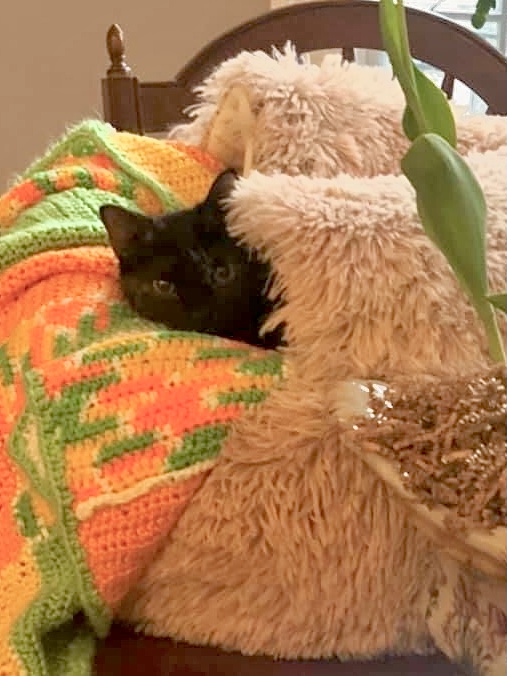
My cat, my Esme, a tortoiseshell, mixed- breed rescue (Can you see how she is part Oriental?? Look at that bone structure! Do you see her grace?), struts around in importance and yet starts at the slightest sudden noise, looking to me for reassurance. She instantly relaxes her tightly coiled body at my calm and loving energy directed at her: yes, my love, everything is okay, you are safe. No matter how merely tolerant she tries to seem of my petting, we both know she’d be lost without me. Hardly a trip to the bathroom goes by without her mewing pitifully at my closed door. Never a night goes by without her curled up on my bed. And when she has lost the trail of me in our house, suddenly unsure of where I am, calling out in a desperate wail, and I respond with a loud and cheerful call, never a time goes by where she does not bound to where I am, trilling in excitement, relief and happiness. Who wouldn’t melt?
But maybe it’s more than that. Maybe it’s that a cat is an uncomplicated, indeed primal being (waaay more primal than a dog, as any cat owner knows!), who responds to a person’s most elemental essence. Esme loves me like my children did before they lost blind faith in me, before I didn’t handle something well, before we had to navigate complex situations. It feels good and is easy to tell myself that Esme is a barometer of my most basic goodness.
This feline carnivorous prowlerthat slinks around my house, that grabs her scratching posts (and occasionally the furniture) with sharp claws and sometimes her teeth, this actual creature in my house that looks like a giant rat from the back when she is sitting and a strange monkey when she balances up on her hind legs begging for a treat, brings me the joy of her attachment and complete trust. Not a lap cat at all, and completely disinterested, if not affirmatively abhorrent of being held, Esme’s idea of showing her positive assessment of me is to allow me to provide her the pleasure of having her neck massaged. Not for more than a minute, mind you, which, is all I need, so we both win.
So, now, I am much more inclined to view pet photos online with a generous heart. For what are they but sweet celebration of an uncomplicated relationship, a perpetual two-way street of positive regard. Pet pictures are happy declarations that we get to adore a simple companion, who will not one day talk back to us or make choices that challenge our peace of mind. They express our delight in being trusted by a primitive beast whose fight or flight system has adjudged us as benevolent.
Still, I’ll try to keep my cat pics to a minimum. But oh, oh, oh! Did I tell you about the time she dragged her wand toy up to my bedside as I was settling down for the night, and then mewed at me to play with her? Isn’t that a-DOR-able?
My father Stanley taught me gratitude the way he taught me everything, which is to say, in the fewest words possible. In contrast, when telling a story, or bringing history alive, boy, could he grandstand. His descriptions were drawn out, delicious, almost overdone, but not quite. A consummate natural performer, he never once doubted whether he had the crowd while holding court. And yet, when it came to the personal, he withheld the flamboyance. He withheld the unnecessary. My father conveyed the essential nut of a thing – whether a choice, a betrayal, a triumph, a lesson, a wonder – with a simplicity that never ceased to flabbergast me, humble me and convince me that I was getting truth.
That’s not to say that he was always direct. Despite his brevity, he could indulge in metaphor, but, even then, it was delivered straightly, pointedly. Once when I brought up the lavish life my aunt had had before my uncle lost his “six-figure” executive job and became a hardscrabble salesman of cheap merchandise from China, he said, “You know the ‘Tortoise and the Hare’ right?” I waited for it. “I was the tortoise.” He said nothing more. And from that, I comprehended all that he wanted me to. Not just about the comeuppance of the arrogant hare, but about the toil and steadiness, the constancy of the tortoise. About allowing that one brief pat on the back and returning to the task at hand.
On the day my father taught me gratitude, however, he delivered a direct declarative sentence. My mother had thrown him a surprise seventy-fifth birthday party, and the assembled guests were clinking their glasses, saying, “Speech! Speech!” My father stood up, and shook his head slowly with lips pursed for a good long pause, so, at first, I thought we would be treated to Stanley as entertainer, to a poem or funny anecdote or maybe a joke thanking my mother for putting up with him all these years.
“I am the luckiest bastard on earth,” he said. And he sat down.
Everyone clapped and a few people chuckled, and I wondered if their clapping and chuckling was in affectionate response to what they presumed was understandable awkwardness at such a moment. They knew my dad could be gruff; they knew he wasn’t suave. It seemed they wanted to reassure him: “That’s okay. We understand you don’t know what to say.” But I knew my father, in seven words, had said everything. It was all there: his amazement at fifty-three years of marriage to a modest and loving woman, who built their entire social fabric and cared enough about him to throw this party; his pride and relief that his three grown daughters, who fussed over him, turned out to be accomplished, well-adjusted people he didn’t have to worry about; his pleasure at grandchildren in varying stages of development, the sixteen-year streak of girls finally, finally broken with a boy; satisfaction in the restaurant catering paid for in full with the fruits of his and my mother’s labors; even anticipation of his accustomed evening in his recliner with a book and a pipe, and his fat belly.
All of those things were there, and something more, the essential bedrock for gratitude. My father told us that he wasn’t entitled to any of it. He was the “luckiest bastard,” just a random guy, a shmo, a tortoise, a self-educated beat cop for 30 years who got to come home to a hot meal and three girls being raised right by his beautiful, capable wife, she a respected teacher to boot. It wasn’t luck, of course, but a bounty collected, earned, one small decision, one small commitment at a time. He didn’t see it that way, though. His humility and astonishment at what he considered sheer dumb luck formed the best blueprint for gratitude I would ever receive. I follow it still.
When she was here, my mother would lie on her bed after I helped her shower, on top of the long white towel she insisted I put down so the bed wouldn’t get wet. But I thought of that towel as part of her cocoon, the one I made by putting another long white towel on top of her, and one small one for under her feet because the main towel wasn’t long enough, and one for under her head of course, because I wanted her hair to dry, but in her mind it was there to prevent the pillow from absorbing all that wetness from her hair, always so careful, my mother. Then I’d put her comforter over this sandwich in which she was the filling, and tuck her in.
With her arms and legs immobilized inside this wrapping, by weakness more than by swaddling, and her now small head peeking out over the cover, she seemed to me almost like my child. She pulled forth from me all the same sweet painful love I had only known for my children, with almost but not quite the same targeted piercing as I felt when my breast milk came in. My mother in my care, so completely, so willingly and with utter belief in her security – it was just the same as with my children. And the sensation, this belief I felt from her, made me love her in a new old way. And when I bent down to kiss her just as I would have my child who was going down for a nap, I was even able to nuzzle her neck in a tickling way that made her giggle, then look into her laughing eyes with my loving ones.
I’d announce that I’d come back into her room in ten or fifteen minutes to check if she were dry and ready to dress, but we both knew I meant I’d really be back in as many as thirty minutes because I’d be trying to get something done in the kitchen and on top of that I had no sense of time. That she knew it and knew that I knew she knew, made her love me in a new way as well. I’d like to think so, anyway. We also both knew that she needed more than 10 or 15 minutes anyhow to recover from the exertion the shower required, but that didn’t make either of us love more or differently, it just made us sad.
My mother had pancreatic cancer, diagnosed at least when she was 85, in some sort of merciful grace by an unseen god. On the other hand, for a woman determined to live into her nineties, it still sucked. She didn’t want to leave; she hadn’t stopped enjoying us all, and the small pleasures that came with her every day. Such a modest woman, she didn’t ask for much and was more than delighted by all that she nevertheless received: our attentions, her comfort and independence, the joys of watching her grandchildren and great grandchildren metamorphizing, the familiarity of the signs on her neighborhood roads, her simple routine just the way she liked it. And so, aware that she might not live into her nineties after all, she determined instead to live as long as she could, and fight against the cancer as hard as an 85-year-old with, well, with pancreatic cancer, can. As she had also lost almost 40 pounds in two months of intermittent hospitalizations which included recovery from a life-threatening surgical accident, leaving her so weak that she was unable to perform even daily living tasks, this made the effort required absurdly difficult, but she was not deterred.
My sisters and I decided that as the daughter with the best layout for her limited strength and mobility, the most unstructured, uncommitted time available, and an observed impressive endurance for those small irritations that can build and build with continuous exposure to one’s mother, sick or no, I would be the one to take her in and see to her care. I think they knew, though, that it was what I wanted. I’d go to the mat for it. My sisters would come for wonderful long visits with our mother, and I would be able to leave for the occasional social engagement, or my own doctor appointments, but always I returned to her without the weight of obligation. I carried instead a kind of gratitude, even a shameful pride, that I could make sure my mother’s existence was the most comfortable one possible in her condition.
She knew this. She knew I was compelled to be the one, driven by devotion or some perceived claim. It could have been because I spent the least time with her, called her least of any of us over the preceding ten years or so, and I felt I had to make that up; or maybe it was because I carried the knowledge that I had spent much of my adult life working through the not always so hidden sorrows and insecurities I developed in part as a result of emotional barriers she erected, which I knew, of course, were the result of her own sorrows and insecurities as a child. . . and so perhaps I felt I had to make our last months (or what I hoped would be years) together as intimate and rid of shadows as they could be. It was true that, due to reckonings with my own daughter, and my fuller appreciation of all the ways I had fallen short for her, indeed due to the understanding I acquired over the years of so many things, I was primed to show my mother a new kind of unadulterated love.
But maybe it was because I needed to show her that I loved her desperately as no other could, as much as when I was child, and I wanted her favor and undivided attention as I did then. As the third child coming into a busy working class household, I never really felt I had the individual attention from her that I wanted. And dammit I was gonna get it! I was going to have it, have her, all to myself. . . It’s this last possibility that disturbs me. And yet, even to the extent it may have been true, my mother silently understood all of this. All the reasons, whether noble or pathetic, she accepted as originating from a pure place (as did my sisters, loving and generous souls that they are). Perhaps on some level my mother even recognized that my troubled relationship with my daughter mirrored somewhat the one she had had with me, in that I too had been the unhappy, solemn, and lonely child whom my mother cherished but did not know how to help; though neither of us needed to speak of that – she, because she did not like to reveal herself or reflect on the past, and I because I had already forgiven her so thoroughly that I wouldn’t even think to bring it up.
When I returned to my mother’s room, she usually reported that she was ready for the rest of our post shower ritual, which included dressing of course, but always began with the drying of her toes. This precise operation, developed in response to her complaints that previous toweling had not sufficiently done the job, entailed my softly running the narrow edge of a dry washcloth between her toes. And it is the drying of the toes that I think of now, this small activity that somehow was the perfect expression of our momentary happiness, away from her cancer, away from the end, in being mother and daughter. I was the one providing the care this time, but it could just has well have been her, when I was in her care, before memory even, running a dry washcloth through my toes in the same way. We were back all the way to that space, before the barriers had time to click into place. Adoring caretaker and trusting receiver, both feeling safe in having their attachment truly known.
If dressing exhausted her further, she’d tell me she needed to remain in bed for a little while longer, perhaps a half hour, for a little nap. She knew that I’d let her sleep for longer than that, because I’d be trying to accomplish some mundane administrative task, or even perhaps get back to a poem I was writing; and I knew she secretly was relieved by my anticipated imprecise adherence to the clock, because she had not yet gathered the will to rise, to make her slow way down the hall to her chair in the family room. But sometimes, before leaving her to rest, I’d lie down next to her, alongside her freshly made cocoon of sheet and comforter, and quietly sing her a song she had once sung to me: This is the story of two little babes who were left in their uncle’s care… This didn’t rankle. We both knew it was my way of telling her that I felt how much she had loved me, and that I carried it still. Sometimes she would join me, sometimes she would just listen and remember.
E. Marmer | Free to Navel Gaze The Three Sisters by Betty Albert
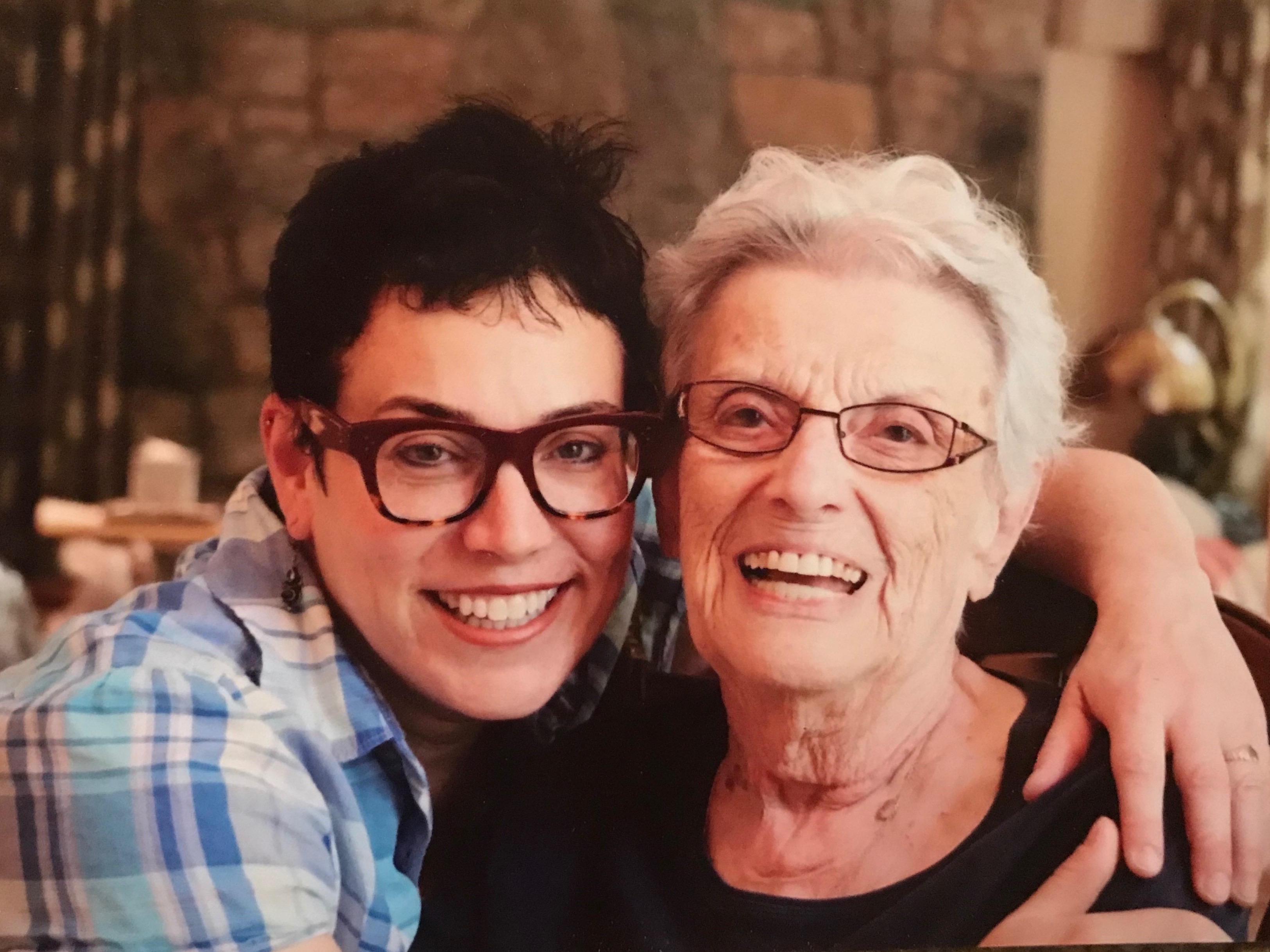
I am now parentless. My father died about fifteen years ago, and a little more than two weeks ago my mother died. And I miss her so terribly. I am continually coming up against the impulse to tell her something that I just observed that she would get a kick out of (or that I wished she would get a kick out of, and then maybe I’d experience a bit of disappointment when she didn’t and couldn’t really seem to understand why I thought it was even worth mentioning, but that was all part of our dynamic). I will miss her till the day I die, because she was such an integral part of my existence, even when I didn’t talk to her every week. Even when I lived in another state. Even when I rejected some of her values or felt different from her. She became no more integral to my existence than she already was when I brought her into my home for the last ten months of her life in order to nurse her. Indeed, her that’s why I felt compelled to nurse her.
Being parentless is a very weird thing. And being motherless is like having the air taken away. But for me, miraculously, the suffocation was fleeting and succor swiftly resupplied. It’s because I have my sisters. Because we all share my mother’s breath.
by Katie M Berggren
We are “the three sisters.” I put us in quotes because we are a unique set. We are not just any set of three sisters. Not that we’re necessarily better or worse than any other set out there. We are just exactly what we are, which no other configuration of sisters in the world replicates perfectly. And we three do not replicate perfectly any other sisterhoods out in the world. So perhaps one of the most amazing things about sisters is that there are no two sets alike. But I see that I should get to the point.
We three sisters happen to be strong and mutually trusting souls. That is, we trust with a whole heart that each of us has unconditional positive regard, good wishes, admiration and need for each other. Even if in some circumstances we might first question (only briefly!) whether there hadn’t been a hint of doubt as to a sister’s purity of intentions, we always make that same choice to trust again and again. We dismiss that doubt, and trust in our conclusion that our sister has only good will for us and never would want to hurt us.
When I contemplate that incredible truth, I also think about its genesis. We love and trust each other that way because we all share the love and trust that emanated from my mother. Somehow, in the way she loved each of us and all of us at once, our mother reassured us that she had enough love for all of us to infinity and back, and that she shared it equally. Indeed, I think she raised us to think of us as “us.” We were always an “us” no matter where each sister happened to be or what she was doing or thinking separately at any given time. And because our mother’s sheer adoration of all of us and each of us was always on display, she convinced each individual sister that she was worthy of the love of the other two. We grew up without a doubt of the lovability of each other, always amazed and grateful that we got to have such marvelous sisters.
This is what “us” feels like.
Art by Michelle Dávalos found at weheartit.com
My mother gave me the gift of my sisters. She gave me two wonderful people to love and trust and she gave me two wonderful people who love and trust me. They were there with me when we nursed our mom and they will be with me always. I am truly blessed to have them, and for the miracle that, through them, my mother truly remains here, part of me. Part of us.
photo by Jeremy D. Hembree photo by Jeremy D. Hembree
I was personally introduced to the Hudson River this past autumn. Not down by New York City, where a personal introduction to that expansive maw, that sparkling, churning, briny phenomenon bristling with industry, transport and technology, is not possible; but up by the Hudson Highlands, where the river narrows to a manageable, gorgeous, natural body, breathtaking and accessible. Not suspecting I had been missing out on a beautiful friendship, I discovered her spirit hiding in plain sight. The Gemini in me recognized her immediately: a spirit both wild and calming, unpredictable and reassuring, changeable and constant. You can meet her too. Just go kayaking.
Though I have been on sailboats, motorboats, cruise ships, rowboats and canoes, nothing prepared me for kayaking on the Hudson. First there is the sheer boldness of it, which only really hits you when it becomes a reality: that a slim plastic or fiberglass craft and one’s own sense of balance and rhythm (hopefully, in working order) are all that carry a suddenly very tiny you along on this famous waterway. Next comes the congratulatory realization that an act of agency brought you to this moment, as in Wow! Aren’t I awesome for thinking of doing this? I’m a do-er! Then, ultimately comes the humbling power of being so close to the river’s surface, for there I was at the water line, with legs inside my craft halfway below the water, and hands occasionally dipping in along with the paddle. I was touching the Hudson, and all the fish, snakes, algae, and disintegrated or rotted forms that had ever passed through her. For most of my life I had seen the Hudson on a weekly basis, taking the river for granted, yet now was wholly transformed by simply being init. I was no longer me, but an organism, a water bug, an air molecule, a floating stick, a native of Earth, feeling all of life flow around me and through me, and knowing that, whatever I was, all that I was mutely and reverently experiencing had been there, witnessed and not witnessed, for millennia.
Having never kayaked before, nor placed myself quite so vulnerably on a powerful, moving river, I had the sense to join a tour with a friend for this experience, out of Cold Spring, New York, led by Hudson River Expeditions. Our guides, Brian and Ken, were expert kayakers who brought an easy energy to their task, commenting and coaching when it was needed but leaving a wide berth when it was wanted. My fellow kayakers were always in view, but I had so much welcome space around me to take it all in, to thrill to the perfectly unformed rocky cliffs, the woodland tinged with just a hint here and there of the fall colors to come, the occasional bald eagle and the clean, hard blue sky. And when the change to the conditions came, unexpectedly, in the last 20 minutes of the tour, our guides were right there to see us safely back. As badass as I liked to believe I was, out there in the gathering darkness, battling the wind coming right against me, and the now very choppy waves sloshing right into my kayak, in truth my usual assumptive I-can-do-this attitude was being sorely tested. I understood that while I was likely to be fine, I’d be damned lucky to get to shore without capsizing. And there, thankfully, was Brian, alongside me suddenly, telling me how to adjust my paddle to get more power, and then stroking with me, giving me wordless but essential support, the way a Lamaze partner breathes you through birth. With about fifty feet to go, I was back to feeling like an Amazon. Yes!! I CAN do this! It’s one of my favorite feelings.
As we pulled our kayaks out of the water, Brian expressly acknowledged the challenge, saying “Well, you’ve just experienced every water condition there is.” Despite trembling slightly with wet and chill, my inner Amazon happily flexed her muscles and beamed with triumph. And now that I know what it’s all about, I can’t wait for the spring when I can go back for more. Having made the Hudson’s acquaintance in this more intimate way, I now find myself wondering… would we recognize each other down by Manhattan? Would she be cordial at least to my tiny speck of a vessel, where she could so easily remain hidden, anonymous?
Anyway, get thee to a kayak. It’s bewitching to meet the river. She brings you right in.
Human communication astounds me. I’d go so far as to say that human communication is the thing that most strains my brain circuits to think about (well, after the universe and higher mathematics, of course). The fact that we can do it, the means by which we do it, and the effects or potentialities of our doing it, are all marvels quite awesome to contemplate.
Just think about it. In our most elemental form, we are large organisms that can move in order to hunt, gather and reproduce. And because we can move very far distances, we need an especially sophisticated way to convey essential information to our fellow organisms. (I’m no professor, of course, so please take my theorizing as the non-scholarly, largely self-stimulating riffing that it is). We cannot rely simply on giving off gases the way trees signal each other about crowding or the state of available resources, or exchange dance moves or glandular liquids to inform each other where the food is, the way members of an insect colony do. Our experiential worlds are too vast, so at some point we started gesturing and beeping at each other. It was more like grunting than beeping of course, but if you imagine it as beeping, the stunning reality of it all grows clear.
For if, in a lab, we were examining stationary beings, little more than polyps on a mossy rock (which some would say is actually what we are) and we discovered that they were beep, beep, beeping at each other, and furthermore reacting in a way that indicated a mutual understanding of what all that beeping was about, we’d be quite amazed. Maybe even gobsmacked.
Let’s take a step back. Before all the beeping started, there were of course all the non-verbal cues that we also see in other mammals and birds. Excitable hopping about, threatening stances, cautious peering, they’re all there with us still. Moreover, like other pack mammals, say wolves, dogs, apes or lions, we also luckily have far more advanced facial muscles, enabling us to contract them this way and that to show fear, anger, pleasure, sorrow and indifference. Studies have confirmed what we already somehow intuitively know, that humans around the globe understand these facial contractions all in the same way.
And don’t forget the more basic electro-magnetic or chemical signals, which personally I’m convinced we still pick up on, even if we can’t explain how we do it. How else would we sense fear in a person standing next to us, or feel someone else’s attraction to us? So even before we get to the verbal stuff, the non-verbal communication is all pretty amazing. Imagine those polyps with little appendages flailing about in certain recognizable patterns and each having the means to perceive and comprehend its neighbor’s movements. Astonishing!
But here we come to verbal communication. Ah, language! If there is anything which displays our stunningly superior brain power it is that! Language not only enables us to convey needs and emotions, it gives us the means to explore and use numerical systems, biology, physics, philosophy and societal norms. How could we have developed and shared knowledge about architecture, history, or justice without language? How could we have built civilizations? Human language covers everything from the simple and concrete to the most abstract concepts imaginable, and the fact that we can use it to identify and share those concepts is extraordinary. Even the concrete in language is far more complex and abstracted than immediately obvious. For if I say to you “Throw me the ball,” I am already participating in a shared system where we have isolated and identified an action as “throwing” and an object as a “ball.” If I ask you what you’d like for dinner tonight, and you tell me, we have not only drawn upon the concepts of food preparation, but also invoked the ideas of planning for the future and altruistic consideration of another’s preferences. And I haven’t even touched on our ability to explore thoughts relating to cynicism, generosity, bridging differences, futility, consciousness, wastefulness, cultivation, et cetera, et cetera, et cetera.
Our brains and vocal chords evolved to a point where we were able to create this incredible tool. What a gift! We then created alphabets and means to record our language for conveyance to larger and larger audiences. And with our language we can effect change to our environment, for good or bad, by obtaining cooperation or fomenting conflict. We can understand each other at levels never before possible, and this has led to accelerated leaps in our development. It’s all so far-reaching, so full of potential, so noble, even. We have, through language, the capacity to share information that can help us understand and preserve our existence and our planet, and on a more personal level, our relationships. Too bad our more primitive emotions of fear, distrust and selfishness and our impulses for dominance and greed continually get in our way. It seems that some aspects of humanity have evolved faster than others.
Well, I for one remain hopeful. Everything on this planet seems to be part of a natural network that interacts harmoniously, and when there are deviations from that model, nature eventually generates a correction. Maybe advanced language is such a correction. Violence and destruction need no words, and the ability of humans to manipulate their environment creates the danger of violence and destruction on scales that no other organisms on our planet can achieve.
rosalilium.com
So, maybe what first evolved as a means to share information to our fellow organisms, grew into the complex system that it is now to temper fear, rage and chaos and give us forward looking sensibilities. It is, after all, through language that we have been able to learn and understand more about each other, in ways no other species can. For us humans, communication is way beyond hunting, gathering and reproducing. It’s the ultimate tool for mutually assured survival in an intelligent world.
See what I did? I used a rumination on communication to express hopefulness for humanity! Isn’t language just fantastic?
This is not the story of the birth of Jesus, nor of a small child’s introduction to the wonders of Santa Claus. No, this is the story of a New York Jewess of advanced middle age (me), finding herself for the first time at the very center of Christmas, or, at least, its production. You may ask, how did this happen? It was the natural, yet, to the uninitiated newbie (again, me), wholly unanticipated consequence of my having gotten a job at the local garden center.
I began my employment last May, when the profusion of geraniums and petunias could not possibly have prepared me for what was ahead. And while, even in that fragrant, humid season, one of my co-workers waxed rhapsodic about how all the tables of green plants and flowers would be replaced come late November by rows of Christmas trees, and how all the yard hands (of which I was one) would be warming their hands to an outdoor fire, as snow gently fell, and family after family happily drove away with a Christmas tree, leaving the yard hands’ pockets bulging with tips, I just couldn’t grasp it. I was too preoccupied trying to understand how my fantasy of arranging flowers, dreamily pruning perennials, and dispensing gardening advice had turned into the reality of dragging wet and muddy hose, pushing heavy carts of inventory, and struggling to remember the names of annuals I’d only first heard of while the customers looked at me like I was some sort of idiot.
When the autumn season, with its mums, pumpkins, cornstalks and cabbages, drew to a close, I was sent home by the boss for a short hiatus. He told me, “Rest up and get ready. You’re going to six days a week starting the day after Thanksgiving.” Actually, he said it in his Australian accent, which made the oncoming season sound like a wild, survivalist bush adventure. That was my first clue that something pretty intense was bearing down on me. I began to get nervous.
Dutifully, if with trepidation, I returned on the appointed day, to find the nursery had been utterly transformed. The indoor store’s inventory of decorative reindeer, Saint Nicks, snowy owls, elves, sparkly ornaments, candles, poinsettias and pine cones, artificial trees, tree skirts, and tasteful hostess gifts were arrayed so densely and so tantalizingly, that it was as if the North Pole and Santa’s workshop had been transported to this one spot about 50 miles North of New York City. And, as I had been foretold, yet couldn’t truly visualize until now when I took it all in in real time, in place of all the racks that had once held row after row of green plants stood hundreds of fragrant trees, in formation like ready foot soldiers. In front of these were plywood tables laden with every size fresh wreath imaginable, along with a bounty of mantle pieces, centerpieces, seasonal planters, swags, garlands, bunches of evergreens, roping and beautifully hand decorated wreaths such as I’d never before seen. For why would I, Jewish daughter, mother, matriarch-in-training, have ever browsed around garden centers for this occasion?
My initial awe and delight at such an array were quickly tamped down by my understanding that not only was I to learn all about this inventory and sell it, but I was also responsible for keeping the inventory coming. Thus, while the initial display of Christmas goods had been prepared in my absence, I, the Jewess, would now be creating replacement bunches of Magnolia leaves, Western Cedar, Frasier fir and Juniper, decorating fresh wreaths, setting up, modifying and replenishing the displays in a beautiful and tantalizing manner as things sold, and creating the occasional seasonal planter or centerpiece. I did all those things, even while I counseled the Christian or secular buying public on the differences in needle retention and ornament support among Frasier, Concolor, Douglas, Noble and Mediterranean Silver firs. I even created our signature display for the driving public, a Christmas explosion for the entrance to our grounds.
Most remarkably of all, I went into people’s homes and strung up their trees with lights. This activity made me understand something – decorating Christmas trees is exhausting, and rife with tension. If I hadn’t already deduced, from observing over and over families or couples trying to reach agreement over trees, wreaths and other decorative items, how thin was the boundary between happy-making, comforting ritual and disgusted, resentful acrimony, the lighting of the trees brought this home. Here was I, a supposedly dispassionate professional, and the sighing that came forth out of my mouth as I twisted lights around uncooperative branches and desperately tried to keep the wires untangled was something to behold. My coworker-mentor gently chided me: how could I have spaced the lights so well on one part of the tree, and put too many on this other section? Fortunately, I had no emotional history with him, so I had not the least desire to smash his face in. I could only guess how many conflicts would arise between loving partners when it came to hanging the ornaments! Yet, I persevered, and did my fair share of lighting two towering trees, a thirteen-footer and a nine-footer, to the immense satisfaction of their purchasers.
Fifty percent of these 1200 lights are mine, baby! (We were requested to make sure the tree was densely lit, and we obliged!)
Perhaps the stress factor is algorithmically related to the height and girth of the tree. Certainly, the time factor is…it took four hours for two people to light that thirteen-foot tree! If you’re going over six feet, do yourself a favor and spare your relationships. Call in the professionals!
In addition to learning that garden centers are really at the center of the Christmas spectacle, I learned a few other things as well. One is that it really can be sweet to witness a family buy a Christmas tree together (except when one of the kids is out of sorts and whining about how he or she never gets input into the selection, or when one of the adults is a cranky, never-can-be-pleased pain in the ass). A young child’s glee while running about the trees, and his or her barely contained excitement when the very best tree has been selected are truly contagious. And it is both an honor and charming fun to be allowed in as a discreet helper-observer, by the couple who have figured out over the years which one of them needs to be the head Christmas tree selector, and to watch the appointed one (self-appointed, usually) stride around with the measurement pole while the other secretly rolls eyes at me.
Another thing I learned is that there is no end to the creativity of those manufacturing Christmas goods. No matter how lovely or unique a decorative item is, there is always a new one waiting to be fashioned and presented. It is, quite simply, very easy to spend money at Christmas. The same people who wanted discounts for sixty dollars worth of perennials in July plopped down hundreds for Christmas goods in December without a moment’s hesitation. I also learned that the logical end to becoming infatuated with tiny Christmas miniatures is a whole village of the damned things, which of course has to be dismantled and stored every year. I saw such a display in a home I visited on my one of tree lighting missions. That is why I stopped at the gumdrop factory (with moving gumdrop conveyor belt!) and pond with gliding swans (propelled into figure eights by magnets under the pond; how irresistable!), though I really regretted missing out on the opportunity to buy the ski mountain complete with moving skiers.
And finally, I learned that keeping a Christmas tree requires checking the water in the stand on a daily basis, unless you want the thing to dry up and look awful, or worse, create a fire hazard. What – A – Pain! I finally figured out that with a PVC pipe and funnel, one could keep the tree watered without the tedious work of removing the tree skirt and braving all the scraping branches and needles at the tree’s base. I learned this of course because I succumbed to the persuasion of one of my coworkers, a plant lover like me. “Get a tree! Look at that cute tree! No one will buy that little fat tree!” What a sucker I was!
Here it is in the corner of my family room, having required the rearrangement of all the furniture.
Tree acquisition, decorating and care is right up there with changing the dishes for Passover, fasting for Yom Kippur or peeling, grating and frying up five bags of potatoes for Chanukah latkes without anybody helping you. I guess we all have our burdensome traditions that, over the years, give us the markers of time, and, thankfully, scores of sweet, or even bittersweet family memories to fill it. All I know is, having been at the eye of the Christmas hurricane I shall never be the same. And thank goodness for that! Something about the joy and irrationality of the Christmas pageantry is a wonderful affirmation of humanity’s wacky elements, and I’m so glad I was there to see it.
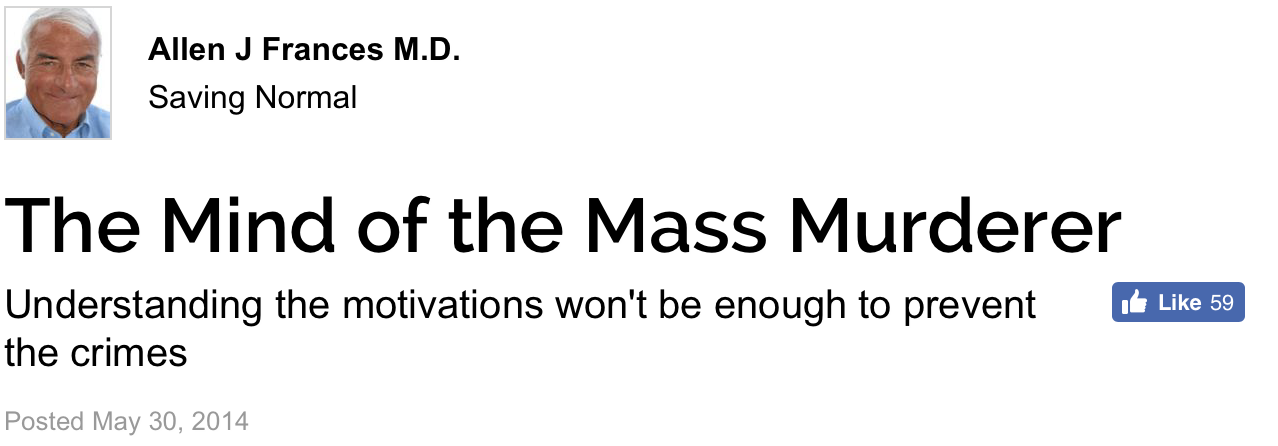
The massacre in Las Vegas may well be the event that finally shakes Congress into action to curb gun violence, even if in just some small way. Perhaps the prevalence of defective people who are capable of using guns in this way is finally sinking into our collective consciousness and will persuade paranoid Americans that having access to guns to make them safer from a suddenly metastasizing government or American hunters and gun enthusiasts that holding an assault rifle to feel a surge of power, are simply not important enough to make all of us sitting ducks. I suddenly needed to understand how it is that someone could mow down strangers with assault rifles. How could a human simply cease to consider other humans as… humans? How can a person turn strangers into ciphers with no value, no history, no soul, so that they are expendable? I searched the internet in my quest for an answer, and came across this very interesting article by Dr. Allen J. Francis, published in Psychology Today in 2014. It’s worth a read, in this age when mass murders seem to have become a ghastly, permanent blight. Despite understanding the phenomenon through the words of Dr. Frances, I can’t help but wonder if at bottom it simply indicates our failure as a species to have evolved far enough from the brutes we once were, or, even more sadly, signals our decay.
Mass murders are becoming a depressingly familiar routine in the United States- we can now expect to experience a media grabbing shooting about once a month. And the frequency can only increase as future cohorts of copycat killers are spawned by the seductive opportunity to temporarily gain the spotlight.
Amidst the anguish and heartbreak felt by the victims’ families, there are always two haunting questions. What motivates someone to kill strangers wholesale in a seemingly senseless way? And what, if anything, can we do to stop these tragedies from recurring?
I am so lucky as to have old friends. Old friends go all the way back to before you carried the weight of your world, or at least to before you carried all of it. They’ve stayed in your life despite all the shit you’ve done and they’ve done, good and bad, which could have carried them away from you, but didn’t, or not permanently, anyway. Somehow, they remain. They know, if not everything about you, enough to see your greatest strengths and your regrettable weaknesses, yet still love you to death.. They take your entirety. They look forward to opportunities to see you – it’s never a chore. You know without even thinking about it, by the sheer number of years they’ve been around, that they’re not going anywhere, and so you can exhale a big sigh of relief and be truly yourself.
When you are with old friends, you can watch dynamics play out that are decades old, or decades in the making, but you never find them wearing, or dull. They are simply there – familiar, comforting and renewing. I was renewed, quite recently, by a weekend away with old friends at a cozy, well-worn farmhouse in New England.
Most remarkably, there was a member of our party, the hostess in fact, who didn’t go back as far as the rest of us, but it felt like she could have. Old friends will embrace as one of their own anyone who wants to be there with them. Anyone who takes them all on because she loves one of them, and who is intuitive and observant enough to know what is reassuring, and worth preserving about their interactions. And, of course, who is lovely herself. Such a person is readily counted as one of the old gang.
Razzing and laughter at dinner gave way to reminiscences into the night, and no one felt like they had to be a certain way, do a certain thing, or even show up. I myself got wasted on Benedryl due to my concern that the smells of the old house meant certain asthma, and went to bed hours before the others. But there was no opprobrium; just the gentle teasing that make you feel the love. A late breakfast, hair of the dog for some, the New York Times crossword, and once we were all refreshed, we splintered off into our different activities. Some chose walking, others biking, still others swimming or reading. We all managed to congregate on the grass outside the old farmhouse for a slow afternoon. No one felt bored, no one felt slothful. We were all just happy to be relaxed…and together. I can’t remember the last time the air felt so fresh, the view so beautiful (meadow, blue sky and distant trees) and time such a gorgeous slow motion swirl of sunshine, buzzing insects, moving clouds and an occasional smile or wordless message exchanged among the celebrants. All set to the magical soundtrack coming from a tiny speaker.
The magic lasted through several meals, a movie, another morning crossword, even up to and past the time to separate. The feelings we shared – of peace, acceptance, good will, love – stayed with us. I had the very good fortune to ride back to my everyday life with the oldest of these old friends. We listened to music and took in the scenery together. I did not bury my head in a book, or lose myself in my own thoughts. I was there, with my friend, nodding and smiling, through all the great songs we bobbed to, all the gorgeous vistas, and the occasional comment offered by one of us. I wanted to be there for as long as I could.
This oldest of friends and I had been sitting together on the grass the day before, during the magical afternoon where time slowed, and at one point we began reflecting on how old friends differ from regular friends. “It’s as if there is a drill that goes through all your layers, all the phases of your life that have accumulated, and old friends can see the different striations, all the different layers that make you… you,” I offered. “I get that, I get that, “ my friend said, nodding in his very beatnik way, the giant heart walking on two legs that he is. “And it’s the core that served as the magnet from the very beginning,” he then observed so brilliantly. Then he went off in a different direction, inspired perhaps by the almost impossibly large and very old pear tree right in front of us. “Maybe an old friend is like an old tree. The trunk is solid and can be counted on, and the many, many limbs aren’t strange, even if they go off in different directions, twisting this way and that. You just look at the trunk and see that they are all part of the one tree.”
I liked that, thinking that each one of us is a tree, with many limbs, and together we are an orchard, where it is safe and lovely to lie and look up at the moving clouds, and float with the sweet perfume of memories, carried by the soft breeze of here and now.
On the way back, we stopped for a piss. His piss, by the side of the road. After I told him that I didn’t want to see him pee, and that he had to be out of my sightline or have his back to me at the very least, he did what he needed and returned with a bouquet of Queen Anne’s Lace. He had pulled them from the side of the road after the deed was done (from a different spot, I’m presuming), and taken the longest stem of one and wrapped and knotted it around the others for a tie. He dropped them onto my lap with the barest of smirks. About fifty miles earlier, I had been sappily watching wave after wave of that wildflower pass by, and remarked to the air, “I love Queen Anne’s Lace. It reminds me of my childhood in the Bronx.” The air, it seems, was paying attention. He doesn’t go back all the way with me to the Bronx, this friend, but far back enough to be there, in my orchard. The sweetness of his gesture summoned up the full range of feelings shared among us all.


 We all went to bed at the same time. We all wore matching pajamas. We made up games that inevitably involved jumping from bed to bed, a feat made possible by the fact that the beds were only about eighteen inches apart if that. And on summer nights, we all saw the same twilit sky from our two open windows, felt the small, hopeful breeze stirring, and heard the summer sounds from the neighborhood floating up to us.