“Mom,” my sixteen-year-old daughter asked me one day, “did you know there’s a scale for sexual orientation, zero for exclusively heterosexual and six for exclusively homosexual?” A few seconds later she added, “I’m a three.”
This was not news to me. She’d struggled quite openly for the past two years to understand her sexuality. The surprise twist was my declaration. “I’d say I’m a two-point-five.”
“What? Shut up!” was her stunned reaction. I could see delight in her eyes even as her brain worked to catch up. It was the kind of delight one feels when admitted into the inner sanctum. The questions came flying: “Does Dad know? When did you know? Have you been with a woman?”
I explained that I’d had numerous “signs” of my bisexuality since college, when I reacted viscerally to a beautiful female classmate. I’d attempted to strike up a conversation with her, hoping for something I couldn’t identify, let alone articulate. And yet, I told my daughter, despite occasionally finding myself intensely attracted to a woman, I wasn’t ready to understand my bisexuality until I watched her coming to terms with hers. But even then, knowing the truth about myself, I waited until she seemed firmly settled in her identity. This wasn’t just to give her the space she needed—I was still having trouble coming out myself.
For 22 years I’d been married to a man and had never been with a woman. Some friends said I had no reason to come out, while others said I couldn’t know for sure I was bisexual until confirming it. They were wrong. I had to come out to be freed from the exhausting task of convincing myself I was straight. To feel the relief of understanding it was okay. And I did not need to touch a woman to recognize the surge of lust, just as a heterosexual man or woman doesn’t need to cheat to know he or she really wants sex with someone who isn’t a partner.
The trust my daughter showed in me, in baring her most personal struggles and fears, was what led me ultimately to be brave. For how could I repay such trust with secrecy, whether to her or to myself?
A few years later it was my daughter who gave me the key to yet another door. We were folding laundry, the sort of peaceful activity that promotes intimacy, when she said, “I don’t know, sometimes I just feel like there’s this guy in me.” This hit me like a rock. A guy in me. A guy in me. The reverberations spread out over years, both forward and back. Days afterward, I was driving her to the train station when I said, “I so love that you feel you have a guy in you. It makes me feel like I’m not alone.”
“Well, I didn’t mean really,” she said, scrolling through her smartphone. “I meant that when I’m attracted to a female, I’m a much more aggressive pursuer than when I’m attracted to a male.”
“Oh,” I said. I was crestfallen and confused.
“Wait a minute.” She shifted in her seat to look at me directly. “What are you saying? Ma, are you gender fluid?”
Gender fluid. The words hung for a long moment. I’d never heard that term before, and the tumblers of a lock were suddenly clicking into place. Here was a Rosetta Stone, to make sense of an awareness that had always been without language, had always made me feel outside the norm, a poseur. And it was this: I was living as a female, with the body of a female and the socially established trappings of a female, but was not nor had ever been exclusively female. Now I knew what to call it. Now it was named, acknowledged. Now I could declare my entirety, to my daughter and to myself.
Recently, I observed a fascinating phenomenon at a holiday party. By “holiday party” I mean of course any party taking place in the month of December which isn’t tied to some other justification, such as a birthday or retirement. At this particular holiday party, the majority of the guests were couples. Being a singleton after a 22 year long marriage, I felt a unique perspective at this scene of holiday cheer. Uncoupled, and therefore not altered by the dynamic of a partnership, I was perhaps more free and undistracted to detect what each couple offered in combination. For what is it we are sensing from others and drawing conclusions from if not their facial expressions, postures, tones of voice, scents and electricity; and when interacting with a couple we get their mixture, how they affect and relate to each other. And there were some couples that clearly were in love with each other, as opposed to abiding in pairings that had over time slowly turned into unexuberant units of familiarity, safety, and attachment, or perhaps had never included besottedness in the first place. How did I ascertain this? It was simply by noticing the enthusiasm the men in these partnerships had for their mates, and the pleasure their mates took in that. I’m not saying that only the men who displayed their enthusiasm were in love. I’m saying rather that there was no question that the men who showed their enthusiasm were in love.
My observations here must be limited to presumably heterosexual males and females in partnership, for that was the type of couple I was meeting and watching. In the case of two notably alive partnerships, the men would chat with others away from their women, but not for too long a stretch. They returned frequently to reconnect or report, perhaps sharing an interesting interaction or nugget of information. They seemed to be truly interested in hearing whatever it was that came out of their partner’s mouth in a group conversation. They offered to get their partners drink refills and introduced themselves to the others in the grouping with confidence and the seemingly genuine offer of bonhomie. Of course it’s true, this all could have been because they relied on their mates to feel safe in the crowded social sea. Chances were, they were invited in the first place because their women were acquainted with the hostess, and so many of the men were meeting each other for the first time. But the proof that it was more than clinging to a buoy came later. As the party wore on, these men didn’t feel the need to leave. They hadn’t exhausted their stores for required but not truly felt social banter. They were grinning slightly and each looking like the leader of their own private pride of lions, content, self-assured, well fed and well petted.
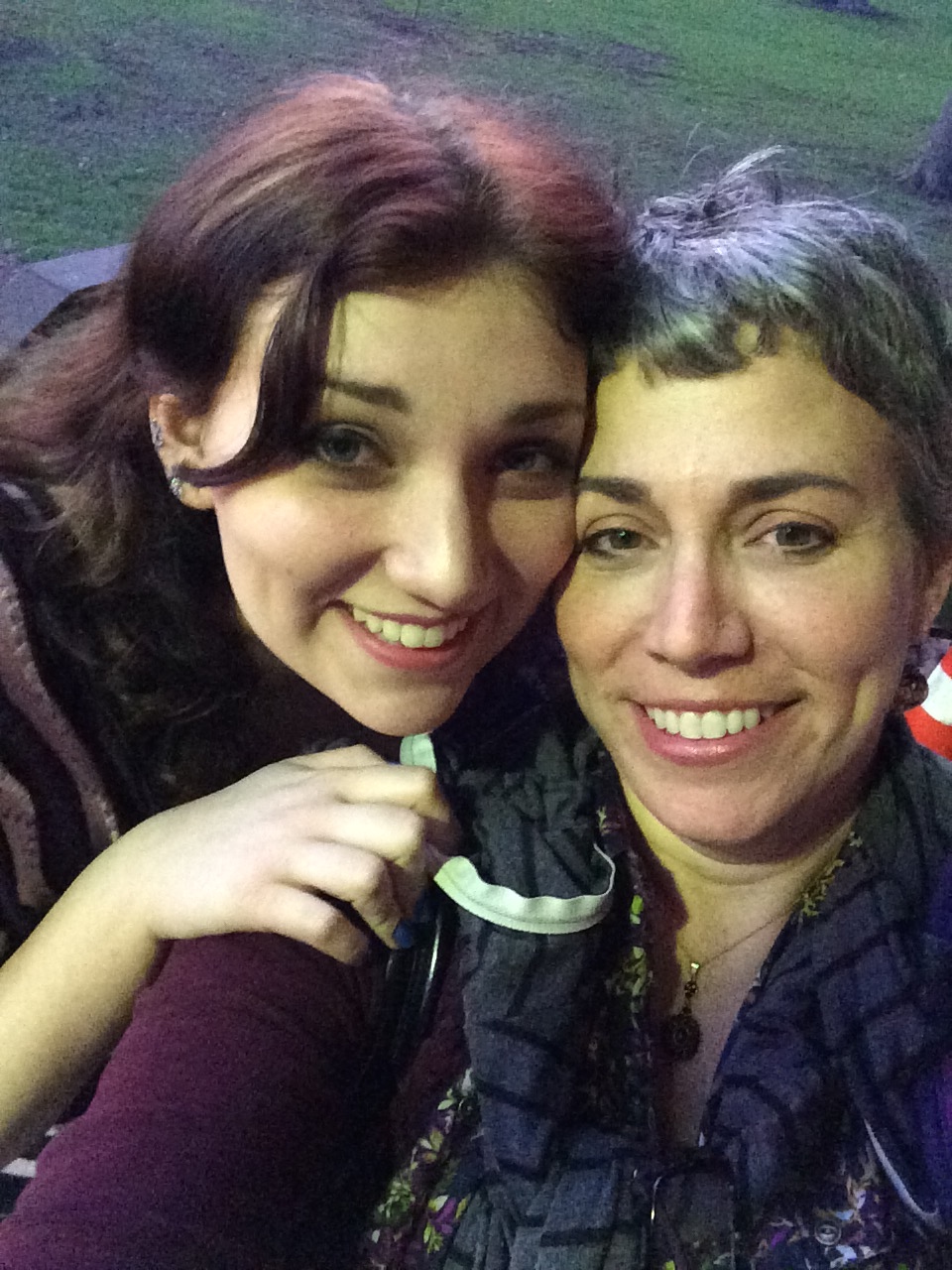
found at https://www.flickr.com/photos/ttstam/3290044006
And they were perfectly at ease in letting everyone see that. See that they were, indeed, loving it all. Loving how their partners loved them. Loving how everyone could see their beautiful, charming, smart and amazing mates. They were glowing and crowing, lucky bastards and they knew it. And their women glowed in the attentions paid them by their men. They felt charming, attractive and essential, beaming back at their men and at everyone in the group. It was quite a thing to behold.
That these apparently besotted men were so unabashed in their attentions made them particularly appealing. They were crazy about their partners and didn’t care who saw it. Or did care, wanting everyone to see it. These men would playfully lean into their mates, nudge them, teasingly chide them while wearing a look of affection if not charmed adoration, and even put their hands or arms on their legs or around their waists in claim and joy.
There is some notion floating around out there that a man becomes more attractive when he is desired, and that this is why some women will try to flirt with or intrigue a man who is committed to someone else. Apparently, these women can’t help themselves. That’s horse hockey. A woman who attempts to interest a happily coupled man has no justification other than being herself a person of poor character. And anyway, it’s not the man being desired that makes him more attractive, it’s the proud and beaming desire he has for his woman. Another woman, observing this, one who is not a thief or an unredeemable narcissist , will simply notice it, mark it, and understand the strong appeal of such a man. It is the appeal of the contented alpha male. A heterosexual man who is confident enough to easily show the world his love for his partner and his active admiration of her (which is an entirely different thing from revealing dependence) is demonstrating his social fearlessness. Wowser!
As it happens, I am friendly with the women I observed in partnership with these besotted alpha males. And so I was very happy for them. It is of course possible that their relationships are flecked by all manner of persistent problems. But it was also evident they are with men who actively and proudly adore them, and that kind of energy must go a long way.
There have been a few things about raising my children I have been a genius at, though, to be honest, these were more of the my-god-they-are-such-gullible-newbies variety and not so much of the I-must-get-them-to-understand-this variety. My most genius invention was the surprise plate. Even more so than the secret cameras I convinced them I had set up at their elementary and middle schools (achieving this through minutely detailed and accurate reportage of tiny incidents that happened in school which I had either witnessed unbeknownst to them or had related to me by other parents who were there). The surprise plate was sheer beauty: so simple but so incredibly effective.
Now, I wouldn’t be surprised if millions of other mothers out there have all come upon the surprise plate as well, because mothers are indeed a clever bunch, but it sure felt like my own genius magic, whipping it up one day almost out of thin air, and getting instant results. It happened on a day when the kids were not hungry enough to start whining about the exact meal they would require, down to each ridiculously innutritious item (with extra frosting!), if they were to be expected to mellow out and not escalate to a tantrum, but still were invested enough to inquire with some interest as to what I intended to present as “lunch.” I hesitated in my response, having been thrown by the fact that it was nowhere near close to lunch, and the kids, thinking they were sniffing disaster, instantly became alarmed. Didn’t my hesitation mean I was planning a bad, awful, disgusting lunch? But like a highly tuned instrument of bio-feedback making a thousand tiny adjustments every moment to prevent the otherwise oncoming meltdown, my scrambling brain made a sudden leap. I turned serenely toward them with wide grin, and, sweeping my arm out in a servile and unctuous arc, I told them, “I didn’t want to tell you, but I’m making you surprise plates.”
“What’s on a surprise plate?” they nervously asked. And with the suavity of a practiced TV host, and the beatific smile and manner of a magical fairy, I answered, “Well, it’s a surprise!”
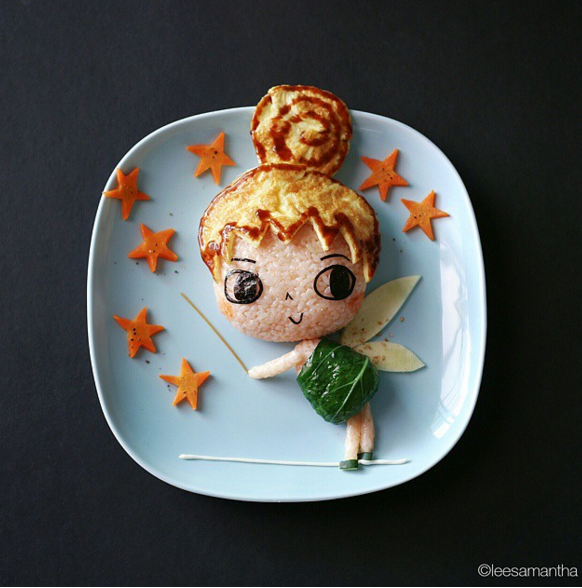
by Samantha Lee, found at http://blogs.disney.com/oh-my-disney/2015/10/14/13-pieces-of-disney-food-art-cute-enough-to-eat/
And they nodded in this information, with a half-understanding, a bit of game curiosity and a good dose of skepticism. I felt that I had averted a storm, at least for the time being. As the time for lunch drew near, I had to figure out what would go on those damn plates. “Okay, there’s the Goldfish, and those grapes I had this morning didn’t have that bad aftertaste from the skin… but what else? What ELSE? And I rifled through the fridge till I found some bologna to roll up and some cooked broccoli left overs, and scouted the pantry till I lighted upon the canned sliced peaches. Sweet, but still marginally nutritious. And to seal the deal, Hostess yodels!
At lunch, I served them with great pomp and circumstance. “Here are your surprise plates!” The fun they had pointing out the various items, their relief in not be served something truly repugnant and, moreover, their delight also in getting not just canned peaches, but a yodel besides, rendered the bologna completely benign. And the broccoli! The broccoli was transformed! It was now merely a mildly confusing disappointment, no longer something to cause eruptions of yowls and hideous, grimacing expressions. “But Mom, there’s broccoli.”
I shrugged with raised upturned hands and philosophically said, “Well, it’s a surprise plate. You never know what you’re gonna get.” This, to my well hidden amazement, led to them affirming with a mix of glee and resignation, “You never know what you’re gonna get!” They ate the broccoli.
The next day, they pleaded in chorus for surprise plates. “Oh no,” I said, “that’s an only once in a while thing,” and I insisted on serving them an “ordinary” lunch of chicken nuggets, banana slices, some green beans and two oreos. After a few times of them asking when they’d get surprise plates again, I finally, and “begrudgingly” said, “Okay, okay! I’ll make surprise plates.” This time it was hardboiled eggs, a one-serving of Mott’s applesauce, some M & M’s, carrot sticks with a little puddle of ranch dressing and cooked zucchini. “Yay, M & M’s! Eww, zucchini!” but they ate it all. That was it! I felt like Dr. Frankenstein must have when he gave life to his monster. “I HAVE DONE IT!”
Those once in a while surprise plates helped me get all kinds of vegetables into my kids’ mouths, and the good-natured-oh-well ingestion of these veggies often led to their eventual acceptance onto both “ordinary” lunch and dinner plates. (Though I wasn’t fool enough try the really challenging ones, like collard greens or kale. Why risk spoiling a good thing?)
I kept up those surprise plates until the day finally came, sadly, when it occurred to one of them to say, “I’m not eating that, Ma.” And just like that, the magic of the surprise plate was gone. Oh well. It was good while it lasted. And thinking about it now, I recall that the idea wasn’t really mine, but actually was my mother’s. She had once told me about the surprise plates she had made for my nieces when they stayed with her, and the notion must have lodged in my brain, waiting for the perfect time to come out. Did she know about the power of the plate to induce the eating of vegetables? She must have. She was a mother, after all.
found at biblemoneymatters.com/how-to-create-a-decorated-handprint-plate/
“We’ll always keep in touch, no matter what happens.”
From buzz feed.com; 16 Pictures of Animals Holding Hands, February 14, 2012
“I’ll never betray you, no matter what happens.”
“I’ll always love you, no matter what happens.”
These are things we all say in a moment of raw, intense feeling. We really mean the first part; boy do we mean it! It floods us and makes our lungs expand and maybe even our nostrils flare and there is no doubt how sincere we are about that feeling. It is a beautiful, naked pledge about our intent at that moment, offered when we are so overcome with emotion that we willingly expose ourselves.
But that second part, “no matter what happens,”… isn’t it a bit of an escape clause? A ceding of responsibility? We expose ourselves, yes, but aren’t we clinging to just that little bit of a fig leaf? No, no, we say! We are just paying homage to the unpredictability of life in the architecture of our pledge, because let’s face it, life happens to us. If anything, that underscores our pledge, right? Makes it all the more sincere, because we will prevail no matter what unexpected things happen to us! And anyway, it’s true!, Things do “happen” to us! Don’t they?
There are undoubtedly times when circumstances are radically thrust upon us, not by choice. An example, of course, is death. Another is powerlessness, say, in the case of a young child, who does not have the means or know-how to overcome obstacles placed in her way by parents’ actions or choices. How about some sort of apocalypse? A contagion decimates our population, all technology breaks down and transportation and communication become virtually impossible. That would definitely be something that happens to us. What about a devastating illness to us or a loved one? What about being fired from your job (assuming it is not because you are an unbearable jerk or lazy ass)? What about an asteroid hitting the earth? Yes, there are indeed many ways in which life “happens.” And to be fair, far less dramatic but no less powerful turns of events also can “happen” to us. People who are dear to us suddenly have needs that conflict with ours or each other. Or our finances change, and that requires radical adjustments. The list is endless.
But what about choice? Our lives are not just left to free-floating chaos, are they? Every day, no matter what “happens,” we make choices that affect how we handle or navigate what has “happened.” Moreover, in many if not most cases, the very thing that “happened” happened precisely because of a choice, or a cumulation of choices. We made it happen. Or we let it.
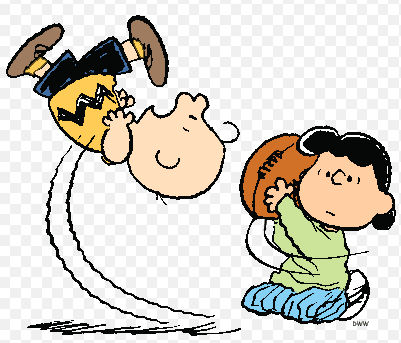
From Peanuts, by Charles Schultz
We make choices every day that direct our journeys on this little speck of rock. Thousands and thousands of choices. Little ones, big ones, easy ones, and excruciatingly hard ones. That last kind, many people avoid making, and they passively ride time for as long as they can without actually making a choice, until the choice is made for them. By waiting, we think we have absolved ourselves of the responsibility of choosing. But the truth is that’s a choice as well, and in most cases anyway we kind of know, deep down in our guts, which way things are more likely to go as a result of our not making the choice.
So, when friendships falter, it’s due to people deciding something. Perhaps it’s due to them deciding, in the midst of feeling overwhelmed by other things, that making the time for that phone call to that particular friend is a low priority. Whereas, calling some other friend to talk remains a high priority. Maybe it’s because that low priority friend has been making us feel bad more and more often, criticizing us or judging us. Maybe that low priority friend doesn’t seem as necessary to our well being as they used to. Regardless of the reason, it’s a choice. To give up reading fiction, because the demands of your job come first no matter how unreasonable or soul-destroying they have become; that’s a choice. To ignore exhortations from your spouse or your mother to stand up straight so you won’t fold in on yourself as you age; that’s a choice. And when it turns out, therefore, that you are indeed stooped over in your middle age, well, that was your choice, not really just genetics “happening” to you. To live with unhappiness because it is too difficult to rectify it, or because you believe making changes will shatter the happiness or stability of someone else; those are choices.
In many cases, the choices we make are the right ones for us. You could even say they are always the right ones, because they reflect what we really want or feel capable of at the time. But even when right for us, they come at a price, and so it’s easier to pretend we aren’t making them. Maybe they come with someone’s hurt feelings, or maybe with our own disappointment in having to let go of something that we did want, but not as much as the other thing we chose.
I just wish people admitted their choices as choices. I think it would empower them. That certainly has been the case for me. Realizing I had made choices and that not everything had just “happened,” led me to take a long hard look at why I had made those choices. I understood more about myself, and facing new, difficult choices became easier.
So I won’t use that formulation, “no matter what happens,” to drive home the truth of my pledges. Instead of saying “I will always [fill in the blank] no matter what happens” I will say “I feel with all my heart that I will always choose us.” Us as friends, lovers, colleagues, teammates, partners in crime, whatever. Unless, of course, I know I wouldn’t really make that choice. Unless, there is something or someone I know I would choose instead when really pressed about it.
Found at thetraveltester.com
Chances are our lives will never go exactly the way we want them to, because, well, things do happen. But the truth is, they’re going pretty damned close to where we want them to, because we make the choices everyday that lead us there.
Over my life a particular memory visited me from time to time. Whenever it came, I always gave it its due attention. But it seemed to serve no purpose other than replaying a long ago hurt and, despite the gentler perspective granted with age and experience, always triggered the same painful mix of bio-chemicals that squirted forth when it actually happened so many years ago.
Of late, the memory began popping up more frequently.
At first, I wasn’t even wondering why. Then, when it finally dawned on me that the same episode was running again and again on my brain’s T.V. screen, I began to suspect that the constant replay was a demand to be noticed. Like a loud megaphone: Hey, dummy! Does this remind you of anything?
It was a time in my life when I was a real pain in the ass. Somewhere between the ages of 8 and 11, I was experiencing the fallout from being taken away from a life that worked for me. In that wonderful former life in the Bronx, my older sister Michele played with me more than she socialized with our eldest sister Renee. In that life, my best friend lived directly across the hall from me, and was available most of the time for companionship. In that life, my mother was home most of the time; and, when she did go out without me, I had the security of my best friend’s mom across the hall, or or my grandmother (who lived two floors below us) and never once felt alone. But in this new suburban life I was now in, I hadn’t made any real friends yet, my companionable sister had crossed over and was now a fellow traveler of our eldest sister, and my mother worked as a teacher. Little did I know that day when we were all so proud of her for graduating and huddled together, smiling for the camera to mark the occasion, that I should have been singing a dirge. For my mother of course did the next logical thing, which was to get a job as a teacher. Not that it affected me during school hours. But, after school, in place of my attentive, soft and patient mother, offering snacks and asking me about my day, there was a different mother. This one was stressed. A new teacher, preparing lessons for the next day. Working on her masters degree, and sometimes traveling into the city for evening classes, or spending yet more hours doing her assignments.
My father was also withdrawing. Not that he ever was the warm and cuddly type. He was a cop, and had to keep up his hard-boiled exterior. But when we lived in the Bronx, it was a few simple steps for him to come into the bedroom I shared with my sisters, to tell us some stories, make us laugh or sing to us. Now, we all inhabited our own separate rooms, up a flight of stairs, and my sisters were getting too old for that sort of thing anyway. And, too, he was facing his own wearying challenges. He was now commuting from the suburbs into a part of the Bronx that was getting scarier and more disassociated from that place where he grew up. The absence of any men who really could relate to him on any level in our upward striving suburban community, and the surreal and battering horror of traveling back and forth from dainty civilization to dystopia on a daily basis, caused him to retreat further into his world of books and pipe tobacco when he was home. And my sisters were off tittering about some shared secret knowledge or hanging out with their friends. I was no longer a cute diversion holding any interest for them, and my felt banishment filled me with resentment and longing.
From The Children’s Encyclopedia, by Arthur Mee. (London: The Education Company. Orig pub. as The Children’s Encyclopædia 1908), “Ideas” section, Volume I, p. 112.
The final loss, in a twisted turn of poor timing, I also was no longer my mother’s “warm little bundle.” This I learned when she started telling me all the time “Oh you used to be my warm little bundle!” As I was getting larger and losing what was left of my wide-eyed and sweet puppy features, it was not possible, had I even tried, to fool anyone into thinking I still needed slack for my hesitations and cluelessness. People expected me to get with the program, understand my responsibilities, stop expecting time made to soothe and redress my little hurts and disappointments.
One Sunday afternoon in particular I was sadder than usual. My sadness moved into broken-heartedness, and I felt strangely incapacitated, virtually listless. I became convinced that I had some sort of mysterious malady, which only a mother would understand, and certainly have the remedy for, if I could just muster up the energy to call for her, which I did. She was all the way downstairs, using up what free weekend time she had entertaining my Aunt Betty, and so I had to summon up quite a bit of energy for my call of “Mahhhhh-meeeeee!” to reach her. That I was in such a sorry state as to be required to use every last bit of my strength to make such an effort only made me that much more broken-hearted. Years later, I understood that what I wanted to see, what I ached to see, was my mother, coming up into the master bedroom (where my incapacitated little body lay), with a gentle reassuring face, soon to be stroking my hair and telling me that if only she could get ride of Aunt Betty she’d be there with me, taking care of me and making everything all right. What I got instead was a slightly exasperated mother, with firmly set lips, who was there to get to the bottom of why her then 9 year old thought she was incapable of walking down the stairs. When I told her that I wasn’t feeling well, she strode over, checked my forehead for heat and looked at me hard, trying to size up which reaction I deserved. I received the, “Well, just rest here and I’ll check on you later” response, which was far short of what I so desperately wanted. She went back down. I spent the next 15 to 20 minutes wondering what went wrong. Why didn’t I get the loving stroking of the hair and the reassurance that our bond remained intact despite all the demands on her time? And, convinced that I didn’t do a good enough job of conveying how broken-hearted I was, I decided as only a 9 year old can that the best way forward was to call her again, and this time really make sure she understood. Although this time I never got to say anything. As soon as I called out my even more plaintive “Mahhhhh-meeeeee!” I could hear Aunt Betty clucking her tongue about what a nuisance I was for my poor mother, and could almost see my mother’s face pained with exhaustion and embarrassment (for Aunt Betty made it clear always that she tolerated no such nonsense from her children). When she appeared at the bedroom door, having made the climb for the second time, someone even more removed from the mother I grieved for was there. I can’t remember what she said, but the words were irrelevant. Her angry expression and tone said it all. I was a burden, whiny, unreasonable and selfish. Something to deal with. Not a hurt little girl, her daughter, without words to express to her mother how alone she felt in her losses. In that moment, I understood fully and perhaps for the first time that my sweet childhood was truly over. I endured the moments of bitter reprimand that followed and said nothing more.
So why the increased frequency of replay? What was I hoping to find in that memory? As early as young adulthood, I had figured out that my mother was in an almost impossible situation, working full time, running our home and raising her girls all without much input or support from my father. I had already worked out that my father was steeling his soft and poetic nature every day for the work of a mercenary, patrolling an unsafe community that was no longer his own. I had already grown to understand that my sisters were just experiencing their own lives with all the complications and transitions that adolescence brings. I had nothing more to learn from that memory, or so I thought.
My own daughter, now 21, has had her own difficult journey. As the first born, she had no older sibling to shelter her when she first entered the world outside of her mother’s arms. She would return home from a difficult day at school to find me, formerly unflagging in my soothing attention, now preoccupied with her younger brother, or in the middle of house chores, or chafing against something gone wrong in my life that I hadn’t put to words or even understood but which only served to unnerve her all the more.
Dreamscape by wbsloan on Flickr
And at those times, when my daughter needed me, I’d deliver a sort of patched together, half-hearted exasperated offering of my own. Sometimes I even lost my patience with her, when all she really wanted was for me to scoop her up and tell her that she was loved, and special, and that I was glad to have her home. Instead, she knew that part of me wished she was still at school, so I could catch my breath, and have just that bit more peace, and maybe somehow get grounded back to who I was. When she came home from her own battles each day, she was greeted, not by the loving, tender mother she wanted, but by the same overwrought mother, with strained smile and limited patience, that I had greeted. The same mother who hoped to fix her daughter’s unhappiness by suggesting better ways to have handled something, as though that would stem the onslaught of painful experiences. The same mother who felt guilty and helpless whenever she witnessed her child’s pain, and never said the right thing. How is it that I determined to do things so differently from my mother, so that my children would not feel the same rejections and misunderstanding I had, but ended up failing so completely in that regard?
Brave and determined soul that she is, my daughter set herself to exorcising all causes for resentments from our relationship while she was still a teenager. After years of less effective confrontations, at 21 she finally developed the language to convey (and I finally refined my listening enough to receive) the simple truth that she had felt like a burden to me. She felt she was the problem child that made everything harder for me… for us. She confessed it to me one night, one night of wonderful, vulnerable, almost scary bonding and revelation. And there it was, at the ready, finally able to reveal why it had been plaguing me: that memory of my own mother, angry with me for needing her when she was barely hanging on herself, and resentful for not knowing how to fix it all, that aching in me and in herself. And I whispered to my darling daughter, “I’m so sorry, sweetheart. I’m so sorry that I didn’t simply hold you and tell you I loved you, that everything would be okay. That all of it mattered, yes, but that none of it mattered now that you were in my arms.” How long would that have taken? Ten minutes? Ten minutes to soothe a child facing the world without her mother. A child without sheltering siblings and with no trusted friends yet. Why couldn’t I just have simply hugged her, without judgment or the desperate wish that all her problems, that she, the way she was, would just change into something else that would make my life easier? Instead, I contributed to a pattern that would haunt us for years: the lonely and misfit daughter and the overwhelmed, worried and ineffectual mother. I’d come to pick her up from a birthday party, with a dreading expression, expecting before being told that there had been some pain for her in the proceedings, some conflict that all the other children and moms couldn’t understand, or prevent, and wished would magically disappear; and instead of scooping her up and being on her side, I’d wish it would all disappear too. I wished she would just be easier. For my sake as well as hers.
So here is my atonement. To my daughter, for doing exactly what my own mother did, and what her mother did before her. For not wanting to acknowledge the legitimacy, the normalcy, and even the inevitability of the hurts a sensitive child feels when weaned from her mother’s side. For not wanting to explore my part in those hurts, making them worse by adding my own frustration, resentment, guilt and feelings of inadequacy as insult to injury. But my atonement also is to my mother. I atone for having judged her as not up to the task of understanding and comforting an angry, sad, lost child. It is a very difficult task, maybe impossible; I know that now. I atone for my high-handed thinking, when I became an adult, that I was big enough and wise enough to forgive her. There was nothing to forgive. She loved me, and my pain pained her. She was a wonderful, wonderful mother, all the more so in light of all she carried. I atone whole-heartedly, seeking her forgiveness for assessing her and finding her wanting, now understanding finally that all the love and best intentions, all the experiences and memories we swear we will bring to our own child-rearing, may not be enough to overcome the limitations and distortions hammered into us by whatever stressors and unspoken resentments are plaguing us at any given time in our adult lives.
The cycle of hurt between parent and child will continue, I suppose. I pray that my daughter will be able to break it should she have an unhappy child. And I hope in any event that my daughter too comes to understand that I loved her always, and that her pain pained me, and that I wish more than anything that I could redo some of those moments she remembers, bringing the perspective I have now, and taking the hurt away.
My son told me recently about a driving “adventure” that he and his buddy went on. The rules of the adventure were this: you drive straight ahead until you reach a T intersection, and then you have to turn right. You continue on straight, or making right turns, until you can go no further. While I was digesting the idea that, only by pure dumb luck I didn’t get a call from Chicago, or Terre Haute, telling me not to worry, they’d be back the next day, my son related with relish and a bit of cackling glee how they ended up in what could be described as the slums of Danbury, CT, a mere 35 minutes away, in a dead end by some housing projects. “Why always a right turn?” I asked him.
“It’s easier,” he said, with a look that said, “D-uh!”
I had reason to think of this driving game again when my friend Diane told me about her current heartache. She had met a man on the west coast when she was out visiting her grown daughter, and their chemistry had been immediate. Apparently, they lit each other up, body and soul, like a generator plant on the New Jersey Turnpike. Because she’d go out 2 times a year to visit, she was able to spend extended time with this man, and they fell deeply and madly in love. Skype and phone calls carried them between visits. After a few years, the time had come when they began contemplating combining their lives, but because both of them had strong family, social, professional, even soulful ties to their own communities 3000 miles apart, they faced some tricky obstacles. They had started talking happily and dreamily about splitting their time on each coast, assuming they could find the way to make their professional activities more portable. While Diane had no friends or community connections on the west, her daughter was there, and she looked forward to the adventure of gaining new friends and activities there. And she would still be spending plenty of time with her family and friends on the east. Her man had both family and siblings on the east, and his kids on the west were virtually grown, ready for their own adventures. Nevertheless, this great love of her life seemed to be balking, talking with anxiety and dread about the huge changes necessary for them to be together on a day-to-day basis. He thought he’d be able to carry most of his work with him, but what if he couldn’t? What if he missed his much larger social circle on the west too much? What if he hated living on the east coast, with its gray cities and variable weather? What if, to accommodate him, she ended up spending more time on the west and began resenting him? What if their projected net worth as a pair really wouldn’t be enough to sustain the kind of lives to which they were accustomed or the resulting travel costs? Diane began feeling hurt. Based on what she understood, these possibilities did not seem likely. And wasn’t their love worth the changes? Wouldn’t the day-to day-joy of being together make everything else seem manageable? Fun, even? She wondered if he had just been indulging in a dream of love, one that evaporated when compromise became necessary, while she had been committing her heart.
“It’s not that,” I told her. “He’s just afraid to make a left turn.”
“Huh?” was her response, but I saw from her face that she could already sort of grasp where I was going.
“Diane,” I said, “this is probably the first left turn this guy has made in about 25 or 30 years.”
Dick Grossberg – CD Clocks
Despite the rules of my son’s driving game, young people make left turns all the time at the craziest intersections. They deliberately put on their left signal, having possibly decided at the last minute that’s where they want to go. They move out in the middle of the intersection with all the attendant risks, and nimbly or not so nimbly make it happen. Sometimes with bravado and confidence, sometimes with elevated heart rate, drawing in breath through clenched teeth or muttering “fuck” under their breath, but they make it. They follow a college sweetheart to a new city, a new country even, with no real plan for their future. They quit a job they realize is making them sick or just not leading anywhere they particularly wanted to go, and begin an entirely new career or profession from nothing. They decide they will go to Bhutan before they settle down into a routine life, and suddenly discover a burning desire to become a Buddhist monk. Why can they do this? Is it just because young people are braver? Do they take more risks because they don’t have the life experience to think through all the possible negative consequences? In other words, are they blissfully ignorant?
I think that is definitely so, but instead of worrying on their behalf, which they never appreciate and indeed chafe against, I think we should take a few lessons from them. I used to be one of those mothers who always offered a nervous litany of concerns and fears about her kids’ choices. Offered the litany without solicitation, of course. It just bubbled up out of me, like a compulsion, and I convinced myself I was doing the right thing, counseling my naïve and judgment-impaired children, throwing water on their fires. It started when they were very young, and became so ingrained in me as a protective impulse, that at some point I couldn’t be any other way. I immediately went to that place where everything that could go wrong would, and into the dread, of course, I factored in the weighty heartache and fresh worrying I would personally experience when things inevitable turned sour. What a drag! How did I get so negative and fearful? And I’m not even remotely as negative as most people I know!
What saved me? I started noticing, finally, that there were some people who, when I mentioned something my kid was going to do, something that I felt okay about, would start going through all the things that could go wrong. They set forth all the reasons I should discourage my child. I started noticing that these were the same people who plan out every detail of their vacations, and always find it necessary to proudly point out how they were able to get a spot close by to an event because they charted out their course days earlier and made sure to arrive an hour early. All risk is managed away to provide as smooth a ride as possible. No supporting a kid’s dream, because a dream isn’t practical and almost certainly will fail. No pursuing their own dreams for the same reason. And certainly no left turns! So many of us will continue down a path that really isn’t suited to us, that is leading us astray or to a dead end, rather than make a left.
But perhaps it isn’t just the ever-spreading tumor of worry that drags us down, away from the risk and the rightly earned delight from successfully making a left. After all, when we are older, our vehicles are longer. Instead of a zippy little car or jet ski built for one, maybe two, they are freakin’ tractor-trailers, or huge tankers that carry all the people, responsibilities and ties we’ve accumulated. They don’t turn easily. They take up the entire intersection as they swing round, creating a disturbance, and threatening to upset our cargo. It makes sense to avoid that left! But is it sense or fear that keeps us from taking it? Is it our forgotten skills or long buried sense of adventure?
I know of people whose lifestyles involve changing locales every 5 or 7 years for professional reasons. Their craft never seems to get too big to turn. They find fun and adventure in every new place, and remain nimble, flexible, daring. Sure, moving is a pain, but they do it with good cheer and make the best of it. They have many friends all over the country with whom they keep up contact and visit. They have safe ports all over. But for those of us who stay in one port for too long, our crafts just seem to get bigger and bigger, maybe even stuck, and other ports begin to seem foreign, scary, hard to navigate, not worth the effort.
Maybe our crafts are not as big as we think. Maybe we just haven’t made a left in some time and we’ve lost the stout heart for it. I think even a person who once led an adventurous life for many years can lose heart if they’ve been settled for a while. They might even still make the occasional right, which isn’t nearly as scary, and tell themselves they’ve been making lefts.
No question, the left turn is far more challenging, even dangerous at times. And yes, being parked, or going straight, or even turning right is much safer. And maybe the surroundings we’ve been in for such an extended period of time are wonderful in many ways that we are loath to give up. But maybe what lies to the left is the promised land, the incredible place we never found because we just wanted to avoid that left. Maybe, if we go for it, we will discover that our craft, while indeed carrying a load, isn’t really that huge and heavy after all, and that we can in fact travel back and forth, keeping the delights of our old port while discovering even greater enchantments at a new one. And in the process, maybe we might realize that the young do not have the market on adventure and exploration, and that there is something to be said for venturing forth without a clear sense of what could happen. Maybe it keeps us young, and what’s wrong with that?
I told Diane, “Tell him to turn on his signal, take a deep breath and get ready for the adventure of a lifetime. Or get on board and remind him how.”
When I was old enough to be driving, but young enough still to be living with my parents, I was returning with my mom from a shopping trip at the mall, when I drove over a mouse in our garage. I don’t know how the exact timing was possible, but his darting out of the way didn’t take him far enough to miss the slowly rolling tire, and I crushed the back half of his body. I discovered this when I opened the door from the parked car, and heard squealing. Squealing that was quiet enough to be barely perceptible, yet still ear piercing. Soul piercing. I craned around and saw the mouse, still alive, pinned there under 2 tons, his head and chest now reaching out from under the wheel, straining for a reality that was no longer possible. I instantly reversed out of the garage, straining for that same reality and then rushed out of the car to see. But no, there he was, half pancake, half mouse. I retracted around the huge fist of a feeling that punched my gut and started wailing and whimpering just like that mouse.
My mother too had been taking in this whole scene, whatever horror she was experiencing enhanced by factors from watching her daughter, her baby, so tormented by something that could not be undone. For a moment she stayed in the horror with me, no doubt incapacitated as I was, but also, it soon became evident, summoning up something colossal. Something so out of her normal way of existing that I felt it happening. I felt her straining against the weight of her nature, 2 tons, just like that car, as she strode with almost too much purpose, just to avoid faltering, to the hanging tools on the garage wall and plucked the heavy metal shovel from its hook. “Stand back!” she commanded, but I could hear the doubt and torture in her voice, as though she wondered without words just how she would be able to do this. In that one fleeting moment, I saw my mom, really saw her, partly crushed by years of doubts and conventions and limitations, and partly alive and strong and defiant. For her baby, for me, she did it. She lifted the shovel high over her shoulder and came down in one fast, unwavering arch of a swipe, right on the mouse’s head. And though the mouse was no longer squealing, his head was not flat like the pancake half of his body, so, the blows coming easier now, she lifted the shovel and slammed it down twice more in quick succession to be sure. Then she stopped, and I beheld her, the horror of the mouse’s fate at my hands supplanted by the awe I felt for my mother. I understood without words the wild and brave extremity she achieved, for me. Not that the mouse was forgotten. Horror, which of course is that feeling you get when confronting something awful and against every value you hold dear, but about which, in that moment at least, you believe you can do nothing, softened into a still difficult but more manageable sorrow that I would recall all my life. But the horror of that moment was dramatically and completely swept aside by the vision of my mother, standing there with the shovel handle clenched in her fists, breathing fast, somewhat overwhelmed and sick to her stomach, trying to regain her composure and a normal blood pressure. Somehow, she did what she had to do: put the mouse out of its misery and thereby smash its and her daughter’s horror completely and beyond reach. In her act, I saw just how much she loved me. For it is one thing to care for and minister to the needs of a child. It’s another thing to do something that requires heaving off one’s own horror. To break through the command of the primitive part of our brains, that renders us afraid and frozen like a threatened gecko. To strain wildly against debilitating, irrational paralysis and manage to act.
We make up all kinds of rationalization after the fact for our debilitation in the face of horror, because it is shameful to us. We know that we were too weak to overcome it; we were completely ineffectual. And when the horror has to do with the social behavior of others our inaction is even more shameful. For we know on some level that paralysis in the face of witnessed violence or physical injury is more excusable than paralysis in the face of witnessed rude, insulting or insensitive social conduct, which after all, presents no actual threat to our bodily integrity. So we paint over such moments with the justifications of societal conventions, “supposed to’s” and staying out of the way and not making a big deal, but afterward we recriminate ourselves silently and repeatedly for having been overpowered by fear. That’s what it is after all. Our residual but still very powerful primitive instinct to freeze in the face of callous or insensitive treatment of others or ourselves is fear.
I have had many, many moments where I failed to act when I witnessed rudeness or insult, whether to me or someone else, and I still feel the shame of those moments so many years later. In the case of mistreatment of my children by ill acting teachers or nasty parents of schoolmates, I managed to summon up at least enough courage not to remain silent, but I didn’t call things out exactly for what they were. I didn’t say, “You grabbed my child! How dare you! Don’t you ever touch my child again!” Instead I said, “My son says you grabbed him by back of his neck when he tried to get something from his cubby, and I’m very concerned about that.” I didn’t say, “Do you realize how twisted and mean, and damaging your sarcasm is to my eight year old? To most eight year olds?” I said, “Your way of interacting with the students doesn’t work for my daughter and I would hope as the teacher you would consider that.” And I didn’t say, “Are you nuts? All the other parents think your kids are the nastiest, most conceited, and crassest kids in the entire school, and you have the nerve to tell me that my kids are defective?” Instead I said, “Well I’m sorry to hear that my kids are doing things when I’m not around that aren’t’ very nice, but that doesn’t give your son a free pass to do something mean that has my daughter feeling sick.” But watching my 21 year old daughter begin truly to understand and struggle through the tangle of mistreatment, selfishness, inconsideration, sexism, you name it, that constitute the “jungle” of our society, and watching her wonder whether she dare call people out for the things they say and do, I feel empowered to rise above my own fetters and shout “Yes! You are right! That person was an asshole! This person tried to belittle you! That other person was manipulative! You are not crazy to think so. You do not have to remain pleasing and conflict averse! You do not have to be worried that people will think you are ‘trouble’ or oversensitive because you refuse to let mistreatment, however nicely dressed or camouflaged or even unintended, pass unchallenged.” As I see her recognizing and identifying all the social interactions that stun us, as I witness her paralysis, I am, it seems, finally able to summon up the strength to heave off some of my own.
A few days ago, the defining moment came.
My daughter and I were eating at a small neighborhood restaurant in Brooklyn. There we were, me with my gray hair, older skin, manner of dress and overall bearing that announced me as a woman over 50, and she being obviously a young woman in her 20’s, perhaps my young friend or perhaps my daughter. Someone who seemed like the owner waited on us, but in any event he was a man somewhere between the age of 38 and 48. He kept referring to us as “girls” and not in that hammy, flirty way that is intended to be a compliment, effective or not, to older women. It was in the dull, automatic, unseeing and oblivious way that some men refer to women generally. With each utterance of “girls” our discomfort grew. We did not have to say much to each other. We both knew that a man waiting on us was referring to a 53 year old mother as a “girl” in the presence of her daughter and that it was belittling, all the more so because it confirmed an absent, careless and undervalued interaction with customers. “You girls want anything else?” It matters not if someone else would have not taken offense; I did. My daughter saw me struggling. She saw me pinned under convention and yet trying to summon up something, anything, to heave it off. When the proprietor brought our check, said, “thank you, girls,” without even looking at us and walked away, I must have contorted my face in some crazy way, for she whispered, “Mom, don’t. Mom, let it pass.” And when I continued to fidget and struggle, apparently presenting the risk of some kind of uncontrolled, over the top outburst, she said, “If you’re going to say something, I’m getting out of the restaurant.” I was too busy summoning up my courage to respond. So she beat a hasty retreat, saying “I’m outta here. I’m going to the bathroom.”
I sat there for about 5 seconds trying to breathe my way to doing what I knew I wanted. I half couldn’t believe it. I was afraid to say something to this stranger. I was afraid lest he think me a crackpot, a “feminist” an overly sensitive, silly female. The conventions and the “supposed to’s” and the always-at-the-ready “Why make a big deal out of something so little?” rose up in my brain. But I knew that if I didn’t say something, I’d be ashamed of myself and always regret it. Not because I’d have let what was just a careless remark pass, but because I’d have let my fear win. I took that one final deep inhalation, stood up and walked over to the proprietor, my payment for lunch already on the table. I said, “Excuse me, you seem like a nice man.” “Thank you,” he interjected. I continued in a calm voice that at first belied how hard my heart was pounding but then actually managed to help me find my ground. “So I’ll ask you to please consider how a 53 year old mother might feel being referred to as a girl in front of her grown daughter.” In the face of his momentary confusion, I added kindly, “I’m really too old to be called a girl; I deserve more respect than that.” He looked at me. Really looked at me for the first time. Suddenly he was a respectful person addressing an older one. A service provider addressing a customer. He asked, “I called you a ‘girl’?” And when I affirmed that he did, he apologized, perhaps more because now he was afraid, (what if I made a scene?) than out of any regret. I smiled, and thanked him and told him with a twinkle that I left him a good tip just the same. Then I turned and strode out, feeling like I had just successfully completed the pole-vault at the Olympics and joyously caring not one whit whether the proprietor was judging me.
My daughter was waiting for me outside. “Mom,” she beamed. “I’m really glad you did that.”
Huh?? “You heard?” I asked.
“Yeah, I heard part of what you were saying after I came out of the bathroom. I was afraid for you to say something, but deep down really I wanted you to.”
Well, I wasn’t doing something as heroic or dramatic as euthanizing a doomed animal, but I managed to heave off my fear, and she watched me do it with pride and gratitude. It was something I had to do. It was my way of saying “See? You can do this, and, by the way, I love you.” And I think by her comments she got that. It was her way of saying “Thanks, Mommy.” In the end, perhaps it seems ludicrous that I would have been afraid to have said something, or even that I felt compelled to do so, and yet, how many times have we not spoken up merely because we didn’t want to seem silly or, heaven forbid, make the transgressor (who may well be unwitting) uncomfortable? And why is seeming silly so catastrophic, to be avoided at all costs?
Nothing makes you grasp how weird sleep is quite like going to sleep for the night in the clothes you wore that day. You take off your shoes and, still wearing shirt, pants, socks, and even the leather belt you had on, just lie on the bed (blanket optional), and sleep for seven or eight hours. People will give you a bunch of different reasons why we don’t normally do this. Like, it’s not comfortable, or you need separate sleep clothes to absorb the sleep smell we all generate (that’s just weird right there!), or if you don’t perform the ritual of undressing and washing, you’ll accumulate all kinds of grime on your face, etc. But these are just sacraments we’ve adopted to prepare for and regulate a most bizarre phenomenon. To sophisticate and romanticize something primal and animal and out of our control: we simply turn off, shut down to a bare minimum of breathing, beating, and chemical regulation. We hibernate like bears, only for several hours and not months at a time. And our dens are in the modern equivalent of caves. Compartments we’ve sectioned off, in dwellings that also have bigger shared compartments for food stores and communal domestic activities.
When you sleep in your day clothes, there is no formal break between your routines for day and night. You take away that tiny moment we’ve indoctrinated ourselves to notice (or, more accurately, created in the first place for our own reassurance). That moment we think we have deliberately chosen to embark on our journey to the restful, restorative, magical, mystical and even potentially frightening world of dreams. When you sleep in your day clothes, there is no ceremony. There is no moment. You just simply move to a bed and stretch out in a horizontal position.
The bed is the key. A lifetime habit of romanticizing sleep doesn’t disappear in one night of being too lazy to get up from the couch after a late television movie. No, to realize how weird sleep is, you have to deliberately decide, “Hey, you know what? I’m gonna go to sleep in my bed and in my clothes!” And you have to do it for two nights in a row at least, if only to shake the notion that sleeping in your clothes makes you a bum, a dysfunctional loser who might as well be passing out drunk. By the second night of sleeping in your day clothes – not the SAME clothes of course; you have to put on fresh clothes each morning! – you will feel instead like you are conducting a legitimate experiment to investigate the reality of sleep, and be shod of the guilt of abandoning conventions shared by all upright members of society. Yes, folks, I did this. Having the house all to myself now that the kids are in college helped. And I’ll even admit that it didn’t start out as an investigation, but merely as an act of defiance. Why bother going through all the rigmarole? I can do whatever I want. I can go to sleep in my clothes!!
But it turned out to be quite informative. It made me see how sleep is merely the recharging of our organic batteries. Sleep, after eating and expelling waste, is perhaps the strongest proof that we are, albeit very advanced creatures, creatures nonetheless. For even though we are never more vulnerable than when we are while sleeping, we must do it. In the end, it is compulsory. We can’t function without it for very long. There we are, completely defenseless, while our brains and our organs recharge and we generate more bone marrow, more neurons, more enzymes. And because deep down – deep, deep deep down – we know we are defenseless, we protect ourselves as much as we can, both physically and psychologically from this stark truth. We invent words like “slumber” to connote activity, a journey through the netherworld. Indeed, we kiss our loved ones goodnight, as if we are all going somewhere. We perform all sorts of rites such as putting on special, cozy garments, or tucking in our children and giving them a bedtime story. We sleep in the privacy of bedrooms, in homes locked for the night. We graciously offer guests the chance to rest undisturbed in private guest quarters, secure in the unspoken understanding that we are nearby sentinels who promise not to spy on them as they sleep. And we in turn don’t allow just anyone to see us sleep. We don’t sleep in front of the contractors who are doing work in our homes, or even good friends, unless we happen to be bunking with them on holiday. When we seek to economize in our youth, and stay in hostels while traveling, it makes us uncomfortable to sleep communally, but we take a calculated risk and put on a show of bravado, even as we clutch our backpacks or money holders close to our bodies. If we are unfortunate enough to fall asleep during a class or a lecture, we always awaken with a sense of mortification, not because we care about having insulted the teacher or the presenter, but because people have seen us in our vulnerable and undignified state. What if we drooled??
One exception that we all seem perfectly willing to make to our careful protection of ourselves in sleep, is napping on public transportation. It seems that from the earliest invention of public transit, we simply had to accept that the rocking, the jiggling, the boredom and the long passages of time would lull some of us into sleep and it just couldn’t be helped. So there is this shared willingness not to watch the guy leaning against the bus window softly snoring, or the couple, weary after a day of sightseeing, nestled into each other with eyes shut. We know that the same courtesy will be accorded to us, if our exhaustion gets the better of us on the commuter train home, or on the six hour plane ride. Indeed, given length of a typical flight, and the relative lack of movement allowed, we have actually come to feel quite safe and appropriate sleeping on a plane. In the case of flights far across hemispheres, we really have no choice. We come up against that compulsory need for recharging, even if we like to think of it more as an acceptable activity rather than what it actually is: a public shutting down. And so we make allowances, and respect the privacy of the snoozing traveler. Well, in most cases we do. Sadly, the introduction of the smart phone with camera has resulted in the potential for ridicule, as this photo taken of me on the way back from a youth trip to Nicaragua demonstrates. I’m the one with slack jaw.
But rather than dwell on the ignominy of shutting down like a switched off robot, ultimately I choose to celebrate what sleep indicates about our complexity of design and functioning. We are advanced organisms, requiring large amounts of energy for diverse and incredible tasks. We propel ourselves through space. We solve problems (and make some). We find our own fuel and make it even more appetizing. We create, and destroy and communicate. And, of course, we think. We contemplate and ruminate and theorize, and – need I say it? – navel-gaze. We even find ways of dressing up sleep so that we don’t have to face how basic and limited we nevertheless remain. If all that means I must be little more than a large body bag every night, so be it. I can’t choose to keep from shutting down, but I can embrace it and all that it allows me to do when I’m awake. Now, where are those pajamas?