Tag: childhood friends

  • Old Friends

    Old Friends

    I am so lucky as to have old friends. Old friends go all the way back to before you carried the weight of your world, or at least to before you carried all of it. They’ve stayed in your life despite all the shit you’ve done and they’ve done, good and bad, which could have carried them away from you, but didn’t, or not permanently, anyway. Somehow, they remain. They know, if not everything about you, enough to see your greatest strengths and your regrettable weaknesses, yet still love you to death.. They take your entirety. They look forward to opportunities to see you – it’s never a chore. You know without even thinking about it, by the sheer number of years they’ve been around, that they’re not going anywhere, and so you can exhale a big sigh of relief and be truly yourself.


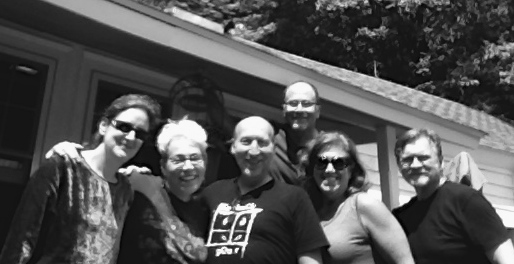
    When you are with old friends, you can watch dynamics play out that are decades old, or decades in the making, but you never find them wearing, or dull. They are simply there – familiar, comforting and renewing. I was renewed, quite recently, by a weekend away with old friends at a cozy, well-worn farmhouse in New England.


    Most remarkably, there was a member of our party, the hostess in fact, who didn’t go back as far as the rest of us, but it felt like she could have. Old friends will embrace as one of their own anyone who wants to be there with them.  Anyone who takes them all on because she loves one of them, and who is intuitive and observant enough to know what is reassuring, and worth preserving about their interactions.   And, of course, who is lovely herself.  Such a person is readily counted as one of the old gang.


    Razzing and laughter at dinner gave way to reminiscences into the night, and no one felt like they had to be a certain way, do a certain thing, or even show up. I myself got wasted on Benedryl due to my concern that the smells of the old house meant certain asthma, and went to bed hours before the others. But there was no opprobrium; just the gentle teasing that make you feel the love. A late breakfast, hair of the dog for some, the New York Times crossword, and once we were all refreshed, we splintered off into our different activities. Some chose walking, others biking, still others swimming or reading. We all managed to congregate on the grass outside the old farmhouse for a slow afternoon. No one felt bored, no one felt slothful. We were all just happy to be relaxed…and together. I can’t remember the last time the air felt so fresh, the view so beautiful (meadow, blue sky and distant trees) and time such a gorgeous slow motion swirl of sunshine, buzzing insects, moving clouds and an occasional smile or wordless message exchanged among the celebrants. All set to the magical soundtrack coming from a tiny speaker.


    The magic lasted through several meals, a movie, another morning crossword, even up to and past the time to separate. The feelings we shared – of peace, acceptance, good will, love – stayed with us. I had the very good fortune to ride back to my everyday life with the oldest of these old friends. We listened to music and took in the scenery together. I did not bury my head in a book, or lose myself in my own thoughts. I was there, with my friend, nodding and smiling, through all the great songs we bobbed to, all the gorgeous vistas, and the occasional comment offered by one of us. I wanted to be there for as long as I could.


    This oldest of friends and I had been sitting together on the grass the day before, during the magical afternoon where time slowed, and at one point we began reflecting on how old friends differ from regular friends. “It’s as if there is a drill that goes through all your layers, all the phases of your life that have accumulated, and old friends can see the different striations, all the different layers that make you… you,” I offered. “I get that, I get that, “ my friend said, nodding in his very beatnik way, the giant heart walking on two legs that he is. “And it’s the core that served as the magnet from the very beginning,” he then observed so brilliantly. Then he went off in a different direction, inspired perhaps by the almost impossibly large and very old pear tree right in front of us. “Maybe an old friend is like an old tree. The trunk is solid and can be counted on, and the many, many limbs aren’t strange, even if they go off in different directions, twisting this way and that. You just look at the trunk and see that they are all part of the one tree.”


    I liked that, thinking that each one of us is a tree, with many limbs, and together we are an orchard, where it is safe and lovely to lie and look up at the moving clouds, and float with the sweet perfume of memories, carried by the soft breeze of here and now.


    On the way back, we stopped for a piss. His piss, by the side of the road. After I told him that I didn’t want to see him pee, and that he had to be out of my sightline or have his back to me at the very least, he did what he needed and returned with a bouquet of Queen Anne’s Lace. He had pulled them from the side of the road after the deed was done (from a different spot, I’m presuming), and taken the longest stem of one and wrapped and knotted it around the others for a tie. He dropped them onto my lap with the barest of smirks. About fifty miles earlier, I had been sappily watching wave after wave of that wildflower pass by, and remarked to the air, “I love Queen Anne’s Lace. It reminds me of my childhood in the Bronx.” The air, it seems, was paying attention. He doesn’t go back all the way with me to the Bronx, this friend, but far back enough to be there, in my orchard. The sweetness of his gesture summoned up the full range of feelings shared among us all.


  • Melvin Beylis Died

    I heard from my mother that Melvin Beylis died.  I’m using fictitious names for privacy, so this man I remember with fondness is going to be named Melvin Beylis.    The last time I saw Melvin was close to 30 years ago, and, before that, was when I was a teenager. But my memories of him from that time, and indeed from my entire youth, are as vivid as the most intense memories can be. As vivid as memories are when they are of someone who epitomized a time and place for you. Melvin did that. He and his wife Myrna epitomized my life in the Bronx, in the 14 story building that seemed to my young eyes to tower above the shorter apartment buildings and townhouses lining Bronx Boulevard.

    Melvin always had a glint in his eye and a warm chuckling smile for me. His voice was barrelly and resonant, though he didn’t talk much. But when he did speak, his accent sounded vaguely exotic to me, a deep rumbling of a way of speaking that was so comforting and familiar, yet foreign in some way. I think his slightly darker skin tone and saucer sized brown eyes added to this notion that he was exotic. I couldn’t know then that what I was hearing was simply a mellifluous Bronx accent. A more sing song version of the hard pronunciations surrounding me on all sides, but flowing out of Melvin with their edges just ever so smoothed off, and sprinkled with his one of a kind giggle. His dark, caramel giggle.

    Melvin’s receding dark hair was slicked back with the natural hair oil most men allowed to accumulate back then, to the apparent approval, or at least with the toleration of their wives and girlfriends. He seemed big and tall, despite rounded, stooped shoulders, and enough extra weight and body hair to look a bit like a shuffling bear. Someone that you wanted to hug, especially when you saw that warm smile and heard that mirthful sound emanating through parted teeth. But my best friend, Laura, told me, by her face and body posture, that her father was not as warm as cuddly as he appeared. She seemed almost a little afraid of him, in a respectful way, the same way I felt about my own father. And so I didn’t hug him, or dissolve into unguarded affection, even though he seemed so inviting. And when I hung back, I could sense the affirmation from Melvin: yes, that’s the right distance.

    I could also sense but not articulate the ways Melvin was different from my father, Bernie, who had a jauntier and harder edge – who seemed more “hard-boiled” – or how Myrna was different from my mother Shirley. Myrna’s hair was a difficult to describe warm brass color, somewhat poufy if not bouffant, and highly sprayed – the kind of hairstyle that gave you no clue as to the wearer’s age, and which she could carry, and indeed did, for the rest of her life. Myrna spoke as someone with not a shred, not a hint, of any self-doubt. Someone who owns a space as soon as she walks into it. Someone whose voice modulates from sarcasm to authority to sly wit, but never falters or softens. She conveyed a confident, unassailable assessment of the facts at all times, never a gentle questioning or exploration. In contrast, my mother Shirley was less apt to offer a viewpoint or perspective, and only did so to be sociable. She spoke with the same accent, and with some measure of steadiness, but next to Myrna she seemed more understated.  Indeed, her two steps forward one step back way of making herself understood seemed practically genteel, and a bit at odds with Bernie’s gruff but good-natured swagger.

    It’s surprising to me to realize now that they all had the same Bronx accent. They all said “ar-right” instead of “all right” and “draww” instead of “drawer.” They all said, “prahhl-ly” instead of “probably” and “beeyoo-ti-fuhhl” instead of “beautiful.” But they all sounded so different from each other, anyway, merely from the added ingredient of their individual attitudes, their different handling of words and emphases. And perhaps because my own parents were too familiar to me, too much the norm, I never realized that they too spoke with the same dialect. The same rolling and pitching and dropping out letters and merging of syllables. The same accent I must have had, realize now I still have, when I’m spending long hours with my sisters and the conversation gets animated. If it weren’t for Melvin and Myrna, and the study of them that living across the hall allowed, if it weren’t for remembering their immutable and undeniable patterns and their warmth – for there was occasional warmth and mirth even in Myrna, behind the caustic surety – I might have never understood just how much I lost.

    We moved away when I was 7, and though I remained friends with Laura for many years (our parents making it as easy as they could for us to see each other regularly and for sustained periods), in my new surroundings I began a process of transformation, a washing out, that led me to the wider world, but at a price. In Rockland County, an increasingly settled area known as “upstate” but only 30 minutes from the Bronx, I mixed with kids who spoke differently. Their parents were from other parts of the city, or from New Jersey, or even farther afield, and they didn’t have the hard r’s I did or say “dawwg.” Many of their parents were professionals or college educated, not like my father the cop or my mother who went back to school to become a teacher only after we were all in school full time, and these adults spoke with a loftiness and expansiveness that seemed like a softer music to me. I wished I had understood then that it was blander.   It wasn’t as lively, or, indeed as alive as the way Melvin and Myrna spoke. And, without even realizing it, I softened my edges. In my little 7 year old brain, then 8, then 9, and so on, I mimicked and strained out the harsh sounds in my words before they slipped from my mouth.  I modified. I took two steps forward and one step back.

    By the time I was living and working in Boston, my exposure to people from all over the country, first at college and then at law school, had ensured that I spoke, if still recognizably from the mid-atlantic states, not at all the way I did when I left the Bronx. Not at all even the way I did when I first arrived at college and met a boy who wrote home about his new girlfriend’s New York accent. More muting, more conforming, more blending, more sophistication I thought, did me the service of rendering me unidentifiable as a Bronx native. In most conversations with my sisters, ones I have with them when others are around and I’m not completely unguarded, I speak differently from them. I even triumphantly noted a time or two in the past that I have come to lose much of the accent they still possess. The one disturbing blip occurred when I worked in a New York law firm my second summer in law school. I had some trouble figuring out the right poised and measured responses to give to partners when they asked me to take on more work, and this led to a coaching session with the partner looking out for the summer associates. He began his helpful, patiently condescending advice with the apparently sympathetic phrase “I, like you, came from a lower, middle class background.” This he apparently discerned from my inadvertent occasional slip back into harder more “Bronxonian” speech patterns while living in the city that summer, since I never discussed my heritage or socio-economic background with anyone at the firm. I remember my ears burning with outrage and humiliation, even as I dismissed him as a wannabe, a poseur.

    In my early adult life, I completely lost touch with Laura, and not just because I lived far away. I ensured the demise of that relationship, first having managed to make her feel increasingly bad whenever we got together by always pointing out all the ways in which our lives and styles had diverged, and then by becoming insufferably self-absorbed, as people who are actually insecure do. It is only now, thinking about Melvin’s large brown eyes and occasional baritone rumblings, and then Myrna’s brash and unflinching assertions, that I remember how I loved the patterns of my childhood. The charm of its familiarity and reliability.   At some point, just a few years ago, I came to understand that when I lost Laura’s friendship I lost something fine and rare, and that her giggling, no doubt a gift from her father, lit me up and made me smile, but it was too late. We had spent our entire adult lives apart, and there was no basis for friendship anymore. There was no longer any basis even 25 years ago, when I told her in an unwelcome phone call that I had heard she had stumbled on her way up the aisle at her wedding, a wedding I should have been at and indeed had been invited to. Far away as we were from each other even then, she could not have understood that I was not trying to point out her awkward moment with intent to diminish her, but was instead lamely trying to reach out, to tell her that I could well imagine her charming giggling at her misstep and the unspoiled and gorgeous and sweet, sweet joy of that moment I wished I could have seen, if only to remember all we shared as children. Even way back then, despite that vague awareness of what I had lost, and that fumbling attempt to reclaim it, I continued moving, if not entirely away from the cradle of the familiar, determinedly insensitive to it. This, I realize now, is a particular thread, a pattern, that repeats and repeats in my tapestry. A tapestry that consequently wasn’t as bold or as lively as I now wished it had been. As I now wish to weave it.

    I think of how Melvin and Myrna represented the Bronx to me, how over the years they and Laura grew more cordial and less warm toward me on those occasions when I did see them, and, in Myrna’s case, true to her tell-it-like-it-is nature, barely cordial. And I find myself so very relieved to discover that those hard r’s and stretched out diphthongs are not completely gone, if only I relax and become completely unselfconscious, and that instead of taking one step back after my two steps forward, I can look around, giggle, and simply wonder aloud good-naturedly if I’m out too far.