Category: Most Recent

The most recent blog post

  • Offerings

    Offerings

    My dad had a love affair with the Native American people. Not that he ever involved himself in native communities or causes, tried to learn more about their culture by direct, intensive study, or even decried the decimation of that people and culture by the white European American settlers and pioneers. He loved them because they were part of a tremendous, dashing and rousing adventure tale; and, being a romantic, my father loved all adventure tales. Screen Shot 2016-09-02 at 8.15.47 PMHe especially loved those adventures that played out in real life, and so he devoured factual history and fictionalized history about such dramatic events as the American Revolution, the expansion of the white settlers west, the Civil War, and of course the two World Wars. He wasn’t limited to American adventures, though they were his favorite kind. He also read about Napoleon and Ghengis Khan, Marco Polo and Erik the Red. In the context of the clash between Native American culture and the white Europeans, who would be the inevitable victors due to their advancement in science and engineering, he offered no platitudes, no assessments of blame, no regrets, only his deep admiration and nostalgia for the warriors and chieftains who, despite being wholly out of their depth in the contest, were indeed noble savages.

    I knew all this because my father was the person I observed most, absorbed most, feared most, wanted attention from most, and, in later years, discussed most in therapy. He would talk about Native Americans with respect and awe. He admired how they put everything on the line for the safety of their villages, how they acted in the name of honor, and were doomed precisely because they were not a devious people. When my sisters and I were very young, he’d put on a native headdress he had purchased while on a trip out to the Southwest with his buddy George in the years following WWII. He’d put the feathers on and hop and grunt the way he thought a brave or a chief might, and we girls would all squeal in delight, but also become just a little afraid of this transformation of our father into a wild man, in touch with the spirit world. He was part of the wild rumpus, and I could see the joy and serious concentration in his face. I could also see the pleasure my mother took in seeing her three girls so entertained and excited, but which I may at the time have mistaken for an endorsement of the authenticity of the proceedings taking place in our living room in the Bronx, far away in space and time from any actual native ceremonies.

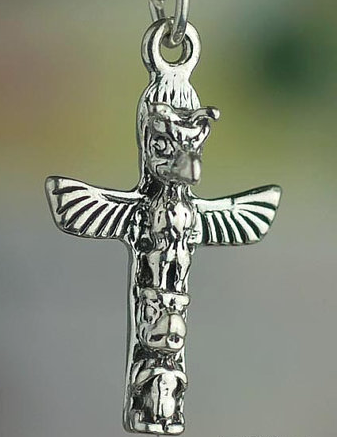
    When I was about 14, far from those days of the wild rumpus, my father came into my room, held out a keychain charm in his palm and said, “This is the second keychain this magazine outfit has sent me, and since I already have one, I thought you might want it.”Screen Shot 2016-09-02 at 8.12.06 PM

    I couldn’t believe it! My father was offering a bit of the noble adventure to me, and I was not going to let him down! I looked at this keychain, a figure of an eagle with spread wings atop other native symbols and totems, and while part of me thought,“Er, what the hell am I going to do with this?” the greater part of me understood, or rather hoped, that this meant he KNEW I could appreciate how special this native American keepsake, which had been manufactured in some factory in Oklahoma or maybe even China, really was. “Oh wow, Dad,” I said. “Thanks.” And I reverently took the keychain and put it on my desk. I had been anointed! I had been chosen! It mattered not that my eldest sister was out of the house in her first year of marriage, or that my next older sister was too caught up in her senior year of high school to be spending much time around the house when my father received this duplicate keychain, leaving me as the only viable recipient. In my young mind, he had chosen me as the one who would understand. And, not knowing, or ever knowing, what to do with it, I left it on my desk as proof that I could be trusted to carry the torch of idealism, romanticism and appreciation for the suffering and ultimate demise of that noble race.

    About two years later, my father was in my room for one reason or another when he saw the keychain on my desk. “Wait a minute,” he muttered, and I thought what was coming next was a glowing acknowledgment of my ability to understand why the keychain was so important. But what came next instead was “Why did you take this out of my drawer?”  When I explained, “No, Dad, you gave it to me, don’t you remember?” he came back with, “If you wanted to see it, you could have asked me. Why would you go into my drawer and take something that wasn’t yours?” I was hit by two utterly unrelated thoughts simultaneously, neither of which I could articulate very well, for my ability to communicate has always been compromised by the rush of emotions. One, my Dad apparently had no memory of having given me the keychain, of that moment in time when I thought we were bonding as elder and protégé, and two, he actually thought I would pry into his private space and go through his drawers. I didn’t know where to turn first, but my dad did the navigating for me. “How could you go into my drawer like that??” he demanded.

    I protested fervently. I said, “Dad, I wouldn’t go into your drawer. You gave it to me, don’t you remember?” You gave it to me!”

    “No, I wouldn’t have given it to you,” he said, apparently having lost all memory of the arrival of a duplicate that would enable him to do just that. “And I could understand if you wanted to see it, but you should have come to me and not just taken it from my drawer.” A few more protests back and forth, and I had become a crying sack on my bed. There were very unsettling things going on. My father had no functioning memory! Either that, or he did not attach the least little bit of significance to the moment, making it easily forgotten. He thought I was capable of sneaky, petty thievery! I wasn’t quite sure which upset me more, but I suppose the indictment of my character won out.

    As I lay there, a shuddering and weeping heap, he stormed off to his room with the keychain he had snatched from my desk, intending to put it in its rightful place. When he opened his drawer, I heard from the other room a faint, “Oh.” He saw his original lying there, unmoved.

    And what happened next was also very upsetting, although not unexpected. My father came to my door and gruffly, with just the barest bit of sheepishness, said, “I’m sorry. Do you hear me, I’m sorry, ok?” There would be no hugs, no scooping, no lamentations of remorse for having hurt me so. I lay on my bed gutted and bereft until after about 20 minutes, when I picked myself up and continued my life. Despite my anger and hurt, I did not return the keychain. I did not chuck it in the garbage. I suppose I hoped it would be cleansed with time and become once again a symbol of my father’s faith in me.

    Another two years later, I was visiting from college, and my father, having come into my room to tell me one thing or another spied the keychain. I kid you not, this is what happened: he said, “Wait a minute… this is mine. Why did you take it?” And the whole thing played out again in miserable inevitability. As a young adult, with greater understanding of the world generally and of my father more specifically, this time I took it in with as much horror as sorrow. My father did not remember having hurt me so, just two years ago. He did not remember discovering the original keychain safely in his drawer. He did not remember me laying on my bed, a quivering, sobbing girl. And, bonus, he still thought me capable of going into his drawers and taking something without asking. This time, my concern for his swiss cheese memory, and what it might mean about his health or ability to learn, won out, just barely, over my hurt feelings. There was no sobbing. Instead, I found my voice and said, “Dad, oh my god, don’t you remember we had this whole conversation before? Don’t you remember how you accused me of taking your keychain and upset me and then you found yours in your drawer and apologized?” And in the face of his continued repetition about how wrong it was for me to go into his drawer, I held fast and spoke like a college freshman. “Dad, you’re upsetting me, wrongfully accusing me, and I advise you to stop because otherwise you’re going to feel bad and foolish in a few minutes!” Despite the surety and relative calm in my voice there was no listening, no consideration of this alternative possibility, no heeding of my warning. My mother had caught on to what was happening this time, and called up the stairs, “Stanley! Listen to what your daughter is saying!”

    Screen Shot 2016-09-02 at 9.21.30 PM
    Omar Gordillo Soto

    But he was not taking in the information. He almost never took in the information.

    It was why he couldn’t know that I was not the sort to go snooping in his drawer or take his treasures. It was why he couldn’t know I had so achingly believed his gift was a special moment of initiation into the armchair adventure club. It was why he could not accept more than two seconds of a hug or engage in dialogue. It was why, when he eventually made his way once again to his drawer and found the keychain occupying its usual spot, he again did not express profound regret for having maligned me or having ignored my protestations.

    I understood like I had never understood before. My father was passionate, vibrant, a storyteller, a dreamer, heroic in his own unflagging commitment to move forward, to provide for his family in a dangerous job that wore him down little by little… and I adored him. But I’d never get in. I’d never have the relationship with him that I truly wanted.

    Twenty-four years later, on the day of the evening my father died, he lay still and silent on his bed, with closed eyes. I sat next to him. I caressed his face, able to do so for the first and last time in my life, and told him how much I loved him. Without knowing whether he could even hear me, I told him how I reenacted all his horseplay and recitations I so loved as a child with my own children, and would again with my grandchildren. I told him how he lived in me, in all of us. How I could always feel his love through the things he did for us, his constancy, and the way he beamed with pleasure and contentment for his family. How much he had always meant to me. I clasped his hand and kissed his forehead. Did I get in at that final moment? I will never know for sure, but it was my most undefended and truest offering nevertheless, for the man who had the biggest impact on my life, for good and bad, who offered me so much, and who I miss every single day.


    Screen Shot 2016-09-02 at 8.17.19 PM
    Joe Velazquez
  • You Like Me!

    You Like Me!

    People of a certain age may remember that moment in 1984 when Sally Field won an Oscar for her performance in Places in the Heart. In her acceptance speech she was overcome with emotion. Barely but beautifully managing to remain coherent, she expressed her profound happiness and amazement that despite not having had an “orthodox” career (after all, she was Gidget and The Flying Nun), and wanting so much to be respected as a serious actress, she was now being recognized as such. Or, as she more succinctly put it: “…I can’t deny the fact that you like me! Right now, you like me!!” Immediately there were jokes on late night comedy shows, teasing remarks in the media, sniggering banter among the general public, all indicting poor Sally for being so unabashedly preoccupied, apparently, with whether people liked and respected her acting. “How embarrassing! How neurotic! How nakedly needy!” went the chatter, and all nodded in agreement. It became something of a meme, pre-internet, and even resurfaced nine years later in The Mask, a bit altered but still clearly a grotesque homage to the original, when Jim Carrey’s Loki character suddenly receives an Oscar in the midst of his violent encounter with the bad guys. Carrey tearfully and vehemently grasps the statuette and sobs, “You love me! You really love me!”

    Even at the time of Sally Field’s speech, I remember feeling a bit peeved by all the ridicule, mainly because it was Sally Field for godssake and who doesn’t love her? So what if she gushed something that sounded a bit too self-revelatory when she accepted her Oscar? It was an unbridled moment of shock, joy and gratitude. Who can be poised under those circumstances? Oh wait, we can. At least, that’s the myth, the standard, the expectation we all accept as gospel. No matter what, don’t reveal uncertainty, insecurity, or a care of any kind for what people think of you or how you are coming across, for that is weakness. And what do we do when we see weakness?   Mock it, cluck our tongues, or thank god we haven’t displayed it ourselves. We align ourselves, so we imagine, with the strong, the confident, the unconcerned.

    Now, however, on the back end of my presumed 100 years of life, I realize keenly that the myth is its own form of weakness. To be so comfortable in your own skin that you are truly unconcerned with how you come across, so that you neither avoid nor pretend away displays of uncertainty, doubt, or even idiocy is the sign of real confidence. It is the deniers, the mockers who are the poseurs. Their derision highlights their fear of being caught in the act of not being self-assured. The people who actually know me best may understand that this is certainly what I’d like to believe, anyway, for they know or at least suspect that I’ve been preoccupied for a good chunk of my life with how I come across to others. Huzzah! I’m free from it now. Finally and irreversibly free from that concern, but oh, how it plagued me! And I daresay it plagues a lot of people who never admit their affliction or even fully understand that they have it.

    I knew I was preoccupied with the judgment of others from an early age; I kept my head down as much as possible. I was quiet with my peers, constantly scanning for whom it was I needed to avoid, or not antagonize, or win over if I were to evade being found out as the strange, uncool, uncertain creature that I was. My first taste of blissful freedom from this preoccupation came at age 12. It was then that I went to sleep away camp. It was a rough and bumpy first 3 weeks. What everyone chalked up to homesickness was actually misery and fear from being among peers who might brand me a loser. It was a misery I experienced all through 4th, 5th and 6th grades, culminating in that summer at camp. I spent a good deal of time in the bunk of my 15 year old sister, sitting on her bed during free periods, learning macramé from the other girls in her bunk, or asking her to let me brush her hair (and surprisingly she did!). I never was so worshipful and doting and meek toward that particular sister as I was that summer, desperately subduing anything remotely pesky lest she banish me and I be cast adrift in the sea of my own bunkmates, all of whom seemed more self-assured, more popular, and more cool than I. Then, at the end of the third week, something extraordinary happened. I overheard two cute, adorable girls, whom everyone respected and admired, conversing about how nice I was! What happened was this: I was using the bathroom in the bunk when this girl Pam thought it would be funny to spy on me from above the divider. I was so surprised and mortified to have my private appointment with the toilet thus invaded, that I literally fell off the seat and cried out, resulting in a rush of girls to the scene. To my amazement, they started berating Pam for being so gross, so mean, so invasive, instead of laughing at me. In a dazed sort of aftershock from the whole affair, I wandered outside to the porch and sat down on a bench. Across the way were the two bunk darlings, Arlene and Mindy. I sat down just in time to hear Arlene say, “I really like Elisa, she’s so nice,” and Mindy answer, “Yeah, I really like her too, she’s so sweet.” They then looked up and saw me sitting there, and we all started laughing in sheepish embarrassment. Except I wasn’t just embarrassed. I was amazed, over the moon, astonished, delighted, so profoundly happy and confused. Could it be? These girls whose imprimatur of acceptance I could have only dreamed about actually enjoyed my presence? It was a seminal moment in my life. I transformed into a happy camper, literally, and proudly mixed in with my bunkmates as one of them. Camp became a place where I was free from the warfare of the cliques and popularity and meanness I witnessed back at elementary school, and it became so dear to me that I cried when it was time to leave. As I had been crying to my sister and my mother for the first 3 weeks about how I wanted to go home, this was somewhat perplexing to them, but nevertheless a huge relief for my mother who no doubt had been fluctuating between guilt and exasperation.

    From that moment on the bunk porch, when I metaphorically clutched my own little award – I can’t deny, you like me! Right now, you LIKE me! – I developed greater ease, and a perspective on the wider world of social opportunity sufficiently broad enough to start looking for friends with whom I could connect. I stopped worrying about or trying to impress kids I really had nothing in common with and certainly didn’t genuinely respect. And in that effort I had wonderful success. I ended up having around me the most amazing authentic friends I could have hoped for. I was comfortable enough to be my goofy self. My more or less emotionally brave, honest, loyal, genuine, and caring self.

    Then college happened, and once again I was thrown into a sea of young, uprooted and somewhat unsure and often posturing youth. My radar went back into primal overdrive. My information was distorted of course. I believed that everyone had someone to go to dinner with, everyone felt connected, everyone was cool, and everyone had a troupe from his or her freshman hall to rove with. Everyone, that is, except me. It never occurred to me that many others, if not most, had the same concerns of appearing easeful and smooth. And while, over the course of the four years, I slowly, slowly recovered from that setback and convinced myself I wasn’t the complete buffoon I feared, I never quite made it all the way back to that state of grace I found in high school among my dear, dear friends and family. And then, in a still somewhat overly self-editing and internally awkward state of mind, I unfortunately launched into law school and after that a corporate law firm (GAK!), a magnet for aggressive competitors and desperately posing associates who only know about half of what they pretend to know. Even the law partners, who must convince everyone and themselves that that are authorities, because verdicts or millions are at stake, know what they are doing only about two thirds of the time. I know this now, especially after having been married to one for a couple of decades. Not only that, I now understand that this is true of just about everybody. People can only do the best they can, and sometime they are doping it through like everyone else. (Except for blockheads who insist on things they know nothing about instead of actually opening up their minds and taking in information. Those jackasses only know what they are doing about a quarter of the time, if that.)

    But back to my immersion in the larger adult world at the age of 25. In this toxic soup of competition, insecurity and posing, I floated. In a new city, far away from family and friends, I began the process of trying to swim, to find my authentic center all over again. Only this time, I didn’t make it anywhere near as far. Let’s just say I entered a prolonged period where I carried the fear of how I was coming across like a block of stone on my back. A fretful monitor in my brain carefully edited my choice of words in the nanoseconds before they came out of my mouth. It scrupulously screened my gestures and manners for anything remotely coarse, naïve, unworthy, insecure. I was consumed by insecurity over seeming insecure! I went over things that happened or that I said after the fact and shrank with mortification over how I could have been such a dolt. I met and married someone floating in that same toxic stew, and we moved to an affluent suburb of carefully practiced gentility, where we felt even more like poseurs. Where parents boasted about their genius children, and tried to appear nonchalant entering or living in huge country versions of mansions with extensive grounds.  Where it was so easy to believe that everyone but you always remains assured, elegant and graceful, self-possessed in their movements and tone of voice, even behind closed doors.

    What was it that freed me finally and irrevocably from all the dread and self-editing? Well, I do still edit myself somewhat, but these days my only filter is a desire to be kind. It took me until I was 52 to really, really understand that pretty much all of those overly self-assured people are full of shit, and that the truly, truly cool genuinely don’t care if they seem clueless, awkward, or temporarily needful. They are unembarrassed to seek approval or support. They know that everyone is unsure some of the time and it’s no big deal to admit it.   I can’t be sure what it was that suddenly led me to open my eyes. To see and even hear the uncertainty and false bravado in so many people around me. To thrust off the expectations or standards of acquaintances and even friends who themselves are worried about the whispers and opinions of others. Maybe it was my utter exhaustion.  Maybe it was the journey I went on to find out what it was I really cared about. Maybe it was watching my own children struggle with these same issues. I want them to know that the truly cool, ironically, are the very people who think nothing of proclaiming in moments of absolute joy and relief and gratitude, “You like me! And I’m so glad!!”

    The final irony here is that once I was completely free from the worry of whether I was poised and likeable, whether I blended, I started putting others at ease. I started cracking more jokes, and making more honest or personal remarks. I started expressing my uncertainty about something in the most forthright way, and to my astonishment people responded with relief! With gratitude that I expressed something they also felt but didn’t want to admit! With unsolicited compliments about how natural, genuine and comfortable in my own skin I was! In short, they gave me awards, and in my mind I happily accepted them. You like me! You really like me!  It was so freeing. So easy! I could be myself. And I wish I could tell her. I wish I could say, “Sally, you are my hero! You deserve an award! Not because you risked being so naked, but because you didn’t hesitate to consider it a risk at all.” If only I had understood way back then.