Category: Personal

  • Connection

    Connection

    scientificamerican.com

    My recent phone encounter with a Microsoft customer service representative from India has renewed my faith in humanity. Not that I’d lost all faith, but the constant, depressing revelations in the news these days chip away at it.  A dose of  connection between two people on different sides of the globe was a welcome infusion of hope.

    Getting customer service from someone in India was once a source of frustration and impatience, if not disgust for many Americans.  The language barrier was the biggest complaint, but there was a certain sense of outrage that the only customer service available for a product invented in America, and indeed purchased in America by the person needing help, would come from people overseas whose English was sometimes hard to understand, and you couldn’t be quite sure they understood you, either. It seems that improvements in the quality and number of excellent English speakers who do this work, and a wider acceptance of global solutions for a global world ameliorated the dread we Americans once experienced reaching out for technical support.  Certainly, as I dialed the customer support number, the thought didn’t even cross my mind that I’d be subjected to someone who would barely understand me. But I think globalized customer service offers more these days than just having my immediate software problem solved without an arduous verbal exchange.  My experience with a certain Indian Sikh gentleman a few days ago has led me to wonder whether getting phone support from someone in a different part of the world actually can promote greater communication generally among people of diverse cultures and beliefs.

    My particular encounter with “V” began with the usual (and hopefully well-disguised) baseline, anticipatory anxiety many customers feel when reaching out to a customer service representative. There is always that concern in the back of my mind that I’m doing a poor job of explaining what is amiss, or that I won’t get very good service.   V immediately said what I think all Microsoft software customer service agents in India seemed trained to say these days, that he would be very happy to help me with my problem. Only, for some reason, I believed him. That in itself was very reassuring.  But it was what he said and did after that, that brought me a sense of our shared humanity, and the potential for humor, kindness and willingness to engage with strangers that lingers still, days later.

    It began when I remarked in passing how at my age I was already at a disadvantage following all the changes and growth of our digital world. Apparently, the lightness of my tone, and my general, albeit tenuous grasp of what he was talking about had led him to believe I was a young person, and so he said, “Elisa, let me tell you, you do not sound 56!” Well!  Of course that led to an even more playful attitude on my part. Though subsequent conversation remained focused on the matter at hand, V and I had taken the first step toward actual genuine communication.  I did not tell him I was a Jewish New Yorker and he did not tell me he was a Sikh.  I deduced that from his last name, Singh.  That he was Indian was a given from his accent, if not his name. I imagined him sitting in his control room wearing his ritually wrapped turban around a bun of hair that had never been cut.

    This is probably not V.


    Neither is this. Though, how could I know?

    This man, of whom I knew nothing except his nationality and religion, and who was located in some room in India, with a headset and surrounded by who knows how many other phone representatives, remained on the line with me during an entire download process which, for reasons not worth explaining, ended up taking a couple of hours.  He told me that I could put my phone down, carry on with whatever I wanted to be doing, and he wouldn’t leave me.  And he didn’t.  At one point we lost the connection and he called me right back.  Good old V.

    In order to enable him to help me, I had given V permission to access control of my computer. This, by the way, is always a leap of faith.  Yes, take control of my computer! Help me! Once everything had downloaded, and he had confirmed all was in good working order, he did something so simple, so unnecessary, so corny, and yet so sweetly remarkable that if I hadn’t already had my guard down, this would have cinched it.  My Word software was open in connection with his assistance, and he playfully created a new document in which he typed “Elisa is a very nice person and is awesome!”  We were still on the phone, and he could hear my reaction to the words appearing on my screen, which was a giggle and expressions of appreciation for the sentiment. Not only was I smiling, but I knew he was too. I told him I would give him an excellent review for his assistance, and after a few more exchanges of gratitude and wishes for a great day, we said goodbye.

    V didn’t have to want to make me smile in order to earn his positive review.  He was courteous, knowledgeable and patient. He didn’t pass me off to someone else when it became obvious that the fix would take hours. He solved my problem.  But purely due to a positive human impulse, he goofed around with me. That simple gesture was so unexpected, so generous, so authentic, that it made me believe that our greater connectivity in this internet age will ultimately prevent us from killing each other.  Is this too great a leap to make from a moment of sweet silliness?

    If anyone is thinking of telling me that creating documents telling customers that they are awesome is a typical gimmick used by customer service reps for Microsoft, don’t do it!  I’d rather believe in the authenticity of the moment! Viva internationally outsourced customer service!



  • First Christmas

    First Christmas

    E. Marmer | Free to Navel Gaze

    This is not the story of the birth of Jesus, nor of a small child’s introduction to the wonders of Santa Claus.  No, this is the story of a New York Jewess of advanced middle age (me), finding herself for the first time at the very center of Christmas, or, at least, its production.  You may ask, how did this happen? It was the natural, yet, to the uninitiated newbie (again, me), wholly unanticipated consequence of my having gotten a job at the local garden center.

    I began my employment last May, when the profusion of geraniums and petunias could not possibly have prepared me for what was ahead. And while, even in that fragrant, humid season, one of my co-workers waxed rhapsodic about how all the tables of green plants and flowers would be replaced come late November by rows of Christmas trees, and how all the yard hands (of which I was one) would be warming their hands to an outdoor fire, as snow gently fell, and family after family happily drove away with a Christmas tree, leaving the yard hands’ pockets bulging with tips, I just couldn’t grasp it. I was too preoccupied trying to understand how my fantasy of arranging flowers, dreamily pruning perennials, and dispensing gardening advice had turned into the reality of dragging wet and muddy hose, pushing heavy carts of inventory, and struggling to remember the names of annuals I’d only first heard of while the customers looked at me like I was some sort of idiot.

    When the autumn season, with its mums, pumpkins, cornstalks and cabbages, drew to a close, I was sent home by the boss for a short hiatus.  He told me, “Rest up and get ready. You’re going to six days a week starting the day after Thanksgiving.”  Actually, he said it in his Australian accent, which made the oncoming season sound like a wild, survivalist bush adventure. That was my first clue that something pretty intense was bearing down on me. I began to get nervous.

    Dutifully, if with trepidation, I returned on the appointed day, to find the nursery had been utterly transformed.  The indoor store’s inventory of decorative reindeer, Saint Nicks, snowy owls, elves, sparkly ornaments, candles, poinsettias and pine cones, artificial trees, tree skirts, and tasteful hostess gifts were arrayed so densely and so tantalizingly, that it was as if the North Pole and Santa’s workshop had been transported to this one spot about 50 miles North of New York City. And, as I had been foretold, yet couldn’t truly visualize until now when I took it all in in real time, in place of all the racks that had once held row after row of green plants stood hundreds of fragrant trees, in formation like ready foot soldiers.  In front of these were plywood tables laden with every size fresh wreath imaginable, along with a bounty of mantle pieces, centerpieces, seasonal planters, swags, garlands, bunches of evergreens, roping and beautifully hand decorated wreaths such as I’d never before seen. For why would I, Jewish daughter, mother, matriarch-in-training, have ever browsed around garden centers for this occasion?

    E. Marmer | Free to Navel Gaze


    E. Marmer | Free to Navel Gaze


    My initial awe and delight at such an array were quickly tamped down by my understanding that not only was I to learn all about this inventory and sell it, but I was also responsible for keeping the inventory coming.  Thus, while the initial display of Christmas goods had been prepared in my absence, I, the Jewess, would now be creating replacement bunches of Magnolia leaves, Western Cedar, Frasier fir and Juniper, decorating fresh wreaths, setting up, modifying and replenishing the displays in a beautiful and tantalizing manner as things sold, and creating the occasional seasonal planter or centerpiece. I did all those things, even while I counseled the Christian or secular buying public on the differences in needle retention and ornament support among Frasier, Concolor, Douglas, Noble and Mediterranean Silver firs. I even created our signature display for the driving public, a Christmas explosion for the entrance to our grounds.

    Here it is!

    E. Marmer | Free to Navel Gaze

    Most remarkably of all, I went into people’s homes and strung up their trees with lights. This activity made me understand something – decorating Christmas trees is exhausting, and rife with tension.  If I hadn’t already deduced, from observing over and over families or couples trying to reach agreement over trees, wreaths and other decorative items, how thin was the boundary between happy-making, comforting ritual and disgusted, resentful acrimony, the lighting of the trees brought this home.  Here was I, a supposedly dispassionate professional, and the sighing that came forth out of my mouth as I twisted lights around uncooperative branches and desperately tried to keep the wires untangled was something to behold.  My coworker-mentor gently chided me: how could I have spaced the lights so well on one part of the tree, and put too many on this other section? Fortunately, I had no emotional history with him, so I had not the least desire to smash his face in. I could only guess how many conflicts would arise between loving partners when it came to hanging the ornaments! Yet, I persevered, and did my fair share of lighting two towering trees, a thirteen-footer and a nine-footer, to the immense satisfaction of their purchasers.

    E. Marmer | Free to Navel Gaze

    Fifty percent of these 1200 lights are mine, baby! (We were requested to make sure the tree was densely lit, and we obliged!)

    Perhaps the stress factor is algorithmically related to the height and girth of the tree.  Certainly, the time factor is…it took four hours for two people to light that thirteen-foot tree!  If you’re going over six feet, do yourself a favor and spare your relationships.  Call in the professionals!

    In addition to learning that garden centers are really at the center of the Christmas spectacle, I learned a few other things as well. One is that it really can be sweet to witness a family buy a Christmas tree together (except when one of the kids is out of sorts and whining about how he or she never gets input into the selection, or when one of the adults is a cranky, never-can-be-pleased pain in the ass).  A young child’s glee while running about the trees, and his or her barely contained excitement when the very best tree has been selected are truly contagious.  And it is both an honor and charming fun to be allowed in as a discreet helper-observer, by the couple who have figured out over the years which one of them needs to be the head Christmas tree selector, and to watch the appointed one (self-appointed, usually) stride around with the measurement pole while the other secretly rolls eyes at me.

    Another thing I learned is that there is no end to the creativity of those manufacturing Christmas goods.  No matter how lovely or unique a decorative item is, there is always a new one waiting to be fashioned and presented.  It is, quite simply, very easy to spend money at Christmas. The same people who wanted discounts for sixty dollars worth of perennials in July plopped down hundreds for Christmas goods in December without a moment’s hesitation. I also learned that the logical end to becoming infatuated with tiny Christmas miniatures is a whole village of the damned things, which of course has to be dismantled and stored every year.  I saw such a display in a home I visited on my one of tree lighting missions. That is why I stopped at the gumdrop factory (with moving gumdrop conveyor belt!) and pond with gliding swans (propelled into figure eights by magnets under the pond; how irresistable!), though I really regretted missing out on the opportunity to buy the ski mountain complete with moving skiers.

    E. Marmer | Free to Navel Gaze

    And finally, I learned that keeping a Christmas tree requires checking the water in the stand on a daily basis, unless you want the thing to dry up and look awful, or worse, create a fire hazard.  What – A – Pain! I finally figured out that with a PVC pipe and funnel, one could keep the tree watered without the tedious work of removing the tree skirt and braving all the scraping branches and needles at the tree’s base. I learned this of course because I succumbed to the persuasion of one of my coworkers, a plant lover like me. “Get a tree!  Look at that cute tree! No one will buy that little fat tree!” What a sucker I was!

    E. Marmer | Free to Navel Gaze

    Here it is in the corner of my family room, having required the rearrangement of all the furniture.

    Tree acquisition, decorating and care is right up there with changing the dishes for Passover, fasting for Yom Kippur or peeling, grating and frying up five bags of potatoes for Chanukah latkes without anybody helping you.  I guess we all have our burdensome traditions that, over the years, give us the markers of time, and, thankfully, scores of sweet, or even bittersweet family memories to fill it.  All I know is, having been at the eye of the Christmas hurricane I shall never be the same.  And thank goodness for that!  Something about the joy and irrationality of the Christmas pageantry is a wonderful affirmation of humanity’s wacky elements, and I’m so glad I was there to see it.

    Merry Christmas!

  • Wide Open

    Wide Open

    instagram.com@medicaltalks

    Recently, someone I know suggested that my last blog entry, “Message in a Bottle” was “oversharing.”  He went on further to ask whether I wrote it to be stroked and praised as a person of great understanding. He stated his concern that it might indicate a form of vanity. This very same person had often expressed to me his wish that I could open up more readily to people other than the handful in my very closest circle and be utterly myself (outspoken, natural and unguarded).


    I dismissed all validity to his remarks about vanity – I know the personal essay is an established art form, and that for centuries our civilization has been reading the personal thoughts, yearnings and epiphanies of writers –  but they stung nevertheless. They stung because 1) I respect his opinion and care about his approval; and 2) I’m by nature inclined to question myself constantly (which is why I haven’t historically been fully at ease or fully myself, although I’ve been making great strides of late).  Did I engage in vanity?  I had to ask myself.  And, because I’m still working to convince myself that my personality actually is a pretty good one, and that most of my actions and instincts are guided by purer motives, surely not one of the seven deadly sins, I had to think long and hard about it.

    Starting with my very first blog post, every single time I hit “Publish” I have worried, “Is this too far?  Is this too personal?  Is this too exposed and does this reveal what a weirdo or overly sensitive person I am?”  And after a minute or two, I calm my worry by remembering that this was why I began writing my blog in the first place.  The real, real reason, beneath wanting to write, and wanting to find out if I could write well, I now understand was that I was giving myself my own sort of therapy for becoming emotionally brave and comfortable in my own skin.  A total emersion therapy, like jumping into and swimming across the cold, old quarry lake.

    https://www.flickr.com/photos/toshofosho/7416482810

    One day, and I will never stop being grateful for that day, I found myself writing an essay, addressed to no one in particular, and, if that weren’t surprising enough, actually creating a blog to publish it.  Who was this person going boldly where she had never gone before? I suspected I had things to say that would connect with people, and I gave a swift kick in the ass to that inner editor, who has lived in my head for most of my life, always telling me I best keep my mouth shut, that I was awkward, an irritant, someone who had to learn to blend and had nothing worthy to contribute.  I will never forget the rush of fear, and the exhilaration when I overcame it and let my first work fly out.  I will never forget it, for I experience it anew each and every time. Is this worthy? I ask, filled simultaneously with dread that it isn’t and astonishment that I sent it out anyway.

    After doing this strange exercise several times I learned a few things, which you think would have enabled me to nix the dread, but no, I haven’t learned that particular lesson yet. I learned, though, that most people react well to my being so open.  That they value my honesty, my proof that they are not alone in having similar feelings.  They value the opportunity to think about something they hadn’t considered before, and a different perspective. And there developed a secondary reason for my blog, which has far overtaken the initial one. I write as an offering. I offer my experience, my growth and my mistakes for examination.  I offer myself.

    https://i.pinimg.com/originals/36/38/ad/3638aded791c87aa39a126d520ba2348.jpg


    And every great artist, thinker, creator has done the same to one extent or another.  Believe me, I humbly know I haven’t a fraction of their talents, but by golly I have their bravery, if not their unquestioning nerve.  I tell myself, “this is worthy,” and I put it out there, quivering in my nakedness, praying that it is.  Do I congratulate myself for that?  You’re damned right I do.


  • Message in a Bottle

    Message in a Bottle

    Emma Hanquist, Artisit

    My daughter carries a heavy load of emotional scars. They come in part, of course, from all the regular wounds that all sensitive people endure, whether inflicted by others, or by one’s own hand, or received upon the usual stumbles and falls that plague all such sensitive souls during childhood, adolescence and early adulthood.   But in addition, some of my daughter’s scars come from uniquely devastating experiences. And some of them come from her unfortunate luck of being born with overactive or underactive brain chemicals, giving her a distorting fun house mirror to work with, and making navigation through the ordinary pitfalls of life and complications of connecting with others all the more treacherous.

    From “Wink Space” by Masakazu Shirane and Saya Miyazaki

    My dear beautiful daughter has been working for her entire life to shatter that mirror, or at least to recognize its distortions and learn to navigate despite them.

    I know that many of her scars came from wounds I inflicted as well, unintentional as they were. Time has given me sight: I can see where I said and did the wrong thing, got drawn into an unhealthy pattern, came up short, missed the mark and even communicated judgment and disapproval. I could take refuge behind that well worn excuse, true as it may be, that all mothers are destined to screw up to varying degrees (because despite the most ardent wishes of their children and themselves, they are indeed flawed, bumbling human creatures like everyone else), but I won’t. I regret all the wounds I inflicted on my daughter. I wish I could take them all back. I can’t, obviously, but I can do one thing at least. I can let her know that never once, in all our years together, regardless of whatever sparring, frustrations, heartaches, mistreatment and misunderstandings we encountered or caused relating to each other, regardless of whatever sorrow I conveyed to her about her struggles and my inability or, in some cases, incompetence to make them go away, that never once was it a sorrow that she was, is, my daughter. From the moment I fell in love with her, looking down at her in my arms, I have rejoiced in being the one lucky enough to get her and have never stopped. When I fretted over how she was handling or not handling a situation, or felt the sting from one of our unhappy exchanges, I was also, always, exalting in how goddamned unique, and irreplaceable she is, how spirited and emotionally complex, how tender-hearted, how brilliantly glowing, how much a gift I didn’t deserve, for who could deserve such a prize as my Sophie. Through it all, and even now at 23, she remains as adored, as treasured, as zealously and jealously held, as much a wonder and a miracle as she was in my arms all those years ago. I wish she could feel exactly what is in my heart, my darling daughter.

    E. Marmer | Free to Navel Gaze

    If she could she’d know what I felt when she fit like a small football against my chest, for that feeling has never left.

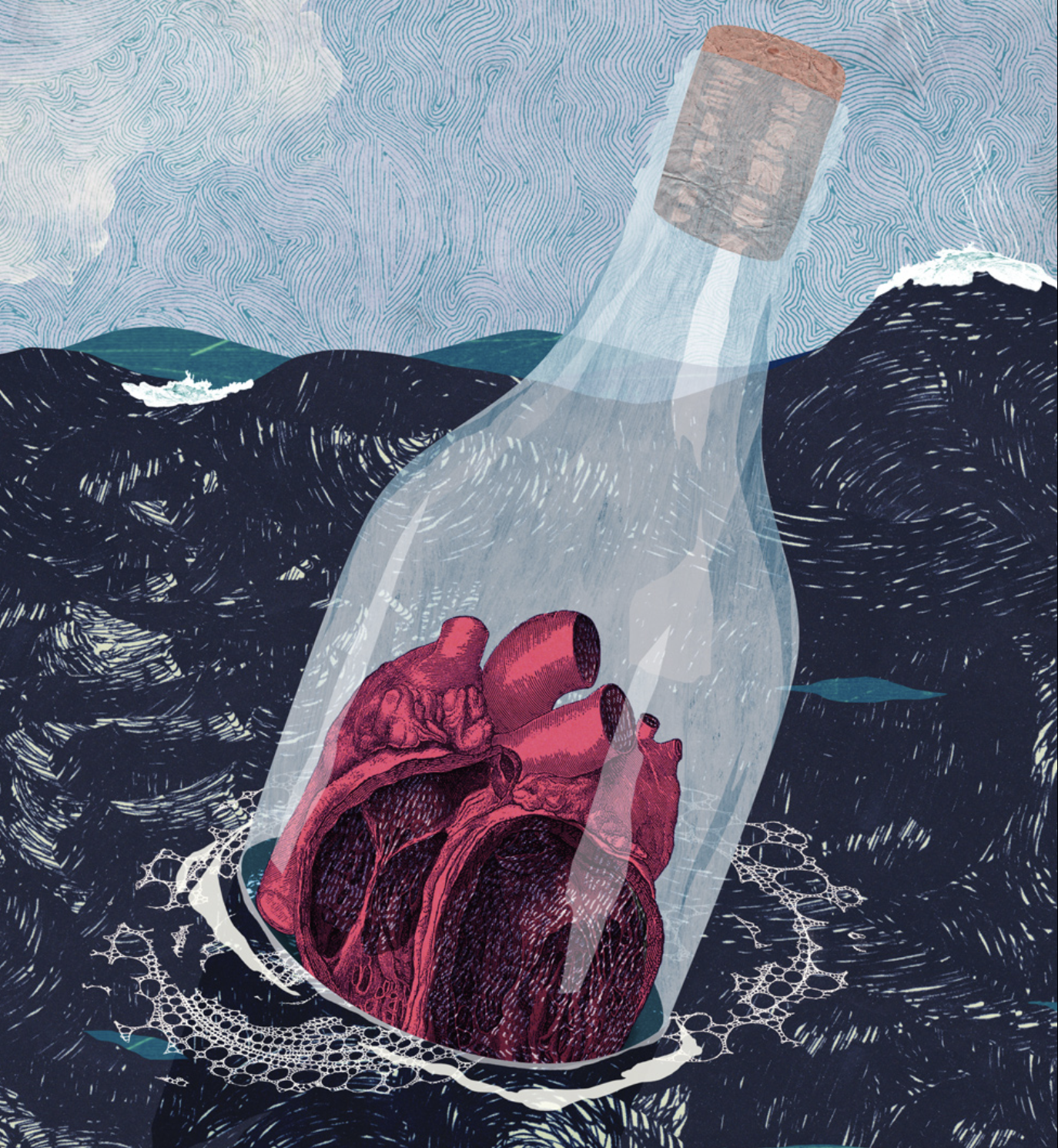
    I don’t expect that my saying all this will magically make some small portion of her scars disappear, though of course I pray every day for her happiness, and it’s no secret from either of us that I wish I did indeed have the bottle of magic balm, the potion to drip into her scars and free her heart from the past, even the many parts of her past that do not relate to me. (I carry that irrational wish despite how she well she has been making some of her scars disappear on her own, with no help from me – she has been achieving so much self-healing, that strong and capable woman.) But if it does anything, I hope this message in a bottle, poor substitute for any magic balm in a bottle though it may be, makes her feel, know, believe, accept that she has made my life meaningful in ways I could never have dreamed of, and that knowing her and being her mother has been one of the greatest joys I have been blessed to receive.

  • Old Friends

    Old Friends

    I am so lucky as to have old friends. Old friends go all the way back to before you carried the weight of your world, or at least to before you carried all of it. They’ve stayed in your life despite all the shit you’ve done and they’ve done, good and bad, which could have carried them away from you, but didn’t, or not permanently, anyway. Somehow, they remain. They know, if not everything about you, enough to see your greatest strengths and your regrettable weaknesses, yet still love you to death.. They take your entirety. They look forward to opportunities to see you – it’s never a chore. You know without even thinking about it, by the sheer number of years they’ve been around, that they’re not going anywhere, and so you can exhale a big sigh of relief and be truly yourself.


    When you are with old friends, you can watch dynamics play out that are decades old, or decades in the making, but you never find them wearing, or dull. They are simply there – familiar, comforting and renewing. I was renewed, quite recently, by a weekend away with old friends at a cozy, well-worn farmhouse in New England.


    Most remarkably, there was a member of our party, the hostess in fact, who didn’t go back as far as the rest of us, but it felt like she could have. Old friends will embrace as one of their own anyone who wants to be there with them.  Anyone who takes them all on because she loves one of them, and who is intuitive and observant enough to know what is reassuring, and worth preserving about their interactions.   And, of course, who is lovely herself.  Such a person is readily counted as one of the old gang.


    Razzing and laughter at dinner gave way to reminiscences into the night, and no one felt like they had to be a certain way, do a certain thing, or even show up. I myself got wasted on Benedryl due to my concern that the smells of the old house meant certain asthma, and went to bed hours before the others. But there was no opprobrium; just the gentle teasing that make you feel the love. A late breakfast, hair of the dog for some, the New York Times crossword, and once we were all refreshed, we splintered off into our different activities. Some chose walking, others biking, still others swimming or reading. We all managed to congregate on the grass outside the old farmhouse for a slow afternoon. No one felt bored, no one felt slothful. We were all just happy to be relaxed…and together. I can’t remember the last time the air felt so fresh, the view so beautiful (meadow, blue sky and distant trees) and time such a gorgeous slow motion swirl of sunshine, buzzing insects, moving clouds and an occasional smile or wordless message exchanged among the celebrants. All set to the magical soundtrack coming from a tiny speaker.


    The magic lasted through several meals, a movie, another morning crossword, even up to and past the time to separate. The feelings we shared – of peace, acceptance, good will, love – stayed with us. I had the very good fortune to ride back to my everyday life with the oldest of these old friends. We listened to music and took in the scenery together. I did not bury my head in a book, or lose myself in my own thoughts. I was there, with my friend, nodding and smiling, through all the great songs we bobbed to, all the gorgeous vistas, and the occasional comment offered by one of us. I wanted to be there for as long as I could.


    This oldest of friends and I had been sitting together on the grass the day before, during the magical afternoon where time slowed, and at one point we began reflecting on how old friends differ from regular friends. “It’s as if there is a drill that goes through all your layers, all the phases of your life that have accumulated, and old friends can see the different striations, all the different layers that make you… you,” I offered. “I get that, I get that, “ my friend said, nodding in his very beatnik way, the giant heart walking on two legs that he is. “And it’s the core that served as the magnet from the very beginning,” he then observed so brilliantly. Then he went off in a different direction, inspired perhaps by the almost impossibly large and very old pear tree right in front of us. “Maybe an old friend is like an old tree. The trunk is solid and can be counted on, and the many, many limbs aren’t strange, even if they go off in different directions, twisting this way and that. You just look at the trunk and see that they are all part of the one tree.”


    I liked that, thinking that each one of us is a tree, with many limbs, and together we are an orchard, where it is safe and lovely to lie and look up at the moving clouds, and float with the sweet perfume of memories, carried by the soft breeze of here and now.


    On the way back, we stopped for a piss. His piss, by the side of the road. After I told him that I didn’t want to see him pee, and that he had to be out of my sightline or have his back to me at the very least, he did what he needed and returned with a bouquet of Queen Anne’s Lace. He had pulled them from the side of the road after the deed was done (from a different spot, I’m presuming), and taken the longest stem of one and wrapped and knotted it around the others for a tie. He dropped them onto my lap with the barest of smirks. About fifty miles earlier, I had been sappily watching wave after wave of that wildflower pass by, and remarked to the air, “I love Queen Anne’s Lace. It reminds me of my childhood in the Bronx.” The air, it seems, was paying attention. He doesn’t go back all the way with me to the Bronx, this friend, but far back enough to be there, in my orchard. The sweetness of his gesture summoned up the full range of feelings shared among us all.


  • Memento

    Memento


    Forgive me, you must, for not remembering whether it was a ’60 or a ’61. The reason you must forgive me is that I loved that car. Not the first one, which was a year older…or was it younger? I really have no memory left for facts like that. But what a memory for the feel of it! That second one you got! It took us on such lovely outings, some close by and some up in New Hampshire and Vermont. The outings were lovely simply because they occurred. We were young and light as a feather, and so every ride and every eventual mishap added to a general feeling of wellbeing. Like when you lost your key and had to hotwire the ignition every time we started off on the next leg of our journey. That wasn’t the least bit irritating. It made the car, and our time in it even better. It made you better. My boyfriend knows how to hotwire a car.


    Once while at some local park, we celebrated a past from the early 60’s that wasn’t ours, but might have belonged to Valiant’s original passengers. So I posed against her like Marilyn Monroe might, or, more accurately like the unspoiled Norma Jean Baker. “Cheesecake” you called it. We laughed at the notion of staging a moment from the past, not realizing we were creating our own.


    We were young in a car, not just any car, but that one. My boyfriend drives a car like this one. It looked like a rocket ship, a vehicle that would take us to places we could only dream of. It was my Chitty Chitty Bang Bang too, you know, not just yours. It had a push-button transmission, and I reveled in those pert, waiting buttons, D for Drive, R for Reverse, P for Park. Buttons like on an accordion. Buttons that cried out to be pressed. Though you never let me press them. Maybe once, while you jealously guarded.


    If only you knew how much I loved it, really loved it, you couldn’t think it such a sin that I don’t remember its model year or the exact nature of its upholstery. I loved that car almost like it was my own, despite not having paid for it or having had anything to do with its maintenance. It was a part of me because it was a part of my happiness of being with you. And it was familiar. Part of my earliest non-verbal memories of sleek or bulbous cars, driven by smartly dressed men who wore pinkie rings and whose girlfriends theoretically offered cheesecake. But it wasn’t too sharp, this Valiant, Not like aggressive stylings of my rich and competitive aunt and uncle, anyway. No, despite its not having a glass dome, this was a car George Jetson might take to work, or someone else just as rumpled and sympathetic from our once sweet and naïve imaginings of how the future might be for the well-intentioned, earnest young man or the family provider. Its rocket ship essence, and its golly gee! interior, transported me in space and time to the comfort of my toddlerhood. The décor of one’s early childhood can indeed comfort and cradle, if those were safe times, and mine were; and, in my childhood, things had celebrated, exaggerated lines and curves, all while appearing clean and uncluttered. They frequently featured flecking, too– that ubiquitous design element in the form of speckles, tweedy nubs, shimmery sparkles or houndstooth that was on everything from floor tile to clothing. There was also a lot of piping at that time. Piping as in trim, not as in plumbing. Valiant’s interior had both flecking and piping, I think. If it didn’t, it sure felt like it did.


    But it wasn’t just familiarity, happy adventures, and being with you that made me love it. You and I happened to have a great agreement of taste about that car, though I never told you. I could and did gaze at that car admiringly, when you weren’t looking, feeling a thrill at its sublime shape, a thrill unlike any reaction I’ve felt toward any other car. So my joy over your having it was also a joy that we could both alight on the same plane, on the same exquisite point in fact. My boyfriend owns a car like this one was less bragging than reverie: My boyfriend and I connect at this intersection of time, style, feel, and function.


    I never told you how much I loved it, because I knew you wouldn’t believe me. I knew I’d never be able to convince you I could love it that much. Enough to want it for my own. Your doubt would have been routed in your conviction in the singularity of your experience. Yet, so dazzled, so happy was I, every time I saw Valiant, that I never had the presence of mind to wonder how it was you could afford it, what earnings you must have had to scrimp together from summer jobs to add to your new teacher’s salary. It is only now, some 30 years later that I know from things you’ve said that you went looking for that car. You knew it from your own childhood, your aunt and uncle having owned one I think, and you wanted to relive the sublime feelings it engendered, over and over again, this time as fully your own. Having it meant so much to you that you gave up the first perfectly wonderful one to get it. You traded up to what you really wanted. You had to get it just right. And boy, did you.


    Yes, Valiant was my Chitty Chitty Bang Bang. I doubt that anyone else in your life loved that car the way I did. That’s why I’m so glad, so glad, that you gave me its key. I put it on a chain and hung it from a nail I hammered into the wall. I know all that you wanted to tell me with that key, and all that you unintentionally told me as well. It’s a marker of where I stand. The nail marks my spot as surely as pencil marks the relative heights of growing children. Yes, my love, you say, I surrender even Valiant to you. And my heart strains against its bars before remembering that here we both stay, Valiant and I, in lovely memories, given up as no longer practical, requiring too much maintenance or capital. I stare at the empty wall above the nail and imagine all the pencil marks that continue above us.

  • Declarations

    Declarations

    “Mom,” my sixteen-year-old daughter asked me one day, “did you know there’s a scale for sexual orientation, zero for exclusively heterosexual and six for exclusively homosexual?” A few seconds later she added, “I’m a three.”

    This was not news to me. She’d struggled quite openly for the past two years to understand her sexuality. The surprise twist was my declaration. “I’d say I’m a two-point-five.”

    “What? Shut up!” was her stunned reaction. I could see delight in her eyes even as her brain worked to catch up. It was the kind of delight one feels when admitted into the inner sanctum. The questions came flying: “Does Dad know? When did you know? Have you been with a woman?”

    I explained that I’d had numerous “signs” of my bisexuality since college, when I reacted viscerally to a beautiful female classmate. I’d attempted to strike up a conversation with her, hoping for something I couldn’t identify, let alone articulate. And yet, I told my daughter, despite occasionally finding myself intensely attracted to a woman, I wasn’t ready to understand my bisexuality until I watched her coming to terms with hers. But even then, knowing the truth about myself, I waited until she seemed firmly settled in her identity. This wasn’t just to give her the space she needed—I was still having trouble coming out myself.

    For 22 years I’d been married to a man and had never been with a woman. Some friends said I had no reason to come out, while others said I couldn’t know for sure I was bisexual until confirming it. They were wrong. I had to come out to be freed from the exhausting task of convincing myself I was straight. To feel the relief of understanding it was okay. And I did not need to touch a woman to recognize the surge of lust, just as a heterosexual man or woman doesn’t need to cheat to know he or she really wants sex with someone who isn’t a partner.

    The trust my daughter showed in me, in baring her most personal struggles and fears, was what led me ultimately to be brave. For how could I repay such trust with secrecy, whether to her or to myself?

    A few years later it was my daughter who gave me the key to yet another door. We were folding laundry, the sort of peaceful activity that promotes intimacy, when she said, “I don’t know, sometimes I just feel like there’s this guy in me.” This hit me like a rock. A guy in me. A guy in me. The reverberations spread out over years, both forward and back. Days afterward, I was driving her to the train station when I said, “I so love that you feel you have a guy in you. It makes me feel like I’m not alone.”

    “Well, I didn’t mean really,” she said, scrolling through her smartphone. “I meant that when I’m attracted to a female, I’m a much more aggressive pursuer than when I’m attracted to a male.”

    “Oh,” I said. I was crestfallen and confused.

    “Wait a minute.” She shifted in her seat to look at me directly. “What are you saying? Ma, are you gender fluid?”

    Gender fluid. The words hung for a long moment. I’d never heard that term before, and the tumblers of a lock were suddenly clicking into place. Here was a Rosetta Stone, to make sense of an awareness that had always been without language, had always made me feel outside the norm, a poseur. And it was this: I was living as a female, with the body of a female and the socially established trappings of a female, but was not nor had ever been exclusively female. Now I knew what to call it. Now it was named, acknowledged. Now I could declare my entirety, to my daughter and to myself.

    E. Marmer | Free to Navel Gaze
  • My Twisted Brigadoon

    My Twisted Brigadoon

    Is a dream that recurs worth repeating?

    In my dreams I bike or drive all over New York City. Through the Bronx, where I spent the first 7 years of my life, and around Manhattan, where I lived for a time and know the best of all the boroughs. Sometimes my rides take me to familiar sections and sights, but they are fictional places I supposedly visited in a fictional past. Tscreen-shot-2016-11-27-at-9-26-14-pmhose places always stir up a strong, lovely sense of happy memories.  It matters not that the particular memories associated with that particular place never happened or that the place itself does not exist.  My subconscious always feels it as a confirmation of the sweet fondness I have for my early childhood and the love I felt from my parents, grandparents and siblings, despite the occasional hurt  I carried far longer than necessary.

    But there are also the dreams of places in New York that exist in my fictional present.  These places don’t raise sweet nostalgia, but some other conglomeration of feelings that are hard to describe. There’s the huge, wild nature preserve at the extreme north of Manhattan, heavily fenced off from human entry, and containing lions, monkeys and lesser apes, bears, and a variety of prey animals.  Usually, I just see it as I drive up the West Side Highway, acres and acres of meadows and woods, feeling the thrill of contained danger and gratitude to city officials for their caring and foresight in establishing such a sanctuary. screen-shot-2016-11-27-at-9-31-26-pm Once or twice, I unfortunately found myself in the preserve, having somehow made my way beyond all the signs at the edge of a public park, also fictional, that warn “DO NOT ENTER. WILD CARNIVOROUS ANIMALS.” I always survive and get out in some way, but not without first having to hide, run, use my wits and get scuffed up in the process.

    There’s also the section beyond Battery Park that becomes a sort of Fire Island paradise, where residents in large homes on large plots with gorgeous water and marsh views off sandy drives are the lucky descendants of people who acquired the land some time, long ago, and who, by consequence of having the wits not to sell, are sitting on the most expensive and the most exclusive section of New York City there is.

    But the part of New York in my dreams which disturbs me is the one my unconscious brain named Charles Town.  I’ve only stumbled on it twice, when the entryway to it somehow magically presented itself to me during bike rides in lower Manhattan.

    The first time I saw it, beckoning as a left turn onto a broad avenue,  complete with trestlework bridge over a narrowed section of the East River, I did not take the invitation. But I understood what I was seeing, saying to myself “Ah! That must be way to the legendary Charles Town I somehow know about!”   I’m sure the trestlework bridge I knew from my years living in Boston, which sat right next to the building where I worked and which beckoned to that actual Charlestown, site of the Bunker Hill Monument, (which also beckoned), was responsible both for the name of this New York Bridgadoon and the appearance of the bridge as well. And there, the parallel ends.

    That first time, what did I know about New York’s legendary Charles Town?  Well, I knew that its entryway was not always available. I knew that it was a supposedly a special, magical place, rumored to be architecturally rich and studded with old trees, filled with a certain variety of New Yorkers who wished to remain secluded and yet needed the occasional link to the Greater New York City for goods, city revenue and geographical, if not, geopolitical annexation.  Its mystery both attracted and repelled me, and I did not make the left.  Instead, I woke up.

    Recently, I found myself at the entryway once again. This time, I knew I had to find out what lay on the other side.  And so I followed the broad avenue over the trestlework bridge, fighting for my small space among the cars and buses that were also crossing over.  Once across, I saw that the few blocks closest to the bridge shared that extreme urban composition and feel one experiences in the biggest cities, but almost immediately that hubbub all fell away to the quieter, neater and quainter atmosphere of a smaller city.  One with many old Colonial and Victorian houses mixed in among 3 or 4 story brick or stone apartment buildings, and with only very few moving cars. Apparently, Charles Town was small enough for walking. There were no bike lanes, either, and my movement through the streets drew attention.  One after another of the area’s inhabitants looked up from what they were doing or broke off their conversation to look at the unusual sight of a bicyclist weaving through their streets.  Despite how enthralled I was by the beauty of the buildings, the abundance of trees, the sprinkling of charming and useful shops that sold yarn, baked goods, ice cream, apparel and books, I did notice the small stir I was creating. Didn’t people ride touring bikes here?  Was it my lack of a helmet?

    The next thing I noticed was that everyone was white. I was white too, but not dressed or groomed as they were. Everyone was wearing country club style clothing: pressed cotton skirts or slacks, collared shirts, v-necked sweaters. On the few occasions when I stopped to ask someone to recommend a lovely street to ride down, or ask about the age of a certain structure, I was met with polite but careful friendliness, and I saw that the speaker’s eyes swept over my oversized and scruffy leather jacket, my bleached blonde pixie hair cut with dark roots poking playfully through, the small diamond stud on my nose.  I became self-concious of my accent, a Bronx-Manhattan hybrid, which sounded nothing like the light lyrical tones coming out of their mouths.  I also understood that a dawning realization had begun to show in my face. What started out as my natural, curious wonder, which could at least be tolerated by the locals, was morphing into a quiet horror that I had entered a world suspended in time, or someone’s imagination, screen-shot-2016-11-27-at-1-56-33-pmand I understood just under conscious thought that my judgment would not be countenanced. I determined to avoid talking to anyone, and simply rode around taking it all in.  Churches, a college, beautiful parks, long tree-lined avenues of house after house with porches and small lawns, all here, part of New York City! And yet, apart. Where was all the color, the differences, the pulse, the cacophony, the life blood?

    As the sky became dusky it occurred to me that I wanted to, needed to get back to that New York that was mine. But I was completely disoriented and without knowledge of the area.  By that lucky coincidence which often makes itself available in dreams, I saw a small mini-bus loading passengers, and I asked one of the women in line, a little old lady with white, finely coiffed hair, whether she could help me find my way back to Manhattan.  “Oh, dear, we are riding to Manhattan, for an evening at the Southpoint Club, and why don’t you get a ride with us?”  This seemed like my only way out, so I accepted and, by way of her introduction of “this nice young lady” was able to gain passage along with my bike.  One of the men on the bus challenged me, however, saying “Wait a minute? Do you have an Adam’s apple?  Let me see!” I showed him my apple-less neck, and smiled sweetly, having decided that it wasn’t the right time to take on gender politics, or mention that I am bisexual and gender-fluid as well. No, I summoned up my softest, most appealing expression, and played the part of that well-meaning but misguided boundary-pushing rebel who is very nice after all, harmless, really.

    The little old lady told me when we were back in Manhattan, but things didn’t look right.  We had taken different causeway than the one I had crossed earlier, and it led to a section at the tip of Manhattan I had never seen before.  A place adjacent, apparently, to the paradisiacal, lush-lawned and marsh-speckled neighborhood from my other forays.  We had arrived at a grand country club, with a huge club house and restaurant, white tinkling lights strung up along walkways bisecting rolling green lawns, an outdoor stage area surrounded by tables and chairs, and white gloved attendants everywhere.  I thanked my white-haired benefactress and rode off, looking for the way north. If only I could find the one rope which marked the final boundary.  It seemed, however, that my straying so far from the others, and on a bicycle no less, caused an alarm, and a few people started running toward me, trying to warn me or tackle me, I wasn’t sure, but contributing in any event to my absolute certainty that I had to find my way out of there.

    Well, I made it to the final rope, and as I ducked under it, dragging my bike, all of Southpoint Club disappeared.  I was at the tip of Manhattan looking at the cars coming up from the battery tunnel, the large traffic signs hoisted by steel posts traversing the streets, and the smell of car exhaust, the sounds of the engines,  some people milling about in all shapes, colors and manner of dress. A balm to my soul.

    screen-shot-2016-11-27-at-2-09-00-pm
    http://gabubumon.tumblr.com/post/145150322429/new-york-state-of-mind-billy-joel

    It was as though my afternoon in that Charles Town Brigadoon had never happened, but it had, hadn’t it?  Only I saw now why it would remain hidden from sight and continue to exist.  If I tried to tell anyone, they would think I was crazy.  They’d say it was only a dream.  And the ones who knew it existed?  They’d deny it too.


  • Offerings

    Offerings

    My dad had a love affair with the Native American people. Not that he ever involved himself in native communities or causes, tried to learn more about their culture by direct, intensive study, or even decried the decimation of that people and culture by the white European American settlers and pioneers. He loved them because they were part of a tremendous, dashing and rousing adventure tale; and, being a romantic, my father loved all adventure tales. Screen Shot 2016-09-02 at 8.15.47 PMHe especially loved those adventures that played out in real life, and so he devoured factual history and fictionalized history about such dramatic events as the American Revolution, the expansion of the white settlers west, the Civil War, and of course the two World Wars. He wasn’t limited to American adventures, though they were his favorite kind. He also read about Napoleon and Ghengis Khan, Marco Polo and Erik the Red. In the context of the clash between Native American culture and the white Europeans, who would be the inevitable victors due to their advancement in science and engineering, he offered no platitudes, no assessments of blame, no regrets, only his deep admiration and nostalgia for the warriors and chieftains who, despite being wholly out of their depth in the contest, were indeed noble savages.

    I knew all this because my father was the person I observed most, absorbed most, feared most, wanted attention from most, and, in later years, discussed most in therapy. He would talk about Native Americans with respect and awe. He admired how they put everything on the line for the safety of their villages, how they acted in the name of honor, and were doomed precisely because they were not a devious people. When my sisters and I were very young, he’d put on a native headdress he had purchased while on a trip out to the Southwest with his buddy George in the years following WWII. He’d put the feathers on and hop and grunt the way he thought a brave or a chief might, and we girls would all squeal in delight, but also become just a little afraid of this transformation of our father into a wild man, in touch with the spirit world. He was part of the wild rumpus, and I could see the joy and serious concentration in his face. I could also see the pleasure my mother took in seeing her three girls so entertained and excited, but which I may at the time have mistaken for an endorsement of the authenticity of the proceedings taking place in our living room in the Bronx, far away in space and time from any actual native ceremonies.

    When I was about 14, far from those days of the wild rumpus, my father came into my room, held out a keychain charm in his palm and said, “This is the second keychain this magazine outfit has sent me, and since I already have one, I thought you might want it.”Screen Shot 2016-09-02 at 8.12.06 PM

    I couldn’t believe it! My father was offering a bit of the noble adventure to me, and I was not going to let him down! I looked at this keychain, a figure of an eagle with spread wings atop other native symbols and totems, and while part of me thought,“Er, what the hell am I going to do with this?” the greater part of me understood, or rather hoped, that this meant he KNEW I could appreciate how special this native American keepsake, which had been manufactured in some factory in Oklahoma or maybe even China, really was. “Oh wow, Dad,” I said. “Thanks.” And I reverently took the keychain and put it on my desk. I had been anointed! I had been chosen! It mattered not that my eldest sister was out of the house in her first year of marriage, or that my next older sister was too caught up in her senior year of high school to be spending much time around the house when my father received this duplicate keychain, leaving me as the only viable recipient. In my young mind, he had chosen me as the one who would understand. And, not knowing, or ever knowing, what to do with it, I left it on my desk as proof that I could be trusted to carry the torch of idealism, romanticism and appreciation for the suffering and ultimate demise of that noble race.

    About two years later, my father was in my room for one reason or another when he saw the keychain on my desk. “Wait a minute,” he muttered, and I thought what was coming next was a glowing acknowledgment of my ability to understand why the keychain was so important. But what came next instead was “Why did you take this out of my drawer?”  When I explained, “No, Dad, you gave it to me, don’t you remember?” he came back with, “If you wanted to see it, you could have asked me. Why would you go into my drawer and take something that wasn’t yours?” I was hit by two utterly unrelated thoughts simultaneously, neither of which I could articulate very well, for my ability to communicate has always been compromised by the rush of emotions. One, my Dad apparently had no memory of having given me the keychain, of that moment in time when I thought we were bonding as elder and protégé, and two, he actually thought I would pry into his private space and go through his drawers. I didn’t know where to turn first, but my dad did the navigating for me. “How could you go into my drawer like that??” he demanded.

    I protested fervently. I said, “Dad, I wouldn’t go into your drawer. You gave it to me, don’t you remember?” You gave it to me!”

    “No, I wouldn’t have given it to you,” he said, apparently having lost all memory of the arrival of a duplicate that would enable him to do just that. “And I could understand if you wanted to see it, but you should have come to me and not just taken it from my drawer.” A few more protests back and forth, and I had become a crying sack on my bed. There were very unsettling things going on. My father had no functioning memory! Either that, or he did not attach the least little bit of significance to the moment, making it easily forgotten. He thought I was capable of sneaky, petty thievery! I wasn’t quite sure which upset me more, but I suppose the indictment of my character won out.

    As I lay there, a shuddering and weeping heap, he stormed off to his room with the keychain he had snatched from my desk, intending to put it in its rightful place. When he opened his drawer, I heard from the other room a faint, “Oh.” He saw his original lying there, unmoved.

    And what happened next was also very upsetting, although not unexpected. My father came to my door and gruffly, with just the barest bit of sheepishness, said, “I’m sorry. Do you hear me, I’m sorry, ok?” There would be no hugs, no scooping, no lamentations of remorse for having hurt me so. I lay on my bed gutted and bereft until after about 20 minutes, when I picked myself up and continued my life. Despite my anger and hurt, I did not return the keychain. I did not chuck it in the garbage. I suppose I hoped it would be cleansed with time and become once again a symbol of my father’s faith in me.

    Another two years later, I was visiting from college, and my father, having come into my room to tell me one thing or another spied the keychain. I kid you not, this is what happened: he said, “Wait a minute… this is mine. Why did you take it?” And the whole thing played out again in miserable inevitability. As a young adult, with greater understanding of the world generally and of my father more specifically, this time I took it in with as much horror as sorrow. My father did not remember having hurt me so, just two years ago. He did not remember discovering the original keychain safely in his drawer. He did not remember me laying on my bed, a quivering, sobbing girl. And, bonus, he still thought me capable of going into his drawers and taking something without asking. This time, my concern for his swiss cheese memory, and what it might mean about his health or ability to learn, won out, just barely, over my hurt feelings. There was no sobbing. Instead, I found my voice and said, “Dad, oh my god, don’t you remember we had this whole conversation before? Don’t you remember how you accused me of taking your keychain and upset me and then you found yours in your drawer and apologized?” And in the face of his continued repetition about how wrong it was for me to go into his drawer, I held fast and spoke like a college freshman. “Dad, you’re upsetting me, wrongfully accusing me, and I advise you to stop because otherwise you’re going to feel bad and foolish in a few minutes!” Despite the surety and relative calm in my voice there was no listening, no consideration of this alternative possibility, no heeding of my warning. My mother had caught on to what was happening this time, and called up the stairs, “Stanley! Listen to what your daughter is saying!”

    Screen Shot 2016-09-02 at 9.21.30 PM
    Omar Gordillo Soto

    But he was not taking in the information. He almost never took in the information.

    It was why he couldn’t know that I was not the sort to go snooping in his drawer or take his treasures. It was why he couldn’t know I had so achingly believed his gift was a special moment of initiation into the armchair adventure club. It was why he could not accept more than two seconds of a hug or engage in dialogue. It was why, when he eventually made his way once again to his drawer and found the keychain occupying its usual spot, he again did not express profound regret for having maligned me or having ignored my protestations.

    I understood like I had never understood before. My father was passionate, vibrant, a storyteller, a dreamer, heroic in his own unflagging commitment to move forward, to provide for his family in a dangerous job that wore him down little by little… and I adored him. But I’d never get in. I’d never have the relationship with him that I truly wanted.

    Twenty-four years later, on the day of the evening my father died, he lay still and silent on his bed, with closed eyes. I sat next to him. I caressed his face, able to do so for the first and last time in my life, and told him how much I loved him. Without knowing whether he could even hear me, I told him how I reenacted all his horseplay and recitations I so loved as a child with my own children, and would again with my grandchildren. I told him how he lived in me, in all of us. How I could always feel his love through the things he did for us, his constancy, and the way he beamed with pleasure and contentment for his family. How much he had always meant to me. I clasped his hand and kissed his forehead. Did I get in at that final moment? I will never know for sure, but it was my most undefended and truest offering nevertheless, for the man who had the biggest impact on my life, for good and bad, who offered me so much, and who I miss every single day.

    Screen Shot 2016-09-02 at 8.17.19 PM
    Joe Velazquez
  • Of Thee I Sing

    Of Thee I Sing

    I recently realized that my lifetime struggles with singing mirror exactly my lifetime struggles with self-acceptance and self-expression. What a cliché.

    saved from my-diy-crafts-tuts/.blogspot.com
    saved from my-diy-crafts-tuts/.blogspot.com

    From the age of 5 or 6, singing was a source of joy, of wings for me. Apparently, my rendition at the age of 6 of My Favorite Things, from The Sound of Music was notable enough that my camp counselor pulled over some of her counselor friends for a repeat performance. But just as I was always scanning my family, friends and peers for cues that I wasn’t quite up to par, I was also always very sensitive to any negative criticism about my singing, and it always trumped whatever genuine smiles I also sometimes elicited. At my Bat Mitzvah, one of my 13 year old guests told me after the ceremony that the Kiddush was not meant to be sung with vibrato. Not ever having had a voice lesson, (or even really understanding what vibrato was) whatever vibrato I had was naturally present, but apparently that was a bad thing. It didn’t help that during my high school years the choral director was an ornery old man with a bad temper and no business working with students. He called me out once in front of the entire choir for singing nasally. He had me sing the phrase “Christe eleison” over and over, slamming his baton each time while he mocked me with an excessively nasal rendition, but never bothering to explain to me how to open the sound. Mercifully, after the third time, I magically, and without any understanding of what I was doing differently, landed on an a clear resonant sound, and he actually raised his arms and proclaimed “Hallelujah!” I understood, of course, that everyone’s mortification was not due to my nasal singing, but due to the dreadful awareness that this could have just as easily been them being humiliated. But I also understood that there was something pathetic, inferior, about my singing. I doubted it constantly.

    The problem was, of course, I cared too much. Singing made me soar. It gave me a means to express my heart, my understanding of pain, love, sauciness, peace, and confusion. And somehow, it also became an offering of myself, so that any shortcomings or rejections were a dagger into my own breast.

    borzui.tumblr.com
    borzui.tumblr.com Alireza Borzui

    I sought voice lessons with extremely unqualified people, who taught me no technique whatsoever, and was consistently placed in the second soprano or even alto sections of choirs, due to the vocal strain I’d exhibit whenever I tried to go into the soprano range. The problem with this was that I had no strength in the alto range either, and so, with a weak sound, limited range and no understanding of my abilities, I lamely persisted, trying to achieve flight, still sensing just out of reach a joy like no other, and yet also feeling clipped, inadequate, and confused as well. In other words, singing became a very emotionally fraught activity for me. A minefield. I was as sensitive and wounded as I was determined.

    For a few years, I seemed to find my place. I sang with an a cappella group in college, doing standards with complex harmonies. My group, The Chattertocks, had an old-fashioned sound, and provided a home for my particular kind of singing, gentle and sweet. As my confidence grew, a few friends of mine noticed and actually told me that I had a beautiful voice, making me happier than they could ever imagine. But once I graduated from college and went into the larger world, my singing tapered off dramatically. I had none of the training or technique for classical singing, the only kind I found available for amateurs, and a short stint with a chamber choir was nothing but a continual fight for my life. In one strange moment, the conductor pointed out to the entire group how I was the only one on my part who consistently came in at the proper time, and how this should shame them all since I the weakest at sight reading and had the least musicianship of the bunch. Yikes.

    Then two developments occurred that contributed to my shutting down. One was that my new husband didn’t seem to enjoy my singing very much. He told me fairly early on in our relationship that when I dreamily sang standards to myself in the car in his presence it was a presumptuous imposition and he’d prefer it if I stopped. The other was that my daughter began singing at the age of 4 and had the voice of an angel. Many years later she told me that it was my singing to her at night that instilled a love of singing in her own heart, but all I could see was that she was a young and vulnerable little girl whose only area of unquestionable confidence was her lovely voice. My focus shifted almost completely to celebration of her unfettered expression. As she grew and faced the painful challenges from being a wonderfully peculiar outlier on the bell curve of uniformity, her singing was something that called to everyone, awkward outliers and popular middlings alike. Even the most scornful peers and parents were moved and had to grant her this acknowledgment – she had a beautiful instrument and naturally knew how to play it like a master. I was so happy for her; she got everything I ever wanted for myself–people to feel something when she sang – and it made her happy as well. I encouraged immediately her interest in private voice lessons, and to this day cannot recall whether that interest generated from a seed planted by her middle school chorus teacher, came to my daughter on its own out of her love of singing, or was all but assured by my constant praise of her voice, and the beaming smile on my face only and barely kept in check by my desire to ensure that my dear girl wouldn’t forget how to remain humble. I never risked diminishing her by conveying that I thought my voice came anywhere near hers, and indeed I never believed that it did. And I daresay, she grew to become as confident in her sound as she was in her face, the other possession of hers that stopped people in their tracks. Which is to say, she became vain. And I was helpless to curb it because I knew she was right. Her own high opinion of her voice was the truth. She was that good. But her vanity and her impatience with lesser practitioners led her to criticize my occasional forays into song and to point out where she could do a better job. It was a one-two punch: Keep your own bird’s song quiet so as not to detract from your child’s, and then hear her chide you for your failings in voice. The vulnerability and honesty in my voice – the expression woven into the notes of my love for her, or whatever particular emotion I dared offer- did not seem to affect her. She heard only the uneven support, the slight wobbling, the occasional sharp or the collapse of the palette.

    So, with my less than enthusiastic husband and virtuoso daughter, I stayed more or less silent for over 20 years.

    found at http://goingoutsidethebox.tumblr.com/post/14320430113/shyness
    found at http://goingoutsidethebox.tumblr.com/post/14320430113/shyness Endless Downstairs

    Then about 5 years ago things began to change. One night at synagogue services I was approached by the conductor of the choir and the lead cantorial soloist. To my secret delight, the conductor told me that the soloist had heard my voice, having been standing close to where I sat, and had gone to directly to her afterward to tell her that the choir should recruit me. I was all at once happy beyond reasoning and also humbled, for the soloist who pronounced this had a beautiful voice indeed. The next thing I knew, with my children grown enough for me to make the time for rehearsals and services, I was in the choir. That led me to me sitting at one of the choir services near a woman I knew loosely from various activities at the synagogue. When we talked about what led each of us to the choir this woman mentioned she was getting voice lessons from someone she recommended highly, and she encouraged me to think about getting lessons as well, if I were seriously interested in reviving my singing. And so I called the voice teacher and began private lessons. These things don’t happen by accident. I must have really wanted to sing.

    Over 5 years later, I am still studying with the same teacher. This wonderful woman, a professional singer and cantor, trained at the best music schools in the country, immediately understood things about my voice that no one else seemed to: I didn’t know how to use it and I was blocked. She helped me unlock an entire additional octave in the soprano range, where I actually belonged, simply by patiently and kindly showing me how to let go of my tightened tensed throat and jaw and my deep-rooted fear. At first, at recitals, I was so afraid to sing in front of others that my heart palpitated and I grew white as a sheet. But I persevered. I persevered without little more than an extracted and somewhat strained compliment from my husband or a careful remark from my daughter, encouraging but with the spectre of all the things she wasn’t saying (and let me know without words that she wasn’t).   I stopped asking them to attend my recitals and chose to believe my teacher’s insistence that I had a gift to give others. I just needed to accept it for what it was and use it how it was meant to be used, instead of trying to emulate or compare myself to other singers and believing always that I fell short.   My dear sisters would occasionally come to hear me sing, smiling and silent but always nodding, fully present and encouraging for the earnest and clearly important struggle, even while they perhaps wished I wasn’t quite so invested and therefore so easily crushed, and even though they might have been hard-pressed, if someone asked them, why it was so painfully important to me. And over the years, little by little I could sing with less and less of the constriction I had always brought. I began asking for, and receiving parts in choir songs. I was asked to sing at my friend’s occasional religious celebrations in her home for the Jewish holidays of Sukkot, Chanukah and Shavuot, and listeners would approach me afterward to tell my how lovely my singing was. The conductor of the synagogue choir invited me to join an elite women’s choir she directed, and the next thing I knew, I was challenging myself and enjoying the stretch for works by Handel, Thompson, and Rachmaninoff. And slowly, ever so slowly, I grew to appreciate that I did have something others enjoyed. A sweetness, an old-fashioned yearning that carried my heart across, and they began telling me that I moved them. They did not focus on the technical failures, the occasional dropped support or forward sounding note. They focused on what I could do for them, and, sure enough, that’s what I began to focus on as well.

    The final breakthrough came to me about a year ago. It dawned on me that when I let go completely of the fear, I indeed connected – both with my voice and with the audience. When it became about them instead of about me, I was freed. I was able to stop worrying about all that I couldn’t do, all that my mistakes revealed about my inadequacies, and just feel that sense of joy that comes from laying it all out there and, becoming a vessel for the listeners to willingly sip from. I could see them clutch at their hearts or mist up. And the more I saw their honest and receiving reactions, the more comfortable I was revealing my voice. The emotion, the vulnerability, the aching. It wasn’t a frightened plea for acceptance anymore; it was a brave gift. People enjoy singers and songs because they express baldly and without abashment all the emotions we feel constrained from expressing ourselves. When listening to a singer communicate a broken heart, or confusion, or flirtation, or over the moon love, people lose themselves and allow themselves to feel what they otherwise might disguise during actual communication. Once I understood that, once I understood that most people are just as constricted and afraid as I had always been, I could feel more at ease revealing not just my voice but who I am.

    borzui.tumblr.com
    borzui.tumblr.com Alireza Borzui

    For this opening up of my voice paralleled in time my slow but insistent opening up (or perhaps reopening) of my nature. And the more I relaxed and revealed without embarrassment that true nature –my giggling, my honest appraisals of what was being said or what I was observing, my desire for friendship or my off-beat sensibilities – the more it seemed that people reacted favorably. More favorably, it turns out, than they did when I tried to blend, tried to remain unseen, smooth and flawless. I discovered that far from being alone in my pained self-thwarting, I was in a sea of people who stay muted because they, too, are afraid to be found wanting. They hang back not because they don’t like warmth and playfulness, but because they don’t want to be branded foolish or undignified or weak. And when I offer myself without nervousness, without dread of rejection, without standing there like a mirror that calls attention to the fears in all of us, it puts them at ease and they respond.

    I’ve heard time and again that singing is one of the most vulnerable activities one can do, and, for me at least, that is true. So is being one’s self. And though this journey to my true voice was very long and painful, I don’t regret the time it took or all the misgivings.

    pinterest.com, pinned by Anne Krüger
    pinterest.com, pinned by Anne Krüger

    I am instead just so happy to take a deep breath and know that I’ve found it.