My dad had a love affair with the Native American people. Not that he ever involved himself in native communities or causes, tried to learn more about their culture by direct, intensive study, or even decried the decimation of that people and culture by the white European American settlers and pioneers. He loved them because they were part of a tremendous, dashing and rousing adventure tale; and, being a romantic, my father loved all adventure tales.  He especially loved those adventures that played out in real life, and so he devoured factual history and fictionalized history about such dramatic events as the American Revolution, the expansion of the white settlers west, the Civil War, and of course the two World Wars. He wasn’t limited to American adventures, though they were his favorite kind. He also read about Napoleon and Ghengis Khan, Marco Polo and Erik the Red. In the context of the clash between Native American culture and the white Europeans, who would be the inevitable victors due to their advancement in science and engineering, he offered no platitudes, no assessments of blame, no regrets, only his deep admiration and nostalgia for the warriors and chieftains who, despite being wholly out of their depth in the contest, were indeed noble savages.
I knew all this because my father was the person I observed most, absorbed most, feared most, wanted attention from most, and, in later years, discussed most in therapy. He would talk about Native Americans with respect and awe. He admired how they put everything on the line for the safety of their villages, how they acted in the name of honor, and were doomed precisely because they were not a devious people. When my sisters and I were very young, he’d put on a native headdress he had purchased while on a trip out to the Southwest with his buddy George in the years following WWII. He’d put the feathers on and hop and grunt the way he thought a brave or a chief might, and we girls would all squeal in delight, but also become just a little afraid of this transformation of our father into a wild man, in touch with the spirit world. He was part of the wild rumpus, and I could see the joy and serious concentration in his face. I could also see the pleasure my mother took in seeing her three girls so entertained and excited, but which I may at the time have mistaken for an endorsement of the authenticity of the proceedings taking place in our living room in the Bronx, far away in space and time from any actual native ceremonies.
When I was about 14, far from those days of the wild rumpus, my father came into my room, held out a keychain charm in his palm and said, “This is the second keychain this magazine outfit has sent me, and since I already have one, I thought you might want it.”
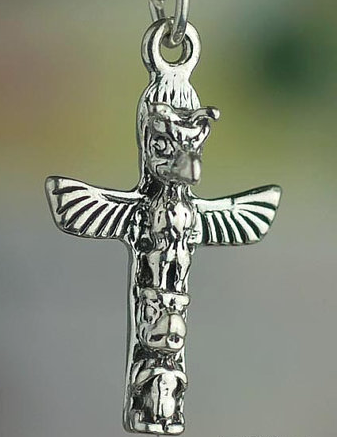
I couldn’t believe it! My father was offering a bit of the noble adventure to me, and I was not going to let him down! I looked at this keychain, a figure of an eagle with spread wings atop other native symbols and totems, and while part of me thought,“Er, what the hell am I going to do with this?” the greater part of me understood, or rather hoped, that this meant he KNEW I could appreciate how special this native American keepsake, which had been manufactured in some factory in Oklahoma or maybe even China, really was. “Oh wow, Dad,” I said. “Thanks.” And I reverently took the keychain and put it on my desk. I had been anointed! I had been chosen! It mattered not that my eldest sister was out of the house in her first year of marriage, or that my next older sister was too caught up in her senior year of high school to be spending much time around the house when my father received this duplicate keychain, leaving me as the only viable recipient. In my young mind, he had chosen me as the one who would understand. And, not knowing, or ever knowing, what to do with it, I left it on my desk as proof that I could be trusted to carry the torch of idealism, romanticism and appreciation for the suffering and ultimate demise of that noble race.
About two years later, my father was in my room for one reason or another when he saw the keychain on my desk. “Wait a minute,” he muttered, and I thought what was coming next was a glowing acknowledgment of my ability to understand why the keychain was so important. But what came next instead was “Why did you take this out of my drawer?” When I explained, “No, Dad, you gave it to me, don’t you remember?” he came back with, “If you wanted to see it, you could have asked me. Why would you go into my drawer and take something that wasn’t yours?” I was hit by two utterly unrelated thoughts simultaneously, neither of which I could articulate very well, for my ability to communicate has always been compromised by the rush of emotions. One, my Dad apparently had no memory of having given me the keychain, of that moment in time when I thought we were bonding as elder and protégé, and two, he actually thought I would pry into his private space and go through his drawers. I didn’t know where to turn first, but my dad did the navigating for me. “How could you go into my drawer like that??” he demanded.
I protested fervently. I said, “Dad, I wouldn’t go into your drawer. You gave it to me, don’t you remember?” You gave it to me!”
“No, I wouldn’t have given it to you,” he said, apparently having lost all memory of the arrival of a duplicate that would enable him to do just that. “And I could understand if you wanted to see it, but you should have come to me and not just taken it from my drawer.” A few more protests back and forth, and I had become a crying sack on my bed. There were very unsettling things going on. My father had no functioning memory! Either that, or he did not attach the least little bit of significance to the moment, making it easily forgotten. He thought I was capable of sneaky, petty thievery! I wasn’t quite sure which upset me more, but I suppose the indictment of my character won out.
As I lay there, a shuddering and weeping heap, he stormed off to his room with the keychain he had snatched from my desk, intending to put it in its rightful place. When he opened his drawer, I heard from the other room a faint, “Oh.” He saw his original lying there, unmoved.
And what happened next was also very upsetting, although not unexpected. My father came to my door and gruffly, with just the barest bit of sheepishness, said, “I’m sorry. Do you hear me, I’m sorry, ok?” There would be no hugs, no scooping, no lamentations of remorse for having hurt me so. I lay on my bed gutted and bereft until after about 20 minutes, when I picked myself up and continued my life. Despite my anger and hurt, I did not return the keychain. I did not chuck it in the garbage. I suppose I hoped it would be cleansed with time and become once again a symbol of my father’s faith in me.
Another two years later, I was visiting from college, and my father, having come into my room to tell me one thing or another spied the keychain. I kid you not, this is what happened: he said, “Wait a minute… this is mine. Why did you take it?” And the whole thing played out again in miserable inevitability. As a young adult, with greater understanding of the world generally and of my father more specifically, this time I took it in with as much horror as sorrow. My father did not remember having hurt me so, just two years ago. He did not remember discovering the original keychain safely in his drawer. He did not remember me laying on my bed, a quivering, sobbing girl. And, bonus, he still thought me capable of going into his drawers and taking something without asking. This time, my concern for his swiss cheese memory, and what it might mean about his health or ability to learn, won out, just barely, over my hurt feelings. There was no sobbing. Instead, I found my voice and said, “Dad, oh my god, don’t you remember we had this whole conversation before? Don’t you remember how you accused me of taking your keychain and upset me and then you found yours in your drawer and apologized?” And in the face of his continued repetition about how wrong it was for me to go into his drawer, I held fast and spoke like a college freshman. “Dad, you’re upsetting me, wrongfully accusing me, and I advise you to stop because otherwise you’re going to feel bad and foolish in a few minutes!” Despite the surety and relative calm in my voice there was no listening, no consideration of this alternative possibility, no heeding of my warning. My mother had caught on to what was happening this time, and called up the stairs, “Stanley! Listen to what your daughter is saying!”

But he was not taking in the information. He almost never took in the information.
It was why he couldn’t know that I was not the sort to go snooping in his drawer or take his treasures. It was why he couldn’t know I had so achingly believed his gift was a special moment of initiation into the armchair adventure club. It was why he could not accept more than two seconds of a hug or engage in dialogue. It was why, when he eventually made his way once again to his drawer and found the keychain occupying its usual spot, he again did not express profound regret for having maligned me or having ignored my protestations.
I understood like I had never understood before. My father was passionate, vibrant, a storyteller, a dreamer, heroic in his own unflagging commitment to move forward, to provide for his family in a dangerous job that wore him down little by little… and I adored him. But I’d never get in. I’d never have the relationship with him that I truly wanted.
Twenty-four years later, on the day of the evening my father died, he lay still and silent on his bed, with closed eyes. I sat next to him. I caressed his face, able to do so for the first and last time in my life, and told him how much I loved him. Without knowing whether he could even hear me, I told him how I reenacted all his horseplay and recitations I so loved as a child with my own children, and would again with my grandchildren. I told him how he lived in me, in all of us. How I could always feel his love through the things he did for us, his constancy, and the way he beamed with pleasure and contentment for his family. How much he had always meant to me. I clasped his hand and kissed his forehead. Did I get in at that final moment? I will never know for sure, but it was my most undefended and truest offering nevertheless, for the man who had the biggest impact on my life, for good and bad, who offered me so much, and who I miss every single day.