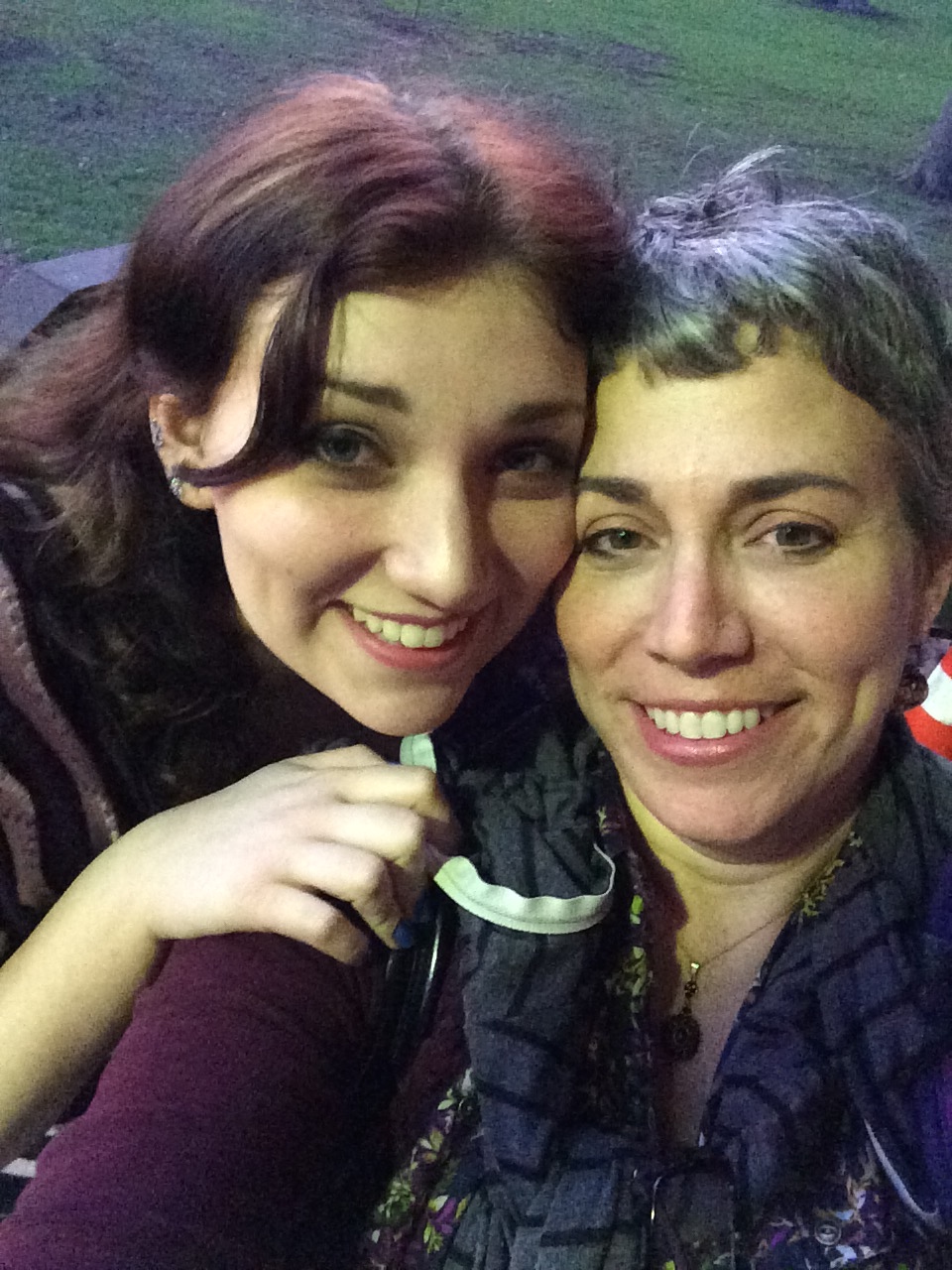
“Mom,” my sixteen-year-old daughter asked me one day, “did you know there’s a scale for sexual orientation, zero for exclusively heterosexual and six for exclusively homosexual?” A few seconds later she added, “I’m a three.”
This was not news to me. She’d struggled quite openly for the past two years to understand her sexuality. The surprise twist was my declaration. “I’d say I’m a two-point-five.”
“What? Shut up!” was her stunned reaction. I could see delight in her eyes even as her brain worked to catch up. It was the kind of delight one feels when admitted into the inner sanctum. The questions came flying: “Does Dad know? When did you know? Have you been with a woman?”
I explained that I’d had numerous “signs” of my bisexuality since college, when I reacted viscerally to a beautiful female classmate. I’d attempted to strike up a conversation with her, hoping for something I couldn’t identify, let alone articulate. And yet, I told my daughter, despite occasionally finding myself intensely attracted to a woman, I wasn’t ready to understand my bisexuality until I watched her coming to terms with hers. But even then, knowing the truth about myself, I waited until she seemed firmly settled in her identity. This wasn’t just to give her the space she needed—I was still having trouble coming out myself.
For 22 years I’d been married to a man and had never been with a woman. Some friends said I had no reason to come out, while others said I couldn’t know for sure I was bisexual until confirming it. They were wrong. I had to come out to be freed from the exhausting task of convincing myself I was straight. To feel the relief of understanding it was okay. And I did not need to touch a woman to recognize the surge of lust, just as a heterosexual man or woman doesn’t need to cheat to know he or she really wants sex with someone who isn’t a partner.
The trust my daughter showed in me, in baring her most personal struggles and fears, was what led me ultimately to be brave. For how could I repay such trust with secrecy, whether to her or to myself?
A few years later it was my daughter who gave me the key to yet another door. We were folding laundry, the sort of peaceful activity that promotes intimacy, when she said, “I don’t know, sometimes I just feel like there’s this guy in me.” This hit me like a rock. A guy in me. A guy in me. The reverberations spread out over years, both forward and back. Days afterward, I was driving her to the train station when I said, “I so love that you feel you have a guy in you. It makes me feel like I’m not alone.”
“Well, I didn’t mean really,” she said, scrolling through her smartphone. “I meant that when I’m attracted to a female, I’m a much more aggressive pursuer than when I’m attracted to a male.”
“Oh,” I said. I was crestfallen and confused.
“Wait a minute.” She shifted in her seat to look at me directly. “What are you saying? Ma, are you gender fluid?”
Gender fluid. The words hung for a long moment. I’d never heard that term before, and the tumblers of a lock were suddenly clicking into place. Here was a Rosetta Stone, to make sense of an awareness that had always been without language, had always made me feel outside the norm, a poseur. And it was this: I was living as a female, with the body of a female and the socially established trappings of a female, but was not nor had ever been exclusively female. Now I knew what to call it. Now it was named, acknowledged. Now I could declare my entirety, to my daughter and to myself.
I recently realized that my lifetime struggles with singing mirror exactly my lifetime struggles with self-acceptance and self-expression. What a cliché.
saved from my-diy-crafts-tuts/.blogspot.com
From the age of 5 or 6, singing was a source of joy, of wings for me. Apparently, my rendition at the age of 6 of My Favorite Things, from The Sound of Music was notable enough that my camp counselor pulled over some of her counselor friends for a repeat performance. But just as I was always scanning my family, friends and peers for cues that I wasn’t quite up to par, I was also always very sensitive to any negative criticism about my singing, and it always trumped whatever genuine smiles I also sometimes elicited. At my Bat Mitzvah, one of my 13 year old guests told me after the ceremony that the Kiddush was not meant to be sung with vibrato. Not ever having had a voice lesson, (or even really understanding what vibrato was) whatever vibrato I had was naturally present, but apparently that was a bad thing. It didn’t help that during my high school years the choral director was an ornery old man with a bad temper and no business working with students. He called me out once in front of the entire choir for singing nasally. He had me sing the phrase “Christe eleison” over and over, slamming his baton each time while he mocked me with an excessively nasal rendition, but never bothering to explain to me how to open the sound. Mercifully, after the third time, I magically, and without any understanding of what I was doing differently, landed on an a clear resonant sound, and he actually raised his arms and proclaimed “Hallelujah!” I understood, of course, that everyone’s mortification was not due to my nasal singing, but due to the dreadful awareness that this could have just as easily been them being humiliated. But I also understood that there was something pathetic, inferior, about my singing. I doubted it constantly.
The problem was, of course, I cared too much. Singing made me soar. It gave me a means to express my heart, my understanding of pain, love, sauciness, peace, and confusion. And somehow, it also became an offering of myself, so that any shortcomings or rejections were a dagger into my own breast.
borzui.tumblr.com Alireza Borzui
I sought voice lessons with extremely unqualified people, who taught me no technique whatsoever, and was consistently placed in the second soprano or even alto sections of choirs, due to the vocal strain I’d exhibit whenever I tried to go into the soprano range. The problem with this was that I had no strength in the alto range either, and so, with a weak sound, limited range and no understanding of my abilities, I lamely persisted, trying to achieve flight, still sensing just out of reach a joy like no other, and yet also feeling clipped, inadequate, and confused as well. In other words, singing became a very emotionally fraught activity for me. A minefield. I was as sensitive and wounded as I was determined.
For a few years, I seemed to find my place. I sang with an a cappella group in college, doing standards with complex harmonies. My group, The Chattertocks, had an old-fashioned sound, and provided a home for my particular kind of singing, gentle and sweet. As my confidence grew, a few friends of mine noticed and actually told me that I had a beautiful voice, making me happier than they could ever imagine. But once I graduated from college and went into the larger world, my singing tapered off dramatically. I had none of the training or technique for classical singing, the only kind I found available for amateurs, and a short stint with a chamber choir was nothing but a continual fight for my life. In one strange moment, the conductor pointed out to the entire group how I was the only one on my part who consistently came in at the proper time, and how this should shame them all since I the weakest at sight reading and had the least musicianship of the bunch. Yikes.
Then two developments occurred that contributed to my shutting down. One was that my new husband didn’t seem to enjoy my singing very much. He told me fairly early on in our relationship that when I dreamily sang standards to myself in the car in his presence it was a presumptuous imposition and he’d prefer it if I stopped. The other was that my daughter began singing at the age of 4 and had the voice of an angel. Many years later she told me that it was my singing to her at night that instilled a love of singing in her own heart, but all I could see was that she was a young and vulnerable little girl whose only area of unquestionable confidence was her lovely voice. My focus shifted almost completely to celebration of her unfettered expression. As she grew and faced the painful challenges from being a wonderfully peculiar outlier on the bell curve of uniformity, her singing was something that called to everyone, awkward outliers and popular middlings alike. Even the most scornful peers and parents were moved and had to grant her this acknowledgment – she had a beautiful instrument and naturally knew how to play it like a master. I was so happy for her; she got everything I ever wanted for myself–people to feel something when she sang – and it made her happy as well. I encouraged immediately her interest in private voice lessons, and to this day cannot recall whether that interest generated from a seed planted by her middle school chorus teacher, came to my daughter on its own out of her love of singing, or was all but assured by my constant praise of her voice, and the beaming smile on my face only and barely kept in check by my desire to ensure that my dear girl wouldn’t forget how to remain humble. I never risked diminishing her by conveying that I thought my voice came anywhere near hers, and indeed I never believed that it did. And I daresay, she grew to become as confident in her sound as she was in her face, the other possession of hers that stopped people in their tracks. Which is to say, she became vain. And I was helpless to curb it because I knew she was right. Her own high opinion of her voice was the truth. She was that good. But her vanity and her impatience with lesser practitioners led her to criticize my occasional forays into song and to point out where she could do a better job. It was a one-two punch: Keep your own bird’s song quiet so as not to detract from your child’s, and then hear her chide you for your failings in voice. The vulnerability and honesty in my voice – the expression woven into the notes of my love for her, or whatever particular emotion I dared offer- did not seem to affect her. She heard only the uneven support, the slight wobbling, the occasional sharp or the collapse of the palette.
So, with my less than enthusiastic husband and virtuoso daughter, I stayed more or less silent for over 20 years.
found at http://goingoutsidethebox.tumblr.com/post/14320430113/shyness Endless Downstairs
Then about 5 years ago things began to change. One night at synagogue services I was approached by the conductor of the choir and the lead cantorial soloist. To my secret delight, the conductor told me that the soloist had heard my voice, having been standing close to where I sat, and had gone to directly to her afterward to tell her that the choir should recruit me. I was all at once happy beyond reasoning and also humbled, for the soloist who pronounced this had a beautiful voice indeed. The next thing I knew, with my children grown enough for me to make the time for rehearsals and services, I was in the choir. That led me to me sitting at one of the choir services near a woman I knew loosely from various activities at the synagogue. When we talked about what led each of us to the choir this woman mentioned she was getting voice lessons from someone she recommended highly, and she encouraged me to think about getting lessons as well, if I were seriously interested in reviving my singing. And so I called the voice teacher and began private lessons. These things don’t happen by accident. I must have really wanted to sing.
Over 5 years later, I am still studying with the same teacher. This wonderful woman, a professional singer and cantor, trained at the best music schools in the country, immediately understood things about my voice that no one else seemed to: I didn’t know how to use it and I was blocked. She helped me unlock an entire additional octave in the soprano range, where I actually belonged, simply by patiently and kindly showing me how to let go of my tightened tensed throat and jaw and my deep-rooted fear. At first, at recitals, I was so afraid to sing in front of others that my heart palpitated and I grew white as a sheet. But I persevered. I persevered without little more than an extracted and somewhat strained compliment from my husband or a careful remark from my daughter, encouraging but with the spectre of all the things she wasn’t saying (and let me know without words that she wasn’t). I stopped asking them to attend my recitals and chose to believe my teacher’s insistence that I had a gift to give others. I just needed to accept it for what it was and use it how it was meant to be used, instead of trying to emulate or compare myself to other singers and believing always that I fell short. My dear sisters would occasionally come to hear me sing, smiling and silent but always nodding, fully present and encouraging for the earnest and clearly important struggle, even while they perhaps wished I wasn’t quite so invested and therefore so easily crushed, and even though they might have been hard-pressed, if someone asked them, why it was so painfully important to me. And over the years, little by little I could sing with less and less of the constriction I had always brought. I began asking for, and receiving parts in choir songs. I was asked to sing at my friend’s occasional religious celebrations in her home for the Jewish holidays of Sukkot, Chanukah and Shavuot, and listeners would approach me afterward to tell my how lovely my singing was. The conductor of the synagogue choir invited me to join an elite women’s choir she directed, and the next thing I knew, I was challenging myself and enjoying the stretch for works by Handel, Thompson, and Rachmaninoff. And slowly, ever so slowly, I grew to appreciate that I did have something others enjoyed. A sweetness, an old-fashioned yearning that carried my heart across, and they began telling me that I moved them. They did not focus on the technical failures, the occasional dropped support or forward sounding note. They focused on what I could do for them, and, sure enough, that’s what I began to focus on as well.
The final breakthrough came to me about a year ago. It dawned on me that when I let go completely of the fear, I indeed connected – both with my voice and with the audience. When it became about them instead of about me, I was freed. I was able to stop worrying about all that I couldn’t do, all that my mistakes revealed about my inadequacies, and just feel that sense of joy that comes from laying it all out there and, becoming a vessel for the listeners to willingly sip from. I could see them clutch at their hearts or mist up. And the more I saw their honest and receiving reactions, the more comfortable I was revealing my voice. The emotion, the vulnerability, the aching. It wasn’t a frightened plea for acceptance anymore; it was a brave gift. People enjoy singers and songs because they express baldly and without abashment all the emotions we feel constrained from expressing ourselves. When listening to a singer communicate a broken heart, or confusion, or flirtation, or over the moon love, people lose themselves and allow themselves to feel what they otherwise might disguise during actual communication. Once I understood that, once I understood that most people are just as constricted and afraid as I had always been, I could feel more at ease revealing not just my voice but who I am.
borzui.tumblr.com Alireza Borzui
For this opening up of my voice paralleled in time my slow but insistent opening up (or perhaps reopening) of my nature. And the more I relaxed and revealed without embarrassment that true nature –my giggling, my honest appraisals of what was being said or what I was observing, my desire for friendship or my off-beat sensibilities – the more it seemed that people reacted favorably. More favorably, it turns out, than they did when I tried to blend, tried to remain unseen, smooth and flawless. I discovered that far from being alone in my pained self-thwarting, I was in a sea of people who stay muted because they, too, are afraid to be found wanting. They hang back not because they don’t like warmth and playfulness, but because they don’t want to be branded foolish or undignified or weak. And when I offer myself without nervousness, without dread of rejection, without standing there like a mirror that calls attention to the fears in all of us, it puts them at ease and they respond.
I’ve heard time and again that singing is one of the most vulnerable activities one can do, and, for me at least, that is true. So is being one’s self. And though this journey to my true voice was very long and painful, I don’t regret the time it took or all the misgivings.
pinterest.com, pinned by Anne Krüger
I am instead just so happy to take a deep breath and know that I’ve found it.
“We’ll always keep in touch, no matter what happens.”
From buzz feed.com; 16 Pictures of Animals Holding Hands, February 14, 2012
“I’ll never betray you, no matter what happens.”
“I’ll always love you, no matter what happens.”
These are things we all say in a moment of raw, intense feeling. We really mean the first part; boy do we mean it! It floods us and makes our lungs expand and maybe even our nostrils flare and there is no doubt how sincere we are about that feeling. It is a beautiful, naked pledge about our intent at that moment, offered when we are so overcome with emotion that we willingly expose ourselves.
But that second part, “no matter what happens,”… isn’t it a bit of an escape clause? A ceding of responsibility? We expose ourselves, yes, but aren’t we clinging to just that little bit of a fig leaf? No, no, we say! We are just paying homage to the unpredictability of life in the architecture of our pledge, because let’s face it, life happens to us. If anything, that underscores our pledge, right? Makes it all the more sincere, because we will prevail no matter what unexpected things happen to us! And anyway, it’s true!, Things do “happen” to us! Don’t they?
There are undoubtedly times when circumstances are radically thrust upon us, not by choice. An example, of course, is death. Another is powerlessness, say, in the case of a young child, who does not have the means or know-how to overcome obstacles placed in her way by parents’ actions or choices. How about some sort of apocalypse? A contagion decimates our population, all technology breaks down and transportation and communication become virtually impossible. That would definitely be something that happens to us. What about a devastating illness to us or a loved one? What about being fired from your job (assuming it is not because you are an unbearable jerk or lazy ass)? What about an asteroid hitting the earth? Yes, there are indeed many ways in which life “happens.” And to be fair, far less dramatic but no less powerful turns of events also can “happen” to us. People who are dear to us suddenly have needs that conflict with ours or each other. Or our finances change, and that requires radical adjustments. The list is endless.
But what about choice? Our lives are not just left to free-floating chaos, are they? Every day, no matter what “happens,” we make choices that affect how we handle or navigate what has “happened.” Moreover, in many if not most cases, the very thing that “happened” happened precisely because of a choice, or a cumulation of choices. We made it happen. Or we let it.
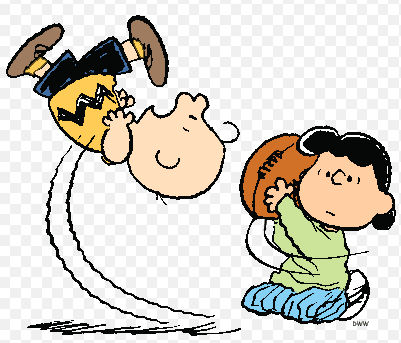
From Peanuts, by Charles Schultz
We make choices every day that direct our journeys on this little speck of rock. Thousands and thousands of choices. Little ones, big ones, easy ones, and excruciatingly hard ones. That last kind, many people avoid making, and they passively ride time for as long as they can without actually making a choice, until the choice is made for them. By waiting, we think we have absolved ourselves of the responsibility of choosing. But the truth is that’s a choice as well, and in most cases anyway we kind of know, deep down in our guts, which way things are more likely to go as a result of our not making the choice.
So, when friendships falter, it’s due to people deciding something. Perhaps it’s due to them deciding, in the midst of feeling overwhelmed by other things, that making the time for that phone call to that particular friend is a low priority. Whereas, calling some other friend to talk remains a high priority. Maybe it’s because that low priority friend has been making us feel bad more and more often, criticizing us or judging us. Maybe that low priority friend doesn’t seem as necessary to our well being as they used to. Regardless of the reason, it’s a choice. To give up reading fiction, because the demands of your job come first no matter how unreasonable or soul-destroying they have become; that’s a choice. To ignore exhortations from your spouse or your mother to stand up straight so you won’t fold in on yourself as you age; that’s a choice. And when it turns out, therefore, that you are indeed stooped over in your middle age, well, that was your choice, not really just genetics “happening” to you. To live with unhappiness because it is too difficult to rectify it, or because you believe making changes will shatter the happiness or stability of someone else; those are choices.
In many cases, the choices we make are the right ones for us. You could even say they are always the right ones, because they reflect what we really want or feel capable of at the time. But even when right for us, they come at a price, and so it’s easier to pretend we aren’t making them. Maybe they come with someone’s hurt feelings, or maybe with our own disappointment in having to let go of something that we did want, but not as much as the other thing we chose.
I just wish people admitted their choices as choices. I think it would empower them. That certainly has been the case for me. Realizing I had made choices and that not everything had just “happened,” led me to take a long hard look at why I had made those choices. I understood more about myself, and facing new, difficult choices became easier.
So I won’t use that formulation, “no matter what happens,” to drive home the truth of my pledges. Instead of saying “I will always [fill in the blank] no matter what happens” I will say “I feel with all my heart that I will always choose us.” Us as friends, lovers, colleagues, teammates, partners in crime, whatever. Unless, of course, I know I wouldn’t really make that choice. Unless, there is something or someone I know I would choose instead when really pressed about it.
Found at thetraveltester.com
Chances are our lives will never go exactly the way we want them to, because, well, things do happen. But the truth is, they’re going pretty damned close to where we want them to, because we make the choices everyday that lead us there.
Nothing makes you grasp how weird sleep is quite like going to sleep for the night in the clothes you wore that day. You take off your shoes and, still wearing shirt, pants, socks, and even the leather belt you had on, just lie on the bed (blanket optional), and sleep for seven or eight hours. People will give you a bunch of different reasons why we don’t normally do this. Like, it’s not comfortable, or you need separate sleep clothes to absorb the sleep smell we all generate (that’s just weird right there!), or if you don’t perform the ritual of undressing and washing, you’ll accumulate all kinds of grime on your face, etc. But these are just sacraments we’ve adopted to prepare for and regulate a most bizarre phenomenon. To sophisticate and romanticize something primal and animal and out of our control: we simply turn off, shut down to a bare minimum of breathing, beating, and chemical regulation. We hibernate like bears, only for several hours and not months at a time. And our dens are in the modern equivalent of caves. Compartments we’ve sectioned off, in dwellings that also have bigger shared compartments for food stores and communal domestic activities.
When you sleep in your day clothes, there is no formal break between your routines for day and night. You take away that tiny moment we’ve indoctrinated ourselves to notice (or, more accurately, created in the first place for our own reassurance). That moment we think we have deliberately chosen to embark on our journey to the restful, restorative, magical, mystical and even potentially frightening world of dreams. When you sleep in your day clothes, there is no ceremony. There is no moment. You just simply move to a bed and stretch out in a horizontal position.
The bed is the key. A lifetime habit of romanticizing sleep doesn’t disappear in one night of being too lazy to get up from the couch after a late television movie. No, to realize how weird sleep is, you have to deliberately decide, “Hey, you know what? I’m gonna go to sleep in my bed and in my clothes!” And you have to do it for two nights in a row at least, if only to shake the notion that sleeping in your clothes makes you a bum, a dysfunctional loser who might as well be passing out drunk. By the second night of sleeping in your day clothes – not the SAME clothes of course; you have to put on fresh clothes each morning! – you will feel instead like you are conducting a legitimate experiment to investigate the reality of sleep, and be shod of the guilt of abandoning conventions shared by all upright members of society. Yes, folks, I did this. Having the house all to myself now that the kids are in college helped. And I’ll even admit that it didn’t start out as an investigation, but merely as an act of defiance. Why bother going through all the rigmarole? I can do whatever I want. I can go to sleep in my clothes!!
But it turned out to be quite informative. It made me see how sleep is merely the recharging of our organic batteries. Sleep, after eating and expelling waste, is perhaps the strongest proof that we are, albeit very advanced creatures, creatures nonetheless. For even though we are never more vulnerable than when we are while sleeping, we must do it. In the end, it is compulsory. We can’t function without it for very long. There we are, completely defenseless, while our brains and our organs recharge and we generate more bone marrow, more neurons, more enzymes. And because deep down – deep, deep deep down – we know we are defenseless, we protect ourselves as much as we can, both physically and psychologically from this stark truth. We invent words like “slumber” to connote activity, a journey through the netherworld. Indeed, we kiss our loved ones goodnight, as if we are all going somewhere. We perform all sorts of rites such as putting on special, cozy garments, or tucking in our children and giving them a bedtime story. We sleep in the privacy of bedrooms, in homes locked for the night. We graciously offer guests the chance to rest undisturbed in private guest quarters, secure in the unspoken understanding that we are nearby sentinels who promise not to spy on them as they sleep. And we in turn don’t allow just anyone to see us sleep. We don’t sleep in front of the contractors who are doing work in our homes, or even good friends, unless we happen to be bunking with them on holiday. When we seek to economize in our youth, and stay in hostels while traveling, it makes us uncomfortable to sleep communally, but we take a calculated risk and put on a show of bravado, even as we clutch our backpacks or money holders close to our bodies. If we are unfortunate enough to fall asleep during a class or a lecture, we always awaken with a sense of mortification, not because we care about having insulted the teacher or the presenter, but because people have seen us in our vulnerable and undignified state. What if we drooled??
One exception that we all seem perfectly willing to make to our careful protection of ourselves in sleep, is napping on public transportation. It seems that from the earliest invention of public transit, we simply had to accept that the rocking, the jiggling, the boredom and the long passages of time would lull some of us into sleep and it just couldn’t be helped. So there is this shared willingness not to watch the guy leaning against the bus window softly snoring, or the couple, weary after a day of sightseeing, nestled into each other with eyes shut. We know that the same courtesy will be accorded to us, if our exhaustion gets the better of us on the commuter train home, or on the six hour plane ride. Indeed, given length of a typical flight, and the relative lack of movement allowed, we have actually come to feel quite safe and appropriate sleeping on a plane. In the case of flights far across hemispheres, we really have no choice. We come up against that compulsory need for recharging, even if we like to think of it more as an acceptable activity rather than what it actually is: a public shutting down. And so we make allowances, and respect the privacy of the snoozing traveler. Well, in most cases we do. Sadly, the introduction of the smart phone with camera has resulted in the potential for ridicule, as this photo taken of me on the way back from a youth trip to Nicaragua demonstrates. I’m the one with slack jaw.
But rather than dwell on the ignominy of shutting down like a switched off robot, ultimately I choose to celebrate what sleep indicates about our complexity of design and functioning. We are advanced organisms, requiring large amounts of energy for diverse and incredible tasks. We propel ourselves through space. We solve problems (and make some). We find our own fuel and make it even more appetizing. We create, and destroy and communicate. And, of course, we think. We contemplate and ruminate and theorize, and – need I say it? – navel-gaze. We even find ways of dressing up sleep so that we don’t have to face how basic and limited we nevertheless remain. If all that means I must be little more than a large body bag every night, so be it. I can’t choose to keep from shutting down, but I can embrace it and all that it allows me to do when I’m awake. Now, where are those pajamas?
Some people use the accusation of “gazing at your own navel” to dismiss a self-exploratory mental exercise as useless, self-indulgent, narcissistic, or worse, primitive. Something an ape might do. But an ape doesn’t ruminate as we do, not about its navel or anything else, and so I reject that characterization. To people apt to describe self-exploration as navel-gazing I say: sadly you are lacking in curiosity, self-awareness and frontal cortex complexity. For engaging in a deep consideration of one’s own ideas of the world is the sign, not just of wanting to soak up social, cultural, emotional and intellectual interactions, but of seeking to develop an understanding of one’s self in relation to all that information. Isn’t that how we improve? And so, I humbly offer you the fruits of my navel-gazing. My intent is to invite you to spark your own inward exploration. E. Marmer