You are my mommy to the fullest degree of meaning that term caries. You are the person to whom I can still, at age 56, show melted, back-to-age-four, unfiltered and undefended affection. As an adult I had to pull away, even at times push you away, but I have always, always, secretly, deep down thought of you as my mommy. I have always remembered the softness of your touch, the looks in your eyes, adoration and concern, how much as a young child I wanted your attention the way a camper wants the attention of the pretty head counselor, the one all the girls want to be close to, because that’s how blissful and melodious it was to be in your notice.
from CBC News article by Stephen Smith, posted 5/31/2017
Here you lie, the woman who would come to us after 8 hours of being professional, confident, commanding, and show us her softness, her frustrations and vulnerability, her plea for support. Knowing all I know now about raising a family and running a household, I feel such regret that, only partway formed, I couldn’t show you the support you needed and deserved. You were our superhero, tending to the demands of providing meaningful and effective instruction to developmentally disabled students, then coming home to buy our groceries, cook our meals, teach us skills, tend to our hurts and make my father feel like the head of household we all knew he wasn’t. Did you learn how to do all that from your own mother, or were you just this incredible from birth?
I take your hand, too precious now to squeeze as strongly as I’d like to announce my declaration of two, or even one. So I rest it on my palm, and stroke it, with silent, unworded awareness that this is the hand that diapered me, dressed me, smoothed my hair, caressed my forehead, held me tight, spanked me, washed the dishes in soapy water, pulled the weeds from our walkway garden bed. This is the hand you patiently let me examine as a child, always looking at the rising moons on your nails, your sturdy thick fingers, the ones you gave me, always searching for the tiny freckle on your ring finger that never ceased to delight me. Your hand is the object of my most reverent respect and gratitude.
putyourhearttopaper.com
I spent the first half of my adulthood figuring out Daddy – why he was the way he was, and why that merited my respect, sympathy, and admiration; and the second half I’m now spending on you. I think it had to go that way, because before I had traveled far enough on the spectrum of motherhood I don’t think I could have fully come to understand what you carried, the emotions, the concerns and the responsibilities.
And now having traveled this far I must say, my god Mom, how could anyone else have possibly been as awesome? How could any other mother possibly have guided us with as much love as you did, displayed such unwavering, unconditional positive regard, even while yelling at us sternly and with the most effectively scary expression? How could any mother have shown us why we should respect and adore our father, how we should treat our elders, share with each other, shoulder our responsibilities, conduct ourselves graciously, modestly, as you did unfailingly, and vacuum the carpet in the correct direction to produce a smooth nap? And how could any other mother have hovered over us as nervously, advising us to do things that we’ve pointed out countless time we already know to do, and communicated with her questioning and unasked for suggestions just how much she wanted for us – positive outcomes, happiness, freedom from disappointments.
I’m constantly aware of the miracle of air and take it for granted at the same time.
You have been like the air. And I see now it was the taking for granted that underscored the miracle, the unquestioned presence, the enmeshment, the essentiality. Mommy.
My recent phone encounter with a Microsoft customer service representative from India has renewed my faith in humanity. Not that I’d lost all faith, but the constant, depressing revelations in the news these days chip away at it. A dose of connection between two people on different sides of the globe was a welcome infusion of hope.
Getting customer service from someone in India was once a source of frustration and impatience, if not disgust for many Americans. The language barrier was the biggest complaint, but there was a certain sense of outrage that the only customer service available for a product invented in America, and indeed purchased in America by the person needing help, would come from people overseas whose English was sometimes hard to understand, and you couldn’t be quite sure they understood you, either. It seems that improvements in the quality and number of excellent English speakers who do this work, and a wider acceptance of global solutions for a global world ameliorated the dread we Americans once experienced reaching out for technical support. Certainly, as I dialed the customer support number, the thought didn’t even cross my mind that I’d be subjected to someone who would barely understand me. But I think globalized customer service offers more these days than just having my immediate software problem solved without an arduous verbal exchange. My experience with a certain Indian Sikh gentleman a few days ago has led me to wonder whether getting phone support from someone in a different part of the world actually can promote greater communication generally among people of diverse cultures and beliefs.
My particular encounter with “V” began with the usual (and hopefully well-disguised) baseline, anticipatory anxiety many customers feel when reaching out to a customer service representative. There is always that concern in the back of my mind that I’m doing a poor job of explaining what is amiss, or that I won’t get very good service. V immediately said what I think all Microsoft software customer service agents in India seemed trained to say these days, that he would be very happy to help me with my problem. Only, for some reason, I believed him. That in itself was very reassuring. But it was what he said and did after that, that brought me a sense of our shared humanity, and the potential for humor, kindness and willingness to engage with strangers that lingers still, days later.
It began when I remarked in passing how at my age I was already at a disadvantage following all the changes and growth of our digital world. Apparently, the lightness of my tone, and my general, albeit tenuous grasp of what he was talking about had led him to believe I was a young person, and so he said, “Elisa, let me tell you, you do not sound 56!” Well! Of course that led to an even more playful attitude on my part. Though subsequent conversation remained focused on the matter at hand, V and I had taken the first step toward actual genuine communication. I did not tell him I was a Jewish New Yorker and he did not tell me he was a Sikh. I deduced that from his last name, Singh. That he was Indian was a given from his accent, if not his name. I imagined him sitting in his control room wearing his ritually wrapped turban around a bun of hair that had never been cut.
This is probably not V.
Neither is this. Though, how could I know?
This man, of whom I knew nothing except his nationality and religion, and who was located in some room in India, with a headset and surrounded by who knows how many other phone representatives, remained on the line with me during an entire download process which, for reasons not worth explaining, ended up taking a couple of hours. He told me that I could put my phone down, carry on with whatever I wanted to be doing, and he wouldn’t leave me. And he didn’t. At one point we lost the connection and he called me right back. Good old V.
In order to enable him to help me, I had given V permission to access control of my computer. This, by the way, is always a leap of faith. Yes, take control of my computer! Help me! Once everything had downloaded, and he had confirmed all was in good working order, he did something so simple, so unnecessary, so corny, and yet so sweetly remarkable that if I hadn’t already had my guard down, this would have cinched it. My Word software was open in connection with his assistance, and he playfully created a new document in which he typed “Elisa is a very nice person and is awesome!” We were still on the phone, and he could hear my reaction to the words appearing on my screen, which was a giggle and expressions of appreciation for the sentiment. Not only was I smiling, but I knew he was too. I told him I would give him an excellent review for his assistance, and after a few more exchanges of gratitude and wishes for a great day, we said goodbye.
V didn’t have to want to make me smile in order to earn his positive review. He was courteous, knowledgeable and patient. He didn’t pass me off to someone else when it became obvious that the fix would take hours. He solved my problem. But purely due to a positive human impulse, he goofed around with me. That simple gesture was so unexpected, so generous, so authentic, that it made me believe that our greater connectivity in this internet age will ultimately prevent us from killing each other. Is this too great a leap to make from a moment of sweet silliness?
If anyone is thinking of telling me that creating documents telling customers that they are awesome is a typical gimmick used by customer service reps for Microsoft, don’t do it! I’d rather believe in the authenticity of the moment! Viva internationally outsourced customer service!
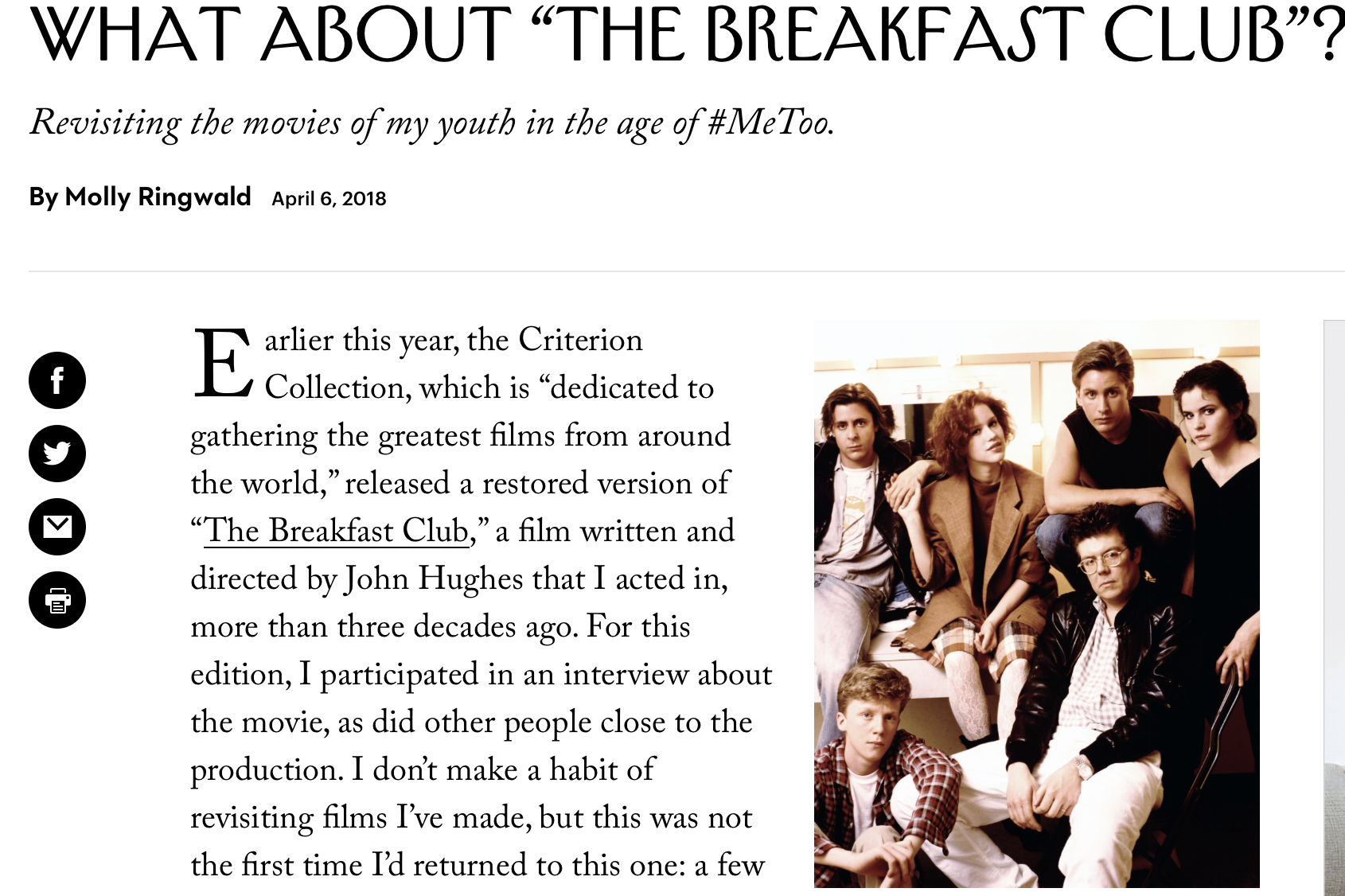
This is a timely and insightful essay looking back at the values portrayed in the John Hughes movies of the 80’s, and comparing them to changing values in the age of Me Too. And the fact that it was written by Molly Ringwald, the actress whose character in The Breakfast was the victim of some pretty bad bullying and sexual harassment by the boy she ends up with at the end, makes it all the more interesting. This woman can write! Who knew?
Human communication astounds me. I’d go so far as to say that human communication is the thing that most strains my brain circuits to think about (well, after the universe and higher mathematics, of course). The fact that we can do it, the means by which we do it, and the effects or potentialities of our doing it, are all marvels quite awesome to contemplate.
Just think about it. In our most elemental form, we are large organisms that can move in order to hunt, gather and reproduce. And because we can move very far distances, we need an especially sophisticated way to convey essential information to our fellow organisms. (I’m no professor, of course, so please take my theorizing as the non-scholarly, largely self-stimulating riffing that it is). We cannot rely simply on giving off gases the way trees signal each other about crowding or the state of available resources, or exchange dance moves or glandular liquids to inform each other where the food is, the way members of an insect colony do. Our experiential worlds are too vast, so at some point we started gesturing and beeping at each other. It was more like grunting than beeping of course, but if you imagine it as beeping, the stunning reality of it all grows clear.
For if, in a lab, we were examining stationary beings, little more than polyps on a mossy rock (which some would say is actually what we are) and we discovered that they were beep, beep, beeping at each other, and furthermore reacting in a way that indicated a mutual understanding of what all that beeping was about, we’d be quite amazed. Maybe even gobsmacked.
Let’s take a step back. Before all the beeping started, there were of course all the non-verbal cues that we also see in other mammals and birds. Excitable hopping about, threatening stances, cautious peering, they’re all there with us still. Moreover, like other pack mammals, say wolves, dogs, apes or lions, we also luckily have far more advanced facial muscles, enabling us to contract them this way and that to show fear, anger, pleasure, sorrow and indifference. Studies have confirmed what we already somehow intuitively know, that humans around the globe understand these facial contractions all in the same way.
And don’t forget the more basic electro-magnetic or chemical signals, which personally I’m convinced we still pick up on, even if we can’t explain how we do it. How else would we sense fear in a person standing next to us, or feel someone else’s attraction to us? So even before we get to the verbal stuff, the non-verbal communication is all pretty amazing. Imagine those polyps with little appendages flailing about in certain recognizable patterns and each having the means to perceive and comprehend its neighbor’s movements. Astonishing!
But here we come to verbal communication. Ah, language! If there is anything which displays our stunningly superior brain power it is that! Language not only enables us to convey needs and emotions, it gives us the means to explore and use numerical systems, biology, physics, philosophy and societal norms. How could we have developed and shared knowledge about architecture, history, or justice without language? How could we have built civilizations? Human language covers everything from the simple and concrete to the most abstract concepts imaginable, and the fact that we can use it to identify and share those concepts is extraordinary. Even the concrete in language is far more complex and abstracted than immediately obvious. For if I say to you “Throw me the ball,” I am already participating in a shared system where we have isolated and identified an action as “throwing” and an object as a “ball.” If I ask you what you’d like for dinner tonight, and you tell me, we have not only drawn upon the concepts of food preparation, but also invoked the ideas of planning for the future and altruistic consideration of another’s preferences. And I haven’t even touched on our ability to explore thoughts relating to cynicism, generosity, bridging differences, futility, consciousness, wastefulness, cultivation, et cetera, et cetera, et cetera.
Our brains and vocal chords evolved to a point where we were able to create this incredible tool. What a gift! We then created alphabets and means to record our language for conveyance to larger and larger audiences. And with our language we can effect change to our environment, for good or bad, by obtaining cooperation or fomenting conflict. We can understand each other at levels never before possible, and this has led to accelerated leaps in our development. It’s all so far-reaching, so full of potential, so noble, even. We have, through language, the capacity to share information that can help us understand and preserve our existence and our planet, and on a more personal level, our relationships. Too bad our more primitive emotions of fear, distrust and selfishness and our impulses for dominance and greed continually get in our way. It seems that some aspects of humanity have evolved faster than others.
Well, I for one remain hopeful. Everything on this planet seems to be part of a natural network that interacts harmoniously, and when there are deviations from that model, nature eventually generates a correction. Maybe advanced language is such a correction. Violence and destruction need no words, and the ability of humans to manipulate their environment creates the danger of violence and destruction on scales that no other organisms on our planet can achieve.
rosalilium.com
So, maybe what first evolved as a means to share information to our fellow organisms, grew into the complex system that it is now to temper fear, rage and chaos and give us forward looking sensibilities. It is, after all, through language that we have been able to learn and understand more about each other, in ways no other species can. For us humans, communication is way beyond hunting, gathering and reproducing. It’s the ultimate tool for mutually assured survival in an intelligent world.
See what I did? I used a rumination on communication to express hopefulness for humanity! Isn’t language just fantastic?
This is not the story of the birth of Jesus, nor of a small child’s introduction to the wonders of Santa Claus. No, this is the story of a New York Jewess of advanced middle age (me), finding herself for the first time at the very center of Christmas, or, at least, its production. You may ask, how did this happen? It was the natural, yet, to the uninitiated newbie (again, me), wholly unanticipated consequence of my having gotten a job at the local garden center.
I began my employment last May, when the profusion of geraniums and petunias could not possibly have prepared me for what was ahead. And while, even in that fragrant, humid season, one of my co-workers waxed rhapsodic about how all the tables of green plants and flowers would be replaced come late November by rows of Christmas trees, and how all the yard hands (of which I was one) would be warming their hands to an outdoor fire, as snow gently fell, and family after family happily drove away with a Christmas tree, leaving the yard hands’ pockets bulging with tips, I just couldn’t grasp it. I was too preoccupied trying to understand how my fantasy of arranging flowers, dreamily pruning perennials, and dispensing gardening advice had turned into the reality of dragging wet and muddy hose, pushing heavy carts of inventory, and struggling to remember the names of annuals I’d only first heard of while the customers looked at me like I was some sort of idiot.
When the autumn season, with its mums, pumpkins, cornstalks and cabbages, drew to a close, I was sent home by the boss for a short hiatus. He told me, “Rest up and get ready. You’re going to six days a week starting the day after Thanksgiving.” Actually, he said it in his Australian accent, which made the oncoming season sound like a wild, survivalist bush adventure. That was my first clue that something pretty intense was bearing down on me. I began to get nervous.
Dutifully, if with trepidation, I returned on the appointed day, to find the nursery had been utterly transformed. The indoor store’s inventory of decorative reindeer, Saint Nicks, snowy owls, elves, sparkly ornaments, candles, poinsettias and pine cones, artificial trees, tree skirts, and tasteful hostess gifts were arrayed so densely and so tantalizingly, that it was as if the North Pole and Santa’s workshop had been transported to this one spot about 50 miles North of New York City. And, as I had been foretold, yet couldn’t truly visualize until now when I took it all in in real time, in place of all the racks that had once held row after row of green plants stood hundreds of fragrant trees, in formation like ready foot soldiers. In front of these were plywood tables laden with every size fresh wreath imaginable, along with a bounty of mantle pieces, centerpieces, seasonal planters, swags, garlands, bunches of evergreens, roping and beautifully hand decorated wreaths such as I’d never before seen. For why would I, Jewish daughter, mother, matriarch-in-training, have ever browsed around garden centers for this occasion?
My initial awe and delight at such an array were quickly tamped down by my understanding that not only was I to learn all about this inventory and sell it, but I was also responsible for keeping the inventory coming. Thus, while the initial display of Christmas goods had been prepared in my absence, I, the Jewess, would now be creating replacement bunches of Magnolia leaves, Western Cedar, Frasier fir and Juniper, decorating fresh wreaths, setting up, modifying and replenishing the displays in a beautiful and tantalizing manner as things sold, and creating the occasional seasonal planter or centerpiece. I did all those things, even while I counseled the Christian or secular buying public on the differences in needle retention and ornament support among Frasier, Concolor, Douglas, Noble and Mediterranean Silver firs. I even created our signature display for the driving public, a Christmas explosion for the entrance to our grounds.
Most remarkably of all, I went into people’s homes and strung up their trees with lights. This activity made me understand something – decorating Christmas trees is exhausting, and rife with tension. If I hadn’t already deduced, from observing over and over families or couples trying to reach agreement over trees, wreaths and other decorative items, how thin was the boundary between happy-making, comforting ritual and disgusted, resentful acrimony, the lighting of the trees brought this home. Here was I, a supposedly dispassionate professional, and the sighing that came forth out of my mouth as I twisted lights around uncooperative branches and desperately tried to keep the wires untangled was something to behold. My coworker-mentor gently chided me: how could I have spaced the lights so well on one part of the tree, and put too many on this other section? Fortunately, I had no emotional history with him, so I had not the least desire to smash his face in. I could only guess how many conflicts would arise between loving partners when it came to hanging the ornaments! Yet, I persevered, and did my fair share of lighting two towering trees, a thirteen-footer and a nine-footer, to the immense satisfaction of their purchasers.
Fifty percent of these 1200 lights are mine, baby! (We were requested to make sure the tree was densely lit, and we obliged!)
Perhaps the stress factor is algorithmically related to the height and girth of the tree. Certainly, the time factor is…it took four hours for two people to light that thirteen-foot tree! If you’re going over six feet, do yourself a favor and spare your relationships. Call in the professionals!
In addition to learning that garden centers are really at the center of the Christmas spectacle, I learned a few other things as well. One is that it really can be sweet to witness a family buy a Christmas tree together (except when one of the kids is out of sorts and whining about how he or she never gets input into the selection, or when one of the adults is a cranky, never-can-be-pleased pain in the ass). A young child’s glee while running about the trees, and his or her barely contained excitement when the very best tree has been selected are truly contagious. And it is both an honor and charming fun to be allowed in as a discreet helper-observer, by the couple who have figured out over the years which one of them needs to be the head Christmas tree selector, and to watch the appointed one (self-appointed, usually) stride around with the measurement pole while the other secretly rolls eyes at me.
Another thing I learned is that there is no end to the creativity of those manufacturing Christmas goods. No matter how lovely or unique a decorative item is, there is always a new one waiting to be fashioned and presented. It is, quite simply, very easy to spend money at Christmas. The same people who wanted discounts for sixty dollars worth of perennials in July plopped down hundreds for Christmas goods in December without a moment’s hesitation. I also learned that the logical end to becoming infatuated with tiny Christmas miniatures is a whole village of the damned things, which of course has to be dismantled and stored every year. I saw such a display in a home I visited on my one of tree lighting missions. That is why I stopped at the gumdrop factory (with moving gumdrop conveyor belt!) and pond with gliding swans (propelled into figure eights by magnets under the pond; how irresistable!), though I really regretted missing out on the opportunity to buy the ski mountain complete with moving skiers.
And finally, I learned that keeping a Christmas tree requires checking the water in the stand on a daily basis, unless you want the thing to dry up and look awful, or worse, create a fire hazard. What – A – Pain! I finally figured out that with a PVC pipe and funnel, one could keep the tree watered without the tedious work of removing the tree skirt and braving all the scraping branches and needles at the tree’s base. I learned this of course because I succumbed to the persuasion of one of my coworkers, a plant lover like me. “Get a tree! Look at that cute tree! No one will buy that little fat tree!” What a sucker I was!
Here it is in the corner of my family room, having required the rearrangement of all the furniture.
Tree acquisition, decorating and care is right up there with changing the dishes for Passover, fasting for Yom Kippur or peeling, grating and frying up five bags of potatoes for Chanukah latkes without anybody helping you. I guess we all have our burdensome traditions that, over the years, give us the markers of time, and, thankfully, scores of sweet, or even bittersweet family memories to fill it. All I know is, having been at the eye of the Christmas hurricane I shall never be the same. And thank goodness for that! Something about the joy and irrationality of the Christmas pageantry is a wonderful affirmation of humanity’s wacky elements, and I’m so glad I was there to see it.
Recently, someone I know suggested that my last blog entry, “Message in a Bottle” was “oversharing.” He went on further to ask whether I wrote it to be stroked and praised as a person of great understanding. He stated his concern that it might indicate a form of vanity. This very same person had often expressed to me his wish that I could open up more readily to people other than the handful in my very closest circle and be utterly myself (outspoken, natural and unguarded).
I dismissed all validity to his remarks about vanity – I know the personal essay is an established art form, and that for centuries our civilization has been reading the personal thoughts, yearnings and epiphanies of writers – but they stung nevertheless. They stung because 1) I respect his opinion and care about his approval; and 2) I’m by nature inclined to question myself constantly (which is why I haven’t historically been fully at ease or fully myself, although I’ve been making great strides of late). Did I engage in vanity? I had to ask myself. And, because I’m still working to convince myself that my personality actually is a pretty good one, and that most of my actions and instincts are guided by purer motives, surely not one of the seven deadly sins, I had to think long and hard about it.
Starting with my very first blog post, every single time I hit “Publish” I have worried, “Is this too far? Is this too personal? Is this too exposed and does this reveal what a weirdo or overly sensitive person I am?” And after a minute or two, I calm my worry by remembering that this was why I began writing my blog in the first place. The real, real reason, beneath wanting to write, and wanting to find out if I could write well, I now understand was that I was giving myself my own sort of therapy for becoming emotionally brave and comfortable in my own skin. A total emersion therapy, like jumping into and swimming across the cold, old quarry lake.
One day, and I will never stop being grateful for that day, I found myself writing an essay, addressed to no one in particular, and, if that weren’t surprising enough, actually creating a blog to publish it. Who was this person going boldly where she had never gone before? I suspected I had things to say that would connect with people, and I gave a swift kick in the ass to that inner editor, who has lived in my head for most of my life, always telling me I best keep my mouth shut, that I was awkward, an irritant, someone who had to learn to blend and had nothing worthy to contribute. I will never forget the rush of fear, and the exhilaration when I overcame it and let my first work fly out. I will never forget it, for I experience it anew each and every time. Is this worthy? I ask, filled simultaneously with dread that it isn’t and astonishment that I sent it out anyway.
After doing this strange exercise several times I learned a few things, which you think would have enabled me to nix the dread, but no, I haven’t learned that particular lesson yet. I learned, though, that most people react well to my being so open. That they value my honesty, my proof that they are not alone in having similar feelings. They value the opportunity to think about something they hadn’t considered before, and a different perspective. And there developed a secondary reason for my blog, which has far overtaken the initial one. I write as an offering. I offer my experience, my growth and my mistakes for examination. I offer myself.
And every great artist, thinker, creator has done the same to one extent or another. Believe me, I humbly know I haven’t a fraction of their talents, but by golly I have their bravery, if not their unquestioning nerve. I tell myself, “this is worthy,” and I put it out there, quivering in my nakedness, praying that it is. Do I congratulate myself for that? You’re damned right I do.
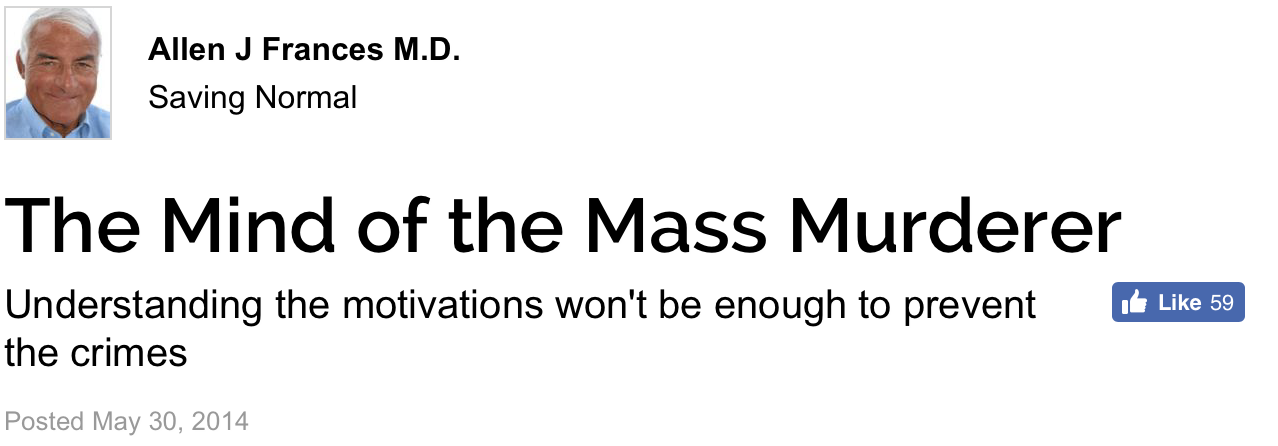
The massacre in Las Vegas may well be the event that finally shakes Congress into action to curb gun violence, even if in just some small way. Perhaps the prevalence of defective people who are capable of using guns in this way is finally sinking into our collective consciousness and will persuade paranoid Americans that having access to guns to make them safer from a suddenly metastasizing government or American hunters and gun enthusiasts that holding an assault rifle to feel a surge of power, are simply not important enough to make all of us sitting ducks. I suddenly needed to understand how it is that someone could mow down strangers with assault rifles. How could a human simply cease to consider other humans as… humans? How can a person turn strangers into ciphers with no value, no history, no soul, so that they are expendable? I searched the internet in my quest for an answer, and came across this very interesting article by Dr. Allen J. Francis, published in Psychology Today in 2014. It’s worth a read, in this age when mass murders seem to have become a ghastly, permanent blight. Despite understanding the phenomenon through the words of Dr. Frances, I can’t help but wonder if at bottom it simply indicates our failure as a species to have evolved far enough from the brutes we once were, or, even more sadly, signals our decay.
Mass murders are becoming a depressingly familiar routine in the United States- we can now expect to experience a media grabbing shooting about once a month. And the frequency can only increase as future cohorts of copycat killers are spawned by the seductive opportunity to temporarily gain the spotlight.
Amidst the anguish and heartbreak felt by the victims’ families, there are always two haunting questions. What motivates someone to kill strangers wholesale in a seemingly senseless way? And what, if anything, can we do to stop these tragedies from recurring?
My daughter carries a heavy load of emotional scars. They come in part, of course, from all the regular wounds that all sensitive people endure, whether inflicted by others, or by one’s own hand, or received upon the usual stumbles and falls that plague all such sensitive souls during childhood, adolescence and early adulthood. But in addition, some of my daughter’s scars come from uniquely devastating experiences. And some of them come from her unfortunate luck of being born with overactive or underactive brain chemicals, giving her a distorting fun house mirror to work with, and making navigation through the ordinary pitfalls of life and complications of connecting with others all the more treacherous.
From “Wink Space” by Masakazu Shirane and Saya Miyazaki
My dear beautiful daughter has been working for her entire life to shatter that mirror, or at least to recognize its distortions and learn to navigate despite them.
I know that many of her scars came from wounds I inflicted as well, unintentional as they were. Time has given me sight: I can see where I said and did the wrong thing, got drawn into an unhealthy pattern, came up short, missed the mark and even communicated judgment and disapproval. I could take refuge behind that well worn excuse, true as it may be, that all mothers are destined to screw up to varying degrees (because despite the most ardent wishes of their children and themselves, they are indeed flawed, bumbling human creatures like everyone else), but I won’t. I regret all the wounds I inflicted on my daughter. I wish I could take them all back. I can’t, obviously, but I can do one thing at least. I can let her know that never once, in all our years together, regardless of whatever sparring, frustrations, heartaches, mistreatment and misunderstandings we encountered or caused relating to each other, regardless of whatever sorrow I conveyed to her about her struggles and my inability or, in some cases, incompetence to make them go away, that never once was it a sorrow that she was, is, my daughter. From the moment I fell in love with her, looking down at her in my arms, I have rejoiced in being the one lucky enough to get her and have never stopped. When I fretted over how she was handling or not handling a situation, or felt the sting from one of our unhappy exchanges, I was also, always, exalting in how goddamned unique, and irreplaceable she is, how spirited and emotionally complex, how tender-hearted, how brilliantly glowing, how much a gift I didn’t deserve, for who could deserve such a prize as my Sophie. Through it all, and even now at 23, she remains as adored, as treasured, as zealously and jealously held, as much a wonder and a miracle as she was in my arms all those years ago. I wish she could feel exactly what is in my heart, my darling daughter.
If she could she’d know what I felt when she fit like a small football against my chest, for that feeling has never left.
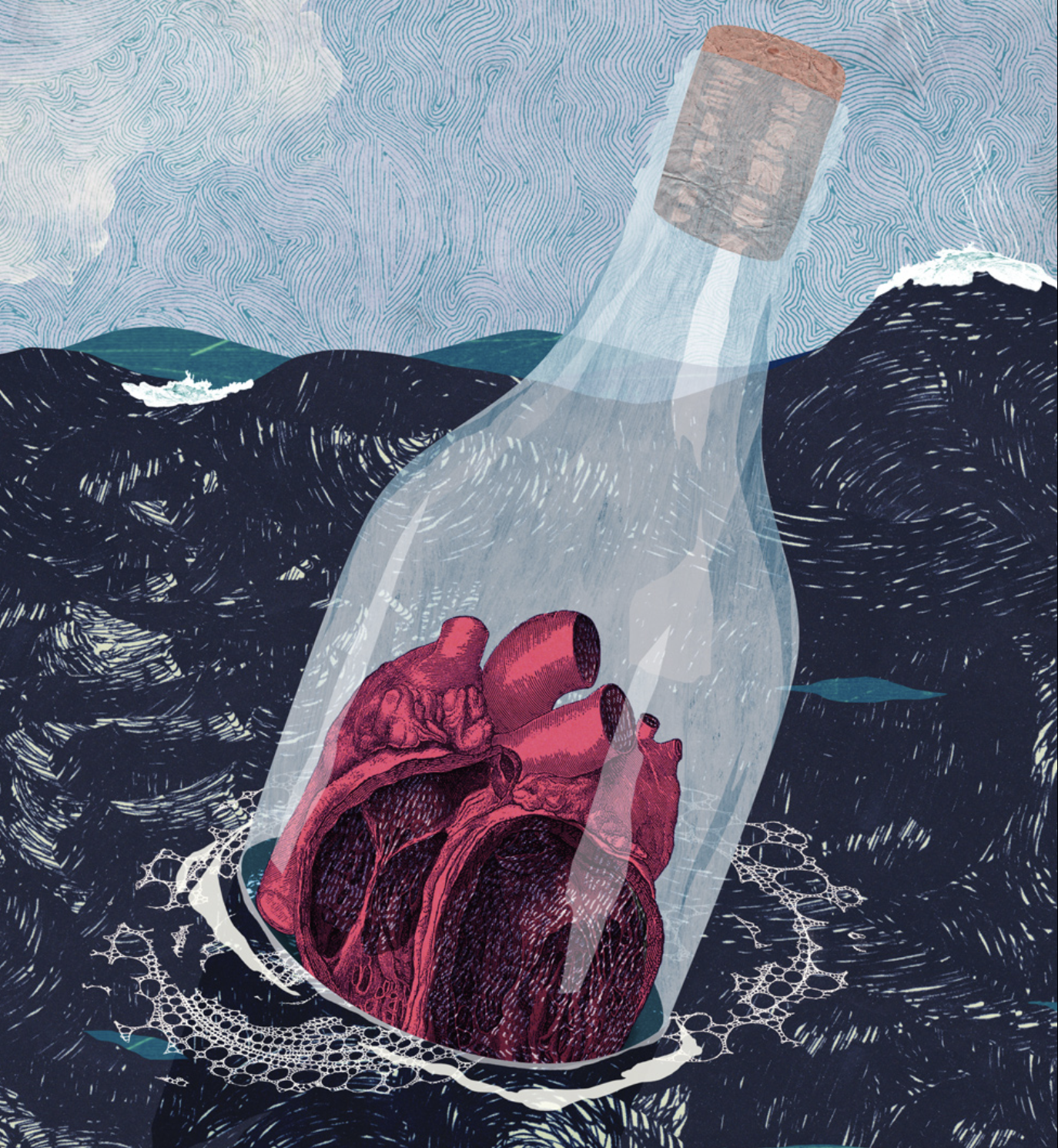
I don’t expect that my saying all this will magically make some small portion of her scars disappear, though of course I pray every day for her happiness, and it’s no secret from either of us that I wish I did indeed have the bottle of magic balm, the potion to drip into her scars and free her heart from the past, even the many parts of her past that do not relate to me. (I carry that irrational wish despite how she well she has been making some of her scars disappear on her own, with no help from me – she has been achieving so much self-healing, that strong and capable woman.) But if it does anything, I hope this message in a bottle, poor substitute for any magic balm in a bottle though it may be, makes her feel, know, believe, accept that she has made my life meaningful in ways I could never have dreamed of, and that knowing her and being her mother has been one of the greatest joys I have been blessed to receive.






 This is probably not V.