Author: E. Marmer

  • My Friend Iris

    My Friend Iris

    I had a friend Iris. I say “had” because I ended the friendship definitively and incontrovertibly, about 18 years ago. I said, “Have a nice life,” and hung up on her. You can’t get any more final than that. This was in the old days, when there was an actual receiver to hang up, which somehow made the gesture all the more powerful. But really, all I did was sweep away the spectral traces, the very contorted and disturbing ghost, of a friendship which in truth had disappeared years before that. What led me to such an abrupt and uncouth snipping of any remaining thread? Well, perhaps it was a case of a slow boil finally and suddenly erupting and spilling over. For years, it seemed, Iris had not really cared about our friendship and had done a number of things to show me that. Either that, or she was so self-absorbed that she hadn’t even realized how shabbily she had treated me.

    Found on images.search.yahoo.com
    Found on images.search.yahoo.com

    We had been close for years in college. The way we met would forever go down in history. I had dated a boy named Gil my sophomore year, but by the end of the summer we had broken up for various reasons. I still loved him, however, and he and I and kept finding our way back to each other on and off for the next 5 years. During one of our “off” spells, he got himself into a spot of trouble, when he mentioned to a girl he had met that he wanted to see the filming of Pinocchio being shown on campus later that week. That girl was none other than Iris. According to Gil, who came to my door on the night of the movie in a panic, Iris was like a steamroller, jumping on Gil’s remark as though he were asking her on a date, and accepting his offer before he could even understand what hit him. Young and inexperienced as he was, and completely lacking in fortitude and finesse, Gil gulped and accepted this turn of events. Except that he didn’t. He spent the next couple of days trying to round up a group to join them, and when that failed, he showed up at my door, an hour before he was supposed to “pick up” Iris, pleading with me to accompany him right then and there so that the “date” wouldn’t be a date. He must have really been desperate to ask me of all people, since we had a confusing and somewhat painful history ourselves, and, indeed, his showing up at the last minute, making me his last resort, attested to that. Still, on some level he knew that our friendship, whatever the rockiness of our romance, was of strong enough stuff to withstand his turning to me for help that he knew I’d give. That’s what I like to think, because the alternative would mean that not only was he inept with Iris, but he cared more about getting my help than wondering if he was causing me any discomfort or heartache by reminding me that he was dating (although apparently not dating Iris).

    In any event, we arrived at her door, Gil having talked nervously the whole way there, breathlessly thanking me for saving him, and when the door opened, there she stood. Shorter than us by one third, with very long, thick and wavy auburn hair, a face full of freckles and large brown eyes. Eyes that looked very confused at that moment to see me standing there. Gil mumbled some kind of incongruous, scrambled, and possibly intentionally incoherent introduction, and off we walked toward the hall where the film would be shown. As we shambled awkwardly across the quad in the dark, the proverbial big elephant lumbering right beside us, I considered. Why did I agree to this? Why did I agree to help this boy who still had strings to my heart, who was being a clod? And why couldn’t he have gone to the movie with Iris, and then afterward simply not follow up? She seemed friendly. Spunky and with a strong essence, but certainly not scary.  I reached a conclusion. Iris didn’t deserve any of this, and I was going to rescue her. So I addressed myself to Iris, and almost exclusively to Iris, with genuine interest about her background, what she was studying and where she grew up. The dialogue flourished, and poor Gil was as much of a third wheel as he was confounded. It seemed that Iris, having swiftly concluded that Gil was not worthy of her attention after showing up unexpectedly with another girl, was thankful for somewhere else to direct it. We found that we had an easy rapport, and a mutual desire for friendship.

    At the the end of the night, which included a stop for a late snack during which Iris and I never stopped gabbing while Gil just sat there like a stone, we made plans to get together later that week. In any event, we went on from there to be good friends. She was direct and assertive, yes, but she was warm, kind, unguarded. She was the most emotionally brave person I had met up till then. Her friendship meant enough to me to keep it away from Gil when he and I inevitably reconnected. He almost certainly thought I was respecting his very clear preference to have as little exposure to Iris as possible, but in truth I was shielding Iris from Gil’s contempt. I cared for her too much to subject her to it, especially when there was a part of me that believed that he just didn’t “get her.” There was a part of me that felt his inability to be straightforward with her or even spend one evening alone in her company was tied to his inability to connect with me. For after all, Iris and I shared emotionally honesty and intensity. We were brave, while Gil was not. When we talked, it was with trust and comfort. I cared for her enough to listen to her tell the story again and again that we met because a boy had asked both of us out for the same date, even though it gave me a pang each time.   It gave me a pang because it pulled up my disappointment with Gil for turning to me for help when what I wanted instead was his love, and it pulled up my disappointment with my dear friend Iris, since she knew that Gil was my great, unrequited love.

    Later on that year, when Gil and I had another attempt at romance that ended badly, at least for me, I went over to Iris’s. It didn’t seem ironic at all. She did something that I will never forget. She read me a story. I was sitting on her bed crying, and without explanation, she brought a picture book over to the bed and began reading it to me. Like a mother to a child. By the end of the book, I felt soothed, calmer, safer. It remains one of the sweetest, gentlest things a friend has ever done for me. Another thing that I will never forget was how, after I had graduated but came back to visit Iris who was then a senior, we spent the day walking and talking around Providence. At one point, I took her hand like I did with my friends when I was 8. We held and swung hands for a good block and a half. She was the only girlfriend I would have ever felt safe enough to do that with, and I was trying to tell her that she was dear to me. I couldn’t say it aloud, but it seems that she understood and accepted it with her usual wholeheartedness.

    We both lived in New York City at the same time for two years and kept up, but once Iris entered the world of high-powered public relations she began to morph from the unguarded, warm, down to earth friend I had known into a competitor. A shined up, stylish and businesslike associate headed for higher things. Her ambition seemed to take over, and she hardened. I moved away and married, and she met and married Todd, a junior law associate who seemed just as enamored with being a young professional as she did. On the rare occasion when we saw them, their interactions with us and with each other seemed to be one witty, acerbic remark after another looking for an audience.

    I guess those years apart really sealed the deal. For when my husband and I moved back to the New York area after 7 years in Boston, Iris and I just never got anywhere near where we once had been. Where, in truth, we had not been for almost a decade. Whatever plans we made that involved she and Todd coming to Westchester for the afternoon seemed always to have conditional status, cancelled at the last minute due to their deciding they were too tired, or wanted to spend the beautiful day going for an ambling country drive. When it was our turn to go into the city to meet Iris and Todd for dinner, we always did.  And Iris always seemed to welcome my coming into the city with my two year old, in stroller, for a play date with her one year old at her apartment.

    The incident that finally stung me into understanding that I no longer meant anything to Iris occurred when she and Todd took a week’s vacation at Lake Mahopac. She actually was the one to make the call, to tell me about their planned trip.   About how, since they’d only be about 30 minutes away, they could use the opportunity to come by for a visit. I had just given birth to my son, and told her that of course, of course, I’d really love for them to come and meet our new family member.  And I meant it.  I meant it when I said it.  Because I wanted my friend Iris to look with me, down at my little boy.

    We arranged that she would call me when they got to Lake Mahopac, or maybe she just said, “Let’s you and I talk when Todd and I get there.”  She also gave me their telephone number there.  After not hearing from her, I called on the third day of a seven day vacation, and asked when they’d like to come. Iris’s answer: “We’re waiting for a rainy day, so we won’t feel like we’re missing out on any of our vacation.”

    Of course the rainy day never came. Either that, or I might have said, out of some sense of self-protection, “Oh, that’s all right. Let’s forget it and do it another time.” I can’t remember.

    I got off the phone profoundly hurt. I went to my husband and told him what transpired. “She doesn’t care about you,” he said bluntly. I spent the next several months coming to terms with that and realizing that she had been putting no real effort into the friendship for years. It was all just half-hearted rote. Phone calls every so often and broken plans to get together, and no real connection anymore. Certainly there was nothing left that would make either Iris or I want to make the effort, let alone compel us, to be there for each other, wholly and firmly there: on site, at the scene of the action, in sadness or joy. The difference between Iris and me, I sadly realized, was that I didn’t want that to be true.  It seemed she didn’t care whether it was true or not. Had she understood well before I did what we had become? Had she intentionally put distance between us for some thoughtlessness of mine of which I was clueless?  Had she been consciously or unconsciously viewing our relationship the way one does a spent houseplant, which one tends without much enthusiasm and secretly wishes would die already so you wouldn’t have to water it?

    So I was completely unprepared when Iris called me six months later. I listened in stunned silence, my neck and head getting hot and my heart beating like crazy, as she asked me if I’d like to come to her apartment (which would have entailed travel for over an hour into the city, with my now 3 year old and my 6 months old infant) for a play date with her 2 year old and to meet her new baby.

    Somehow, this call was an even greater insult that the last one. Did she not know how badly hurt I was to realize I was now no longer one of those would-be-a-delightful-addition-to-a- vacation-for a-few-hours friends, and instead, over the years, I had somehow become merely a perfectly-adequate-activity-that-could-fill-some-time-only-if-other-options-were-rained-out friend?   Didn’t she know that I had been grieving this newly ascertained truth that we were no longer close?  Hadn’t she blown off my invitation for her to meet my new baby? Yet she was inviting me to undertake the difficulty of bringing my 3 year old and infant to her apartment, complete with all the equipment and accessories that would require . Didn’t she know that for her, for all those years, I had swallowed my pang and smiled every time she seized the opportunity to tell people that we met when a boy asked us both out for the same date? Maybe she did that because, to her,  that’s all she and I had been reduced to: a funny, not so funny story.  “Iris,” I croaked, in a voice choked with emotion, “you treated me so badly last summer that I thought you wanted to end the friendship. So no, I won’t be coming into the city. Have a nice life.” Click.

    Did I handle it well? No.  Of course, I know that. I didn’t say, “Iris, what you said and did last summer hurt me terribly, and here’s why.” I just blurted a whole bunch of stuff.  Then I hung up on her. No question, I was temporarily insane, overwhelmed by a flood of emotions that I only vaguely understood. I pulled a “nutty,” as they say. I even purposefully tied up the phone for about 15 minutes afterward, rambling on to my husband, seeking his consolation. But as I stared at the now silent phone, still quaking, I couldn’t help but wonder what would I have done, if an old friend angrily told me I had treated her so badly that she wished me a nice life and hung up on me. And it occurred to me that I would have called back repeatedly till I got her, and pleaded to know what I could have possibly done to upset her so. If she were someone I really cared about, that is.   I was therefore left to consider two possibilities. One was that Iris felt so angry that I was, to her mind, hostile and outrageous for no fathomable reason, that her anger trumped any caring or interests she had in finding out why I would say such a thing and trying to make things right regardless. In that scenario, she was the mistreated friend and I therefore wasn’t worth one more minute of her time. The other possibility was that my husband was right. She didn’t care. Either way, it meant there was no friendship to save.  And so I stood up, put away the phone, took a deep breath and picked up my bereavement where I left off, now with a fresh stab of grief.

    Still, 18 years later, I sometimes think of her. I think of how she read me a story and how we swung hands. Those were two gifts I will always treasure.  I think of them last…. and first. First, the memories come to me.  Then, I wonder how she and her family might be doing. Next, I feel the grief for a lost friend and especially that honest vulnerability and emotional bravery that once were, and maybe still are, the wonderful truths behind her brash façade. Then, last, always, always last, I return, with gratitude and affection, to those moments of true exchange and friendship when we were young.

  • Summoning Up

    Summoning Up

    Screen Shot 2015-05-24 at 7.46.39 PMWhen I was old enough to be driving, but young enough still to be living with my parents, I was returning with my mom from a shopping trip at the mall, when I drove over a mouse in our garage. I don’t know how the exact timing was possible, but his darting out of the way didn’t take him far enough to miss the slowly rolling tire, and I crushed the back half of his body. I discovered this when I opened the door from the parked car, and heard squealing. Squealing that was quiet enough to be barely perceptible, yet still ear piercing. Soul piercing. I craned around and saw the mouse, still alive, pinned there under 2 tons, his head and chest now reaching out from under the wheel, straining for a reality that was no longer possible. I instantly reversed out of the garage, straining for that same reality and then rushed out of the car to see. But no, there he was, half pancake, half mouse. I retracted around the huge fist of a feeling that punched my gut and started wailing and whimpering just like that mouse.

    My mother too had been taking in this whole scene, whatever horror she was experiencing enhanced by factors from watching her daughter, her baby, so tormented by something that could not be undone.  For a moment she stayed in the horror with me, no doubt incapacitated as I was, but also, it soon became evident, summoning up something colossal. Something so out of her normal way of existing that I felt it happening. I felt her straining against the weight of her nature, 2 tons, just like that car, as she strode with almost too much purpose, just to avoid faltering, to the hanging tools on the garage wall and plucked the heavy metal shovel from its hook. “Stand back!” she commanded, but I could hear the doubt and torture in her voice, as though she wondered without words just how she would be able to do this. In that one fleeting moment, I saw my mom, really saw her, partly crushed by years of doubts and conventions and limitations, and partly alive and strong and defiant. For her baby, for me, she did it. She lifted the shovel high over her shoulder and came down in one fast, unwavering arch of a swipe, right on the mouse’s head. And though the mouse was no longer squealing, his head was not flat like the pancake half of his body, so, the blows coming easier now, she lifted the shovel and slammed it down twice more in quick succession to be sure. Then she stopped, and I beheld her, the horror of the mouse’s fate at my hands supplanted by the awe I felt for my mother. I understood without words the wild and brave extremity she achieved, for me. Not that the mouse was forgotten. Horror, which of course is that feeling you get when confronting something awful and against every value you hold dear, but about which, in that moment at least, you believe you can do nothing, softened into a still difficult but more manageable sorrow that I would recall all my life. But the horror of that moment was dramatically and completely swept aside by the vision of my mother, standing there with the shovel handle clenched in her fists, breathing fast, somewhat overwhelmed and sick to her stomach, trying to regain her composure and a normal blood pressure. Somehow, she did what she had to do: put the mouse out of its misery and thereby smash its and her daughter’s horror completely and beyond reach. In her act, I saw just how much she loved me. For it is one thing to care for and minister to the needs of a child. It’s another thing to do something that requires heaving off one’s own horror. To break through the command of the primitive part of our brains, that renders us afraid and frozen like a threatened gecko. To strain wildly against debilitating, irrational paralysis and manage to act.

    We make up all kinds of rationalization after the fact for our debilitation in the face of horror, because it is shameful to us. We know that we were too weak to overcome it; we were completely ineffectual. And when the horror has to do with the social behavior of others our inaction is even more shameful. For we know on some level that paralysis in the face of witnessed violence or physical injury is more excusable than paralysis in the face of witnessed rude, insulting or insensitive social conduct, which after all, presents no actual threat to our bodily integrity. So we paint over such moments with the justifications of societal conventions, “supposed to’s” and staying out of the way and not making a big deal, but afterward we recriminate ourselves silently and repeatedly for having been overpowered by fear. That’s what it is after all. Our residual but still very powerful primitive instinct to freeze in the face of callous or insensitive treatment of others or ourselves is fear.

    I have had many, many moments where I failed to act when I witnessed rudeness or insult, whether to me or someone else, and I still feel the shame of those moments so many years later. In the case of mistreatment of my children by ill acting teachers or nasty parents of schoolmates, I managed to summon up at least enough courage not to remain silent, but I didn’t call things out exactly for what they were. I didn’t say, “You grabbed my child! How dare you! Don’t you ever touch my child again!” Instead I said, “My son says you grabbed him by back of his neck when he tried to get something from his cubby, and I’m very concerned about that.” I didn’t say, “Do you realize how twisted and mean, and damaging your sarcasm is to my eight year old? To most eight year olds?” I said, “Your way of interacting with the students doesn’t work for my daughter and I would hope as the teacher you would consider that.” And I didn’t say, “Are you nuts? All the other parents think your kids are the nastiest, most conceited, and crassest kids in the entire school, and you have the nerve to tell me that my kids are defective?” Instead I said, “Well I’m sorry to hear that my kids are doing things when I’m not around that aren’t’ very nice, but that doesn’t give your son a free pass to do something mean that has my daughter feeling sick.” But watching my 21 year old daughter begin truly to understand and struggle through the tangle of mistreatment, selfishness, inconsideration, sexism, you name it, that constitute the “jungle” of our society, and watching her wonder whether she dare call people out for the things they say and do, I feel empowered to rise above my own fetters and shout “Yes! You are right! That person was an asshole! This person tried to belittle you! That other person was manipulative! You are not crazy to think so. You do not have to remain pleasing and conflict averse! You do not have to be worried that people will think you are ‘trouble’ or oversensitive because you refuse to let mistreatment, however nicely dressed or camouflaged or even unintended, pass unchallenged.” As I see her recognizing and identifying all the social interactions that stun us, as I witness her paralysis, I am, it seems, finally able to summon up the strength to heave off some of my own.

    A few days ago, the defining moment came.

    My daughter and I were eating at a small neighborhood restaurant in Brooklyn. There we were, me with my gray hair, older skin, manner of dress and overall bearing that announced me as a woman over 50, and she being obviously a young woman in her 20’s, perhaps my young friend or perhaps my daughter. Someone who seemed like the owner waited on us, but in any event he was a man somewhere between the age of 38 and 48. He kept referring to us as “girls” and not in that hammy, flirty way that is intended to be a compliment, effective or not, to older women. It was in the dull, automatic, unseeing and oblivious way that some men refer to women generally. With each utterance of “girls” our discomfort grew. We did not have to say much to each other. We both knew that a man waiting on us was referring to a 53 year old mother as a “girl” in the presence of her daughter and that it was belittling, all the more so because it confirmed an absent, careless and undervalued interaction with customers. “You girls want anything else?” It matters not if someone else would have not taken offense; I did. My daughter saw me struggling. She saw me pinned under convention and yet trying to summon up something, anything, to heave it off. When the proprietor brought our check, said, “thank you, girls,” without even looking at us and walked away, I must have contorted my face in some crazy way, for she whispered, “Mom, don’t. Mom, let it pass.” And when I continued to fidget and struggle, apparently presenting the risk of some kind of uncontrolled, over the top outburst, she said, “If you’re going to say something, I’m getting out of the restaurant.” I was too busy summoning up my courage to respond. So she beat a hasty retreat, saying “I’m outta here. I’m going to the bathroom.”

    I sat there for about 5 seconds trying to breathe my way to doing what I knew I wanted. I half couldn’t believe it. I was afraid to say something to this stranger. I was afraid lest he think me a crackpot, a “feminist” an overly sensitive, silly female. The conventions and the “supposed to’s” and the always-at-the-ready “Why make a big deal out of something so little?” rose up in my brain. But I knew that if I didn’t say something, I’d be ashamed of myself and always regret it. Not because I’d have let what was just a careless remark pass, but because I’d have let my fear win. I took that one final deep inhalation, stood up and walked over to the proprietor, my payment for lunch already on the table. I said, “Excuse me, you seem like a nice man.” “Thank you,” he interjected. I continued in a calm voice that at first belied how hard my heart was pounding but then actually managed to help me find my ground. “So I’ll ask you to please consider how a 53 year old mother might feel being referred to as a girl in front of her grown daughter.” In the face of his momentary confusion, I added kindly, “I’m really too old to be called a girl; I deserve more respect than that.” He looked at me. Really looked at me for the first time. Suddenly he was a respectful person addressing an older one. A service provider addressing a customer. He asked, “I called you a ‘girl’?” And when I affirmed that he did, he apologized, perhaps more because now he was afraid, (what if I made a scene?) than out of any regret. I smiled, and thanked him and told him with a twinkle that I left him a good tip just the same. Then I turned and strode out, feeling like I had just successfully completed the pole-vault at the Olympics and joyously caring not one whit whether the proprietor was judging me.

    Screen Shot 2015-05-24 at 7.49.52 PM

    My daughter was waiting for me outside. “Mom,” she beamed. “I’m really glad you did that.”

    Huh?? “You heard?” I asked.

    “Yeah, I heard part of what you were saying after I came out of the bathroom. I was afraid for you to say something, but deep down really I wanted you to.”

    Well, I wasn’t doing something as heroic or dramatic as euthanizing a doomed animal, but I managed to heave off my fear, and she watched me do it with pride and gratitude. It was something I had to do. It was my way of saying “See? You can do this, and, by the way, I love you.” And I think by her comments she got that. It was her way of saying “Thanks, Mommy.” In the end, perhaps it seems ludicrous that I would have been afraid to have said something, or even that I felt compelled to do so, and yet, how many times have we not spoken up merely because we didn’t want to seem silly or, heaven forbid, make the  transgressor (who may well be unwitting) uncomfortable? And why is seeming silly so catastrophic, to be avoided at all costs?

    My daughter and I linked arms and walked on.

  • Sleep is Weird

    Sleep is Weird

    found at cambio.com
    found at cambio.com

    Nothing makes you grasp how weird sleep is quite like going to sleep for the night in the clothes you wore that day. You take off your shoes and, still wearing shirt, pants, socks, and even the leather belt you had on, just lie on the bed (blanket optional), and sleep for seven or eight hours.   People will give you a bunch of different reasons why we don’t normally do this. Like, it’s not comfortable, or you need separate sleep clothes to absorb the sleep smell we all generate (that’s just weird right there!), or if you don’t perform the ritual of undressing and washing, you’ll accumulate all kinds of grime on your face, etc. But these are just sacraments we’ve adopted to prepare for and regulate a most bizarre phenomenon. To sophisticate and romanticize something primal and animal and out of our control: we simply turn off, shut down to a bare minimum of breathing, beating, and chemical regulation. We hibernate like bears, only for several hours and not months at a time. And our dens are in the modern equivalent of caves. Compartments we’ve sectioned off, in dwellings that also have bigger shared compartments for food stores and communal domestic activities.

    When you sleep in your day clothes, there is no formal break between your routines for day and night. You take away that tiny moment we’ve indoctrinated ourselves to notice (or, more accurately, created in the first place for our own reassurance). That moment we think we have deliberately chosen to embark on our journey to the restful, restorative, magical, mystical and even potentially frightening world of dreams. When you sleep in your day clothes, there is no ceremony. There is no moment. You just simply move to a bed and stretch out in a horizontal position.

    The bed is the key. A lifetime habit of romanticizing sleep doesn’t disappear in one night of being too lazy to get up from the couch after a late television movie. No, to realize how weird sleep is, you have to deliberately decide, “Hey, you know what? I’m gonna go to sleep in my bed and in my clothes!” And you have to do it for two nights in a row at least, if only to shake the notion that sleeping in your clothes makes you a bum, a dysfunctional loser who might as well be passing out drunk.   By the second night of sleeping in your day clothes – not the SAME clothes of course; you have to put on fresh clothes each morning! – you will feel instead like you are conducting a legitimate experiment to investigate the reality of sleep, and be shod of the guilt of abandoning conventions shared by all upright members of society. Yes, folks, I did this. Having the house all to myself now that the kids are in college helped. And I’ll even admit that it didn’t start out as an investigation, but merely as an act of defiance. Why bother going through all the rigmarole?  I can do whatever I want.  I can go to sleep in my clothes!!

    But it turned out to be quite informative. It made me see how sleep is merely the recharging of our organic batteries. Sleep, after eating and expelling waste, is perhaps the strongest proof that we are, albeit very advanced creatures, creatures nonetheless. For even though we are never more vulnerable than when we are while sleeping, we must do it. In the end, it is compulsory. We can’t function without it for very long. There we are, completely defenseless, while our brains and our organs recharge and we generate more bone marrow, more neurons, more enzymes. And because deep down – deep, deep deep down – we know we are defenseless, we protect ourselves as much as we can, both physically and psychologically from this stark truth. We invent words like “slumber” to connote activity, a journey through the netherworld. Indeed, we kiss our loved ones goodnight, as if we are all going somewhere. We perform all sorts of rites such as putting on special, cozy garments, or tucking in our children and giving them a bedtime story. We sleep in the privacy of bedrooms, in homes locked for the night. We graciously offer guests the chance to rest undisturbed in private guest quarters, secure in the unspoken understanding that we are nearby sentinels who promise not to spy on them as they sleep. And we in turn don’t allow just anyone to see us sleep. We don’t sleep in front of the contractors who are doing work in our homes, or even good friends, unless we happen to be bunking with them on holiday. When we seek to economize in our youth, and stay in hostels while traveling, it makes us uncomfortable to sleep communally, but we take a calculated risk and put on a show of bravado, even as we clutch our backpacks or money holders close to our bodies. If we are unfortunate enough to fall asleep during a class or a lecture, we always awaken with a sense of mortification, not because we care about having insulted the teacher or the presenter, but because people have seen us in our vulnerable and undignified state. What if we drooled??

    One exception that we all seem perfectly willing to make to our careful protection of ourselves in sleep, is napping on public transportation. It seems that from the earliest invention of public transit, we simply had to accept that the rocking, the jiggling, the boredom and the long passages of time would lull some of us into sleep and it just couldn’t be helped. So there is this shared willingness not to watch the guy leaning against the bus window softly snoring, or the couple, weary after a day of sightseeing, nestled into each other with eyes shut. We know that the same courtesy will be accorded to us, if our exhaustion gets the better of us on the commuter train home, or on the six hour plane ride. Indeed, given length of a typical flight, and the relative lack of movement allowed, we have actually come to feel quite safe and appropriate sleeping on a plane. In the case of flights far across hemispheres, we really have no choice. We come up against that compulsory need for recharging, even if we like to think of it more as an acceptable activity rather than what it actually is: a public shutting down. And so we make allowances, and respect the privacy of the snoozing traveler. Well, in most cases we do. Sadly, the introduction of the smart phone with camera has resulted in the potential for ridicule, as this photo taken of me on the way back from a youth trip to Nicaragua demonstrates. I’m the one with slack jaw.

    public snoozing

    But rather than dwell on the ignominy of shutting down like a switched off robot, ultimately I choose to celebrate what sleep indicates about our complexity of design and functioning. We are advanced organisms, requiring large amounts of energy for diverse and incredible tasks. We propel ourselves through space. We solve problems (and make some). We find our own fuel and make it even more appetizing. We create, and destroy and communicate. And, of course, we think. We contemplate and ruminate and theorize, and – need I say it? – navel-gaze. We even find ways of dressing up sleep so that we don’t have to face how basic and limited we nevertheless remain. If all that means I must be little more than a large body bag every night, so be it. I can’t choose to keep from shutting down, but I can embrace it and all that it allows me to do when I’m awake. Now, where are those pajamas?

  • The Loveys

    The Loveys

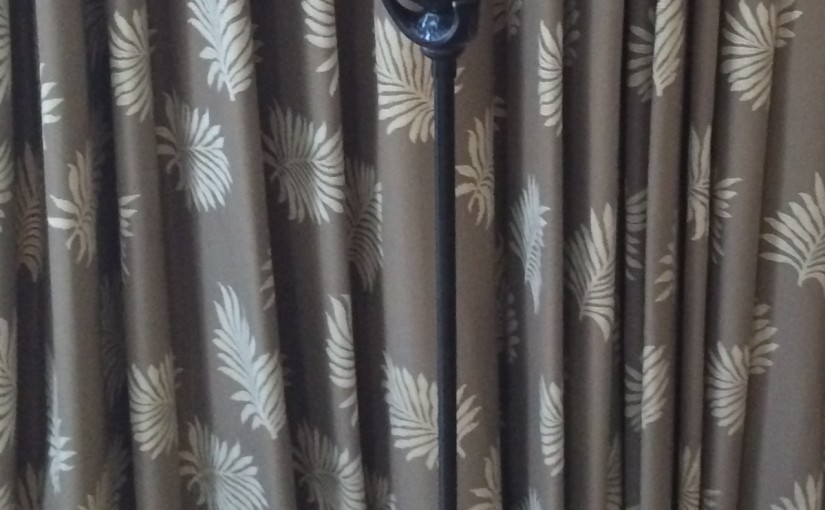
    lampFrom my kitchen table I can see that lamp. That floor lamp I finally came up with an excuse to get rid of (it really is far too puny for our oversized family room, and I had no other place to use it) and temporarily replaced with a bigger, more me kind of a lamp. Before the day went out, my son asked, with his panic barely contained, “What did you do with that lamp?”

    “What lamp?” I innocently asked, without any actual innocence.

    “That lamp that was in the family room? Did you get rid of it??”

    I told my son that I still had it. “But see how much better this lamp is for the space?” I sweetly suggested. He was not fooled. “Can you put it back?” he pleaded. He then dropped the cement. The fixative that would tie that fuggin’ lamp to me for all time. “I love that lamp. It’s been in every home we’ve ever lived in. I remember that lamp from forever.” And then the coup de grâce: “…It’s my childhood.” Just like that, I was doomed. Doomed to keep that lamp for all time, till I die.

    I understood the power of the lamp for my son. For I too had THE item, a small mass produced print, purchased at some such place like Alexander’s (in the Bronx) or Woolworth’s, of a Paris night scene by Maurille Prévost. This cheap replica, printed on swirl-embossed paper to suggest actual brushstrokes, and set in a common, 1960’s ready-to-hang frame of the sort found everywhere in tasteful or striving middle class homes across the country, was so dear to me that my eye would scan the wall for it virtually every time I was in our kitchen in Rockland County. Before that, when we lived in an apartment in the Bronx, I’d look up from my spot on the smooth-tiled foyer floor (the small sofa seemed reserved for my Dad or visiting adults) and find my familiar friend reassuringly in its place, my proof that I was in the right home. When my parents were preparing for a garage sale prior to moving from their Rockland home to a more suitable dwelling for retirement years, I quickly grabbed the print off the wall and held it close. “Were you thinking of getting rid of this? Cause I’d want it,” I whimpered. And moments later I was the happy owner of my childhood companion, which I promptly hung up in my home, to the confusion of my husband.

    So I knew that lamp, that damned lamp, was not just a lamp to my son. My 18 year old son, skilled in never appearing to break cool when it served him, actually voiced a plea for this unoriginal, this unremarkable, this you-should-be-ashamed-of-yourself-sorry-excuse-for-a-lamp lamp, with bond paper dyed and embossed to look like a genuine tanned-leather shade and dark-brown bronze pole complete with matching, hammered base which no lamp should ever have, ever again. He was desperate. Believe me, I knew this from recognizing that same imploring expression of poorly disguised anguish my mind’s eye recalled from my very own face. Worse, I was 35 at the time! But, I wasn’t going to let on just how well I knew. “Okay, sweetie,” I said with my inner Oscar winning actor’s most benevolent patience. “For you, I’ll switch them back.” And as I turned to go, when my face was safely “out of scene,” and out of sight, my inner actor, who is, actually, me, dropped the act and celebrated my coup in grasping the truth: “That’s his lovey.”

    Of course, I’m a smug dope cause my lovey is that dumb, cheap, embossed paper print with the cook arriving for work via bicycle and with his chef’s hat on already, while he’s still straddling the bike, at an establishment simply and humbly called “Restaurant.” And I remember the love I had, have, for my lovey. The joy that filled me as though I were a child again when my mother, in the manner of a carnival barker awarding a small kid a prize that was worth absolute crap all the while making the kid feel like she was getting gold, told me “It’s yours!” And I couldn’t bring myself to ruin my son’s not-so-secret, young child’s stab of joy and relief. So I said nothing to him. Nothing to let him know I was on to him. Knew his secret. And even more importantly, nothing to let him know that that very same lamp had been a prick at my heart every single time I looked at it.

    I had purchased that lamp during a New England style colonial antique furniture-browsing day with my mother-in-law and sister-in-law, about 4 years into my marriage. Why I was even in that particular browsing experience was a source of mystery to me, since I despise New England colonial antiques, and deep down always did, but my apparent inability to say, “no thanks, Mom, I hate the kind of antiques you love” when she brought up the idea to go browsing for the new home in the “country” that her son and I recently acquired (and so What better place for “country furniture” right?) had something to do with it.  I suppose it was tied to the very impulse that later led me to suggest out loud that I might buy the lamp. It was an obligatory outing with “the matrons.” Not that my mother-in-law or sister-in-law were particularly matronly or even were aware they were serving that function. We poor females don’t always know when we morph into a member of the matrons, those women who, among so many other stultifying suggestions and comments, imply to you that furniture shopping is something “the women” do to feather their family nests. And furthermore know how to do primly, and respectably, and for not too much cost because we want to be responsible in our spending after all. And being with the matrons, I didn’t say, couldn’t say, couldn’t admit, “I hate furniture shopping. I couldn’t give a shit about what my furniture looks like, really,” or say “Guys, I’ll shop for my furniture when I good and feel like it, and it won’t be this New England, stripped of all ornamentation or frivolity, and painted or stained only in muted shades that suitably convey puritan plainness, humility and purity shit. It’ll be something positively vulgar, like florid and overly carved Victorian pieces or something out of the 50’s version of the future,” or even “There’s really something messed up about the fact that women do this in groups, to help each other, right? Where are the men? I mean, HELLO! Don’t you realize that we are still doing the same shit our very hairy hundreds of thousands of years ago predecessors did?”

    So there I was, along on this activity. For some reason, probably just because it was along our path, we walked into a furniture store that was not filled with colonial antiques or reproductions, but with newer, somewhat everyday, tasteful furnishings. Maybe, understanding what felt like my only way out, I scanned around for something, anything that I could live with. Or maybe the selection just seemed so much better than it was because it appeared after a sea of items I couldn’t ever imagine owning, that I really thought I liked what was in the store. But for whatever reason, that’s when it happened. “What do you think of this lamp for our living room?” I asked.   BOOM. There it was. My surrender to the matrons. And one moment later, the fog cleared, and I understood that I had selected something that I really didn’t love or even want, but I held steady. I must have figured, better to get it over with, offer up the sacrifice, and then never have to go through this ceremonial joint furniture shopping ever again. Only I couldn’t have known then that it was the beginning of a long line of offerings that became second nature to me, and led me so far away from myself that I mourned my absence.

    To be fair, neither my in-laws, nor anyone else, required my offerings. Indeed, over the years my mother-in-law developed a love affair with expressionist and folk art, which she indulged in freely by altering many of her colonial pieces with paint and decals of bursting blooms, or wildly colored finishes, and by transforming her walls into galleries for some of her own very vivid, unabashed and often quite thrilling expressions of color, form and movement. She was feeling free to be herself. Why wasn’t I? Maybe, once you suspect deep down that you have entered a life that isn’t quite working for you, you do whatever you can to disguise your true impulses and desires. Maybe you do whatever you can to prevent yourself and others from knowing the truth: you do not feel yourself. You do not feel alive.

    And so I loathed that lamp. For 19 years I secretly loathed that lamp. But now, well past 50, I finally decided I could simply get rid of it. I no longer felt tied by some inexplicable, self-imposed obligation to temper everything in my style, my home, words that leave my mouth. Yet, here is my son. To him the lamp is his childhood, and he loves it. The strange thing is, that somehow rehabilitates the lamp for me. I can look at it and it no longer pulls up an unpleasant association just outside my conscious language.   It is my son’s lovey, … and that is… so cute. I love that lamp! That is the lamp my son looked up at and felt reassured by! How could I ever get rid of it? What was I thinking?! And so, that lamp is now among my favorite items in the house. The house we will be listing on the market this spring, now that my husband and I have separated. I will be sure to keep that lamp in every home I live in, so that my son will know he’s in the right place, or one of two right places of course.

    Back to here, from my seat at the kitchen table, I see the lamp. And shifting my eyes I see that I am also in perfect line with that print. THE print, my lovey. Suddenly the thought occurs to me, what if my mother or father had an unpleasant association with that print? What if it was an awful association? I call my mother immediately.

    “You remember that little print of the cook outside the restaurant on his bicycle?”

    “No.” That puts me on notice right there that I am probably on safe ground.

    “The one that used to hang in our foyer at Bronx Boulevard and then in our kitchen in Rockland?”

    “No, honey, I don’t remember it? Why?”

    At first, my lovey not having an anguished past that my mother would instantly recall and convey to me disappoints me. It made my lovey a bit more… prosaic. The possibilities had been endless. It could have been something that my mother’s wandering and ultimately abandoning father gave her that she couldn’t quite bring herself to throw out. Or it could have been an imposition by her mother-in-law, who firmly declared that it was fitting and expected to see it hanging there in the foyer every time she visited our apartment that was so much smaller and less glamorous than hers. I try to inject some drama.

    “Well, you gave it to me because I remembered it so dearly from my childhood, but I was wondering if it turned out that it had actually been a source of emotion for you. You know, like, maybe Grandma Gussie gave it to you and you secretly hated it?”

    My mother chuckles kindly as one does at a child with a wild imagination. “No, dear, I probably just picked it up somewhere. I would do that. I’d see something that would strike me, that I’d like, and I’d get it.”

    Touché.

    Well, it turns out that my lovey is really quite a layered symbol after all. Far from prosaic, it now serves not only as totem of  my youth, but also the ability to allow unabashed expression of myself that I once wielded and now wield again. And on top of that, while the materials used for the print and frame were inexpensive and unimaginative at the time of manufacture, they are “vintage” now, and the content, the lovely little scene by Prévost, is quite striking. I rise to wipe layers of dust and grime from the unprotected surface, it occurring to me that the dark colors I always assumed were part of the print might actually be forty years of accumulated film.  As the brighter colors burst from under the damp dusting cloth, I realize that the scene has always been a window into my mother’s tastes that I had not really ever looked through.

    Prevost


  • Melvin Beylis Died

    I heard from my mother that Melvin Beylis died.  I’m using fictitious names for privacy, so this man I remember with fondness is going to be named Melvin Beylis.    The last time I saw Melvin was close to 30 years ago, and, before that, was when I was a teenager. But my memories of him from that time, and indeed from my entire youth, are as vivid as the most intense memories can be. As vivid as memories are when they are of someone who epitomized a time and place for you. Melvin did that. He and his wife Myrna epitomized my life in the Bronx, in the 14 story building that seemed to my young eyes to tower above the shorter apartment buildings and townhouses lining Bronx Boulevard.

    Melvin always had a glint in his eye and a warm chuckling smile for me. His voice was barrelly and resonant, though he didn’t talk much. But when he did speak, his accent sounded vaguely exotic to me, a deep rumbling of a way of speaking that was so comforting and familiar, yet foreign in some way. I think his slightly darker skin tone and saucer sized brown eyes added to this notion that he was exotic. I couldn’t know then that what I was hearing was simply a mellifluous Bronx accent. A more sing song version of the hard pronunciations surrounding me on all sides, but flowing out of Melvin with their edges just ever so smoothed off, and sprinkled with his one of a kind giggle. His dark, caramel giggle.

    Melvin’s receding dark hair was slicked back with the natural hair oil most men allowed to accumulate back then, to the apparent approval, or at least with the toleration of their wives and girlfriends. He seemed big and tall, despite rounded, stooped shoulders, and enough extra weight and body hair to look a bit like a shuffling bear. Someone that you wanted to hug, especially when you saw that warm smile and heard that mirthful sound emanating through parted teeth. But my best friend, Laura, told me, by her face and body posture, that her father was not as warm as cuddly as he appeared. She seemed almost a little afraid of him, in a respectful way, the same way I felt about my own father. And so I didn’t hug him, or dissolve into unguarded affection, even though he seemed so inviting. And when I hung back, I could sense the affirmation from Melvin: yes, that’s the right distance.

    I could also sense but not articulate the ways Melvin was different from my father, Bernie, who had a jauntier and harder edge – who seemed more “hard-boiled” – or how Myrna was different from my mother Shirley. Myrna’s hair was a difficult to describe warm brass color, somewhat poufy if not bouffant, and highly sprayed – the kind of hairstyle that gave you no clue as to the wearer’s age, and which she could carry, and indeed did, for the rest of her life. Myrna spoke as someone with not a shred, not a hint, of any self-doubt. Someone who owns a space as soon as she walks into it. Someone whose voice modulates from sarcasm to authority to sly wit, but never falters or softens. She conveyed a confident, unassailable assessment of the facts at all times, never a gentle questioning or exploration. In contrast, my mother Shirley was less apt to offer a viewpoint or perspective, and only did so to be sociable. She spoke with the same accent, and with some measure of steadiness, but next to Myrna she seemed more understated.  Indeed, her two steps forward one step back way of making herself understood seemed practically genteel, and a bit at odds with Bernie’s gruff but good-natured swagger.

    It’s surprising to me to realize now that they all had the same Bronx accent. They all said “ar-right” instead of “all right” and “draww” instead of “drawer.” They all said, “prahhl-ly” instead of “probably” and “beeyoo-ti-fuhhl” instead of “beautiful.” But they all sounded so different from each other, anyway, merely from the added ingredient of their individual attitudes, their different handling of words and emphases. And perhaps because my own parents were too familiar to me, too much the norm, I never realized that they too spoke with the same dialect. The same rolling and pitching and dropping out letters and merging of syllables. The same accent I must have had, realize now I still have, when I’m spending long hours with my sisters and the conversation gets animated. If it weren’t for Melvin and Myrna, and the study of them that living across the hall allowed, if it weren’t for remembering their immutable and undeniable patterns and their warmth – for there was occasional warmth and mirth even in Myrna, behind the caustic surety – I might have never understood just how much I lost.

    We moved away when I was 7, and though I remained friends with Laura for many years (our parents making it as easy as they could for us to see each other regularly and for sustained periods), in my new surroundings I began a process of transformation, a washing out, that led me to the wider world, but at a price. In Rockland County, an increasingly settled area known as “upstate” but only 30 minutes from the Bronx, I mixed with kids who spoke differently. Their parents were from other parts of the city, or from New Jersey, or even farther afield, and they didn’t have the hard r’s I did or say “dawwg.” Many of their parents were professionals or college educated, not like my father the cop or my mother who went back to school to become a teacher only after we were all in school full time, and these adults spoke with a loftiness and expansiveness that seemed like a softer music to me. I wished I had understood then that it was blander.   It wasn’t as lively, or, indeed as alive as the way Melvin and Myrna spoke. And, without even realizing it, I softened my edges. In my little 7 year old brain, then 8, then 9, and so on, I mimicked and strained out the harsh sounds in my words before they slipped from my mouth.  I modified. I took two steps forward and one step back.

    By the time I was living and working in Boston, my exposure to people from all over the country, first at college and then at law school, had ensured that I spoke, if still recognizably from the mid-atlantic states, not at all the way I did when I left the Bronx. Not at all even the way I did when I first arrived at college and met a boy who wrote home about his new girlfriend’s New York accent. More muting, more conforming, more blending, more sophistication I thought, did me the service of rendering me unidentifiable as a Bronx native. In most conversations with my sisters, ones I have with them when others are around and I’m not completely unguarded, I speak differently from them. I even triumphantly noted a time or two in the past that I have come to lose much of the accent they still possess. The one disturbing blip occurred when I worked in a New York law firm my second summer in law school. I had some trouble figuring out the right poised and measured responses to give to partners when they asked me to take on more work, and this led to a coaching session with the partner looking out for the summer associates. He began his helpful, patiently condescending advice with the apparently sympathetic phrase “I, like you, came from a lower, middle class background.” This he apparently discerned from my inadvertent occasional slip back into harder more “Bronxonian” speech patterns while living in the city that summer, since I never discussed my heritage or socio-economic background with anyone at the firm. I remember my ears burning with outrage and humiliation, even as I dismissed him as a wannabe, a poseur.

    In my early adult life, I completely lost touch with Laura, and not just because I lived far away. I ensured the demise of that relationship, first having managed to make her feel increasingly bad whenever we got together by always pointing out all the ways in which our lives and styles had diverged, and then by becoming insufferably self-absorbed, as people who are actually insecure do. It is only now, thinking about Melvin’s large brown eyes and occasional baritone rumblings, and then Myrna’s brash and unflinching assertions, that I remember how I loved the patterns of my childhood. The charm of its familiarity and reliability.   At some point, just a few years ago, I came to understand that when I lost Laura’s friendship I lost something fine and rare, and that her giggling, no doubt a gift from her father, lit me up and made me smile, but it was too late. We had spent our entire adult lives apart, and there was no basis for friendship anymore. There was no longer any basis even 25 years ago, when I told her in an unwelcome phone call that I had heard she had stumbled on her way up the aisle at her wedding, a wedding I should have been at and indeed had been invited to. Far away as we were from each other even then, she could not have understood that I was not trying to point out her awkward moment with intent to diminish her, but was instead lamely trying to reach out, to tell her that I could well imagine her charming giggling at her misstep and the unspoiled and gorgeous and sweet, sweet joy of that moment I wished I could have seen, if only to remember all we shared as children. Even way back then, despite that vague awareness of what I had lost, and that fumbling attempt to reclaim it, I continued moving, if not entirely away from the cradle of the familiar, determinedly insensitive to it. This, I realize now, is a particular thread, a pattern, that repeats and repeats in my tapestry. A tapestry that consequently wasn’t as bold or as lively as I now wished it had been. As I now wish to weave it.

    I think of how Melvin and Myrna represented the Bronx to me, how over the years they and Laura grew more cordial and less warm toward me on those occasions when I did see them, and, in Myrna’s case, true to her tell-it-like-it-is nature, barely cordial. And I find myself so very relieved to discover that those hard r’s and stretched out diphthongs are not completely gone, if only I relax and become completely unselfconscious, and that instead of taking one step back after my two steps forward, I can look around, giggle, and simply wonder aloud good-naturedly if I’m out too far.

  • What’s wrong with navel-gazing anyway?

    Found at: craneimal.blogspot.com
    Found at: craneimal.blogspot.com

    Some people use the accusation of “gazing at your own navel” to dismiss a self-exploratory mental exercise as useless, self-indulgent, narcissistic, or worse, primitive.  Something an ape might do.  But an ape doesn’t ruminate as we do, not about its navel or anything else, and so I reject that characterization. To people apt to describe self-exploration as navel-gazing I say: sadly you are lacking in curiosity, self-awareness and frontal cortex complexity. For engaging in a deep consideration of one’s own ideas of the world is the sign, not just of wanting to soak up social, cultural, emotional and intellectual interactions, but of seeking to develop an understanding of one’s self in relation to all that information. Isn’t that how we improve? And so, I humbly offer you the fruits of my navel-gazing.  My intent is to invite you to spark your own inward exploration. E. Marmer