In his New York Times column, Frank Bruni tells us why scheduling snippets of time together for quality bonding with loved ones doesn’t actually lead to the quality we seek, or need.
EVERY summer for many years now, my family has kept to our ritual. All 20 of us — my siblings, my dad, our better halves, my nieces and nephews — find a beach house big enough to fit the whole unruly clan. We journey to it from our different states and time zones. We tensely divvy up the bedrooms, trying to remember who fared poorly or well on the previous trip. And we fling ourselves at one another for seven days and seven nights.
That’s right: a solid week. It’s that part of the ritual that mystifies many of my friends, who endorse family closeness but think that there can be entirely too much of it. Wouldn’t a long weekend suffice? And wouldn’t it ward off a few spats and simplify the planning?
The answer to the second question is yes, but to the first, an emphatic no…
The tale of Dr. Jekyll and Mr. Hyde is so much a part of our popular culture that virtually everyone knows its key premise, without ever having read it, or even knowing who wrote it (Robert Louis Stevenson). For some reason (I’m guessing insanity), Jekyll wants to segregate the selfish, depraved and conscience-free half of his nature from his altruistic, civil and dutiful side. He dreams of how wonderful it would be if each half could function without inhibition, free from the influence of the other. Sounds to me like a rationalization to let the dark side go nuts. Jekyll invents a potion to achieve the schism, the actual scientific means by which he accomplishes this left a mystery to the reader. After Jekyll drinks the foul brew, hideous, corporeal Hyde begins to roam the night. Unrestrained by the goodness and civility of Jekyll, Hyde not only degenerates into a murderous fiend, but becomes harder and harder to control. A cautionary tale, indeed.
Well, it turns out that I too have a “screw that!” conscience-free side to my personality, though thankfully she is neither villain nor murderous fiend. I have decided to call her “Estelle.” The most subversive thing Estelle ever did was to buy the loudly ticking antique pendulum clock that is now hanging just to the left of our family room television, despite knowing darn well that the men in the household didn’t want anything distracting from their view of whatever sports game or movie was on, let alone something that made noise and moved. She may also have had a hand in my apparently sudden decision, while accompanying my daughter to a piercing shop, to get a nose stud at age 52 (C’mon! You’ve wanted one for YEARS, you gutless suburbanite!), but I’m not sure about that one.
found at bokehphotography.uk.com
Estelle isn’t out to make trouble. She is just the morality-free, propriety-free, completely selfish truth teller who has finally learned how to jab her way forward to “keep things real.” She tells it like it is… loudly. Indeed, the longer I pretend not to hear her, the louder she gets. Like that ticking clock she insists “Oh yeah? Well here I am! Get used to it!” I first came to know her in the wee hours, when she’d awaken me in the dark, hoarsely whispering to me about how I’d been on autopilot for much of my adult life, navigating according to values or standards that never quite fit me. About how, as a result, the current configuration of my life was suffocating me. About how for years I’d been a pretender in my marriage, my own home, to my family and friends, trying to convince everyone and myself that I was happy.
My inner truth-teller, Estelle
Naturally, at first, Estelle frightened me, and I tried to hush her up. But she wouldn’t relent. Estelle was the first one to tell me that there was no way I could pull off preppy, country club clothing. (With those bazooms and that unmistakably Semitic visage??) To flat out say that I’d never be friends with the women in my synagogue’s Sisterhood so why did I keep trying (You don’t even like them!!). To pester me into admitting out loud that I had developed somewhat of a drinking problem. Nothing gets by Estelle. Her inconvenient and sometimes painful truths are often disruptive, but they are always liberating, even if at times anti-social. For example, Estelle helps me understand that when I nagged everyone in my family not to eat potato chips from the bag, it was really just because I resented being the only one who cared about a clean sofa or being the one left with the broken, saliva encrusted detritus at the bottom of the bag, but now that I have the house to myself, I too can happily jam my hand into the bag, cram chips in my mouth and lick my fingers, all while watching Dawn of the Planet of the Apes at an unsustainably loud volume on the surround sound. Estelle says, “This is awesome!”
But while I am thankful that Estelle keeps me honest and helps me cast off the “supposed to’s” that dull, dishearten or, worse, crush me, I have realized that, of course, Stevenson is right. Even when it comes to my loud-no-bullshit-can’t-help-but-love-her Estelle, free reign would be a disaster. She must remain an internal force, a passenger on my crowded bus of characters. There will be no potion taking for me. For though she keeps the constructs of others from making me miserable, Estelle unleashed would be a misery to everyone else. She is blunt, inconsiderate, obnoxious, unintentionally but unsparingly hurtful. I learned this when, over the last two years or so she began taking more liberties, perhaps giddy with her vindication that she had been right about so many things.
On one such occasion, my daughter and I had just concluded a long, overwrought argument in a restaurant, my husband and son trying desperately to act like they weren’t with us, even though we were all at the same table. It finally seemed like my family would be able to move on to a nice dinner; peace and harmony had been thrown up in the air, but were once again beginning to settle on us like a blanket. Nevertheless, upon hearing the last half-hearted diss my daughter flung at me, which ordinarily I would have easily ignored for the greater good, Estelle came roaring forth. I found myself actually snorting and loudly muttering, in the most unmotherly way imaginable, “Give me a break.” Fortunately, all at the table, including my daughter, were so astonished at this aberration, the complete abandon of such a declaration, its sheer reckless nerve, that everyone started laughing and dinner was saved. But in another surfacing of Estelle, I wasn’t so lucky. My son was fervently and sincerely, if a just a wee bit sanctimoniously, trying to explain why something had mattered to him, and Estelle burst free, changing my aspect so completely that she was virtually corporeal like Hyde. Momentarily whisking me to some far away place, where she apparently knew I’d secretly rather be, she blithely sighed, “Blah, Blah, Blah,” in an absent-minded, sing song kind of way. My son and I were both shocked. We had just seen and heard something or someone that wasn’t at all the entity usually in charge, and this force, whatever it was, was completely unconcerned with his feelings. Estelle, it seems, doesn’t give a good goddamn about anyone but me. My son told me it was probably the coldest, and therefore the most hurtful thing I had ever done or said to him, and I could see why. Yow.
Poor Estelle! She only wants me to remain true to myself. She champions my causes. But she has indeed led me to hurt people I love when I’ve let her steer the bus. She takes me to the other extreme. So, to actually remain true to myself, my entire self, I’ll take her under advisement, but negotiate compromise and find my center. Thanks Estelle! Now, will you shut up?
There is a lot that is annoying, and even terrible, about aging. The creakiness of the body; the drifting of the memory; the reprising of personal history ad nauseam, with only yourself to listen.
But there is also something profoundly liberating about aging: an attitude, one that comes hard won. Only when you hit 60 can you begin to say, with great aplomb: “I’m too old for this…”
Found at ffffound.com/image/86187f0f0806edaebfd8dccfe2cd12318812478a?c=9269514
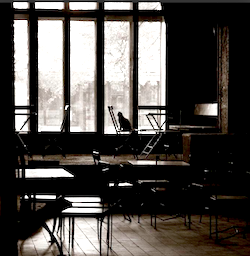
They sat at a small table mid-way into the café, four people around a table really only big enough for two. Glynna looked around at Jason and Jason’s parents, Laura and Ken. Their faces were in shadows in the dark café. It made her uncomfortable to not be able to see them more clearly. She looked down. It was almost impossible to read the little menu that the server had given them. “Why did they have to choose this dark hole of a café?” Glynna thought with more than a little irritation. She rolled her eyes in her mind. She knew why of course, they had had a whole discussion earlier about finding the perfect little café. They had walked quite a bit to get a distance from the more touristy areas of Madrid, so they could experience a real café, where real Spaniards drink their coffee or espresso or whatever it is that they drink. Glynna thought the whole thing was ridiculous. Real Spaniards want to see their menus just like me, she thought. Besides, real Spaniards aren’t in cafes at four pm on a working day, she thought, and she looked around, her eyes adjusting to the dark. Aside from them, there were three other customers, an older man who looked down on his luck and a young couple in their twenties. Students, she thought.
On their way here, they had passed a number of brighter, more welcoming places, places that seemed to offer more hope of actually refreshing them after a long day of sight-seeing, but one after the other was dismissed by Jason and her in-laws as too inauthentic. Glynna thought they were perfectly suitable and said so, but they poo-pooed her, saying things like, “You don’t know when you will ever be in Spain again. Don’t you want to experience it fully?” Why weren’t her in-laws the sort of normal 65 year olds whose feet got tired and who protested at prolonged walking? If their feet hurt they didn’t show it. They seemed satisfied that they had succeeded in achieving their quest for the right café. Indeed, they kept talking about how supremely satisfied they were with the whole trip thus far, how it was a big success. This was their celebratory retirement trip and they had treated Glynna and Jason so they could all go together. Glynna’s parents were watching her and Jason’s kids while they were away. Glynna had not looked forward to it.
She turned toward the large glass window at the front of the café, the only true source of light in the place. It was so bright compared to the dark cave they were in, and yet the light from it seemed to get swallowed up by the room not very far from the window, so that only the tables right near it had any light at all, a soft, blue-ish light that seemed very dreamlike. It must be the time of day, Glynna thought, or the buildings on the street cutting off a stronger light. She thought about the light past the window, the light past the buildings on the street, if only one could get beyond them. Suddenly, she had to get beyond them; she felt she was suffocating in that black hole of a café.
“I need some air,” Glynna said quietly, to the surprise of her husband and in-laws. “I’m just going to talk a bit of a walk. I didn’t want any coffee anyway.”
Jason was the first to comprehend what she was saying, “What are you talking about? I thought you needed to rest? And I don’t think it’s a very good idea. You don’t know your way around.” Ken and Laura nodded in agreement. “Have something to eat and drink to get some energy, said Ken. “It doesn’t have to be coffee. We’ll be walking outside soon enough.” As punctuation Laura added, “That’s crazy Glynna.”
Glynna had her back to the window as she faced them, but she could feel it there, behind her, a bright opening in a black expanse. The close, dank air of the café was starting to make her feel ill. “I’m not hungry. I just need some air. I won’t be long. I’ll just go up and down the block, maybe around the corner. I have a watch. You all relax and have your coffee, and I’ll be back in 15- 20 minutes. Then we can all leave together.”
She didn’t wait for their responses, she just turned and headed out. In the corner of her eye she saw Jason start to rise in protest, but she kept going and he didn’t follow her out. The light temporarily blinded her, as she had been accustomed to the dark of the café, but she didn’t stop. She half-staggered for a brief moment while she headed away from the café. Then, regaining her sense of balance, she lifted her chin and took in her surroundings as she walked.
Where was she? Where was she really? She hadn’t been paying too much attention as they walked in search of a café. She had been too preoccupied with her thoughts about how silly the whole thing seemed. The street was lined with a combination of older and newer building styles. The buildings seemed to be mostly apartments over an occasional commercial establishment. They weren’t very tall, just two and three stories, but the street was narrow, which accounted for the filtering of the light. She needed to get to a more open area. But which way to go? She didn’t want to get lost, she thought, just have a bit of an adventure, maybe go for a walk for a few blocks to get rid of this feeling of claustrophobia that was pressing her in. She headed up the block, and immediately started feeling better.
She felt excited and a little girlish. It was silly, really, she was just going for a little walk. But it seemed like a great adventure. It was so freeing, to be completely on her own. She could walk where she pleased. She felt a surge of energy and happiness. Like a rising balloon. How silly it was! And yet she smiled as she headed for the corner. She had to keep from skipping! She swung her arms and took wide strides swishing her skirt in recompense.
At the intersection she looked up and down the street she had come to. It was just as narrow as the one behind her, but the buildings were more varied, and there were a few wrought iron balconies with flowers. There wasn’t much foot traffic. On her left she saw a man with a bundle of some sort hurrying toward her, and started a bit before she realized with some embarrassment that he was oblivious to her. He scuttled past her, on some important mission. She followed him with her eyes as he crossed the sidewalk, and then, feeling eyes upon her, she looked up. A matronly woman stood on a balcony, surrounded by terra cotta pots of varied sizes, her crossed arms and ample bosom up against the railing. She was watching Glynna and didn’t look away when Glynna matched her gaze. To her own surprise, Glynna felt neither embarrassment nor irritation. She just studied the woman for a moment, then turned away to continue her adventure. “Oh wait!” she thought. “Better check the time, so I know when to head back.” She looked at her watch. It said four twenty. “I’ll make sure to be back no later than four forty,” she thought. She turned to the right and started up the street. She could feel the big bosomed woman’s eyes following her.
This street went a bit of a ways before coming to another. She strode purposefully along, and yet felt very young in the knowledge that she had no purpose, that she knew of, anyway. All the time in the world was in these twenty minutes that belonged just to her. She saw two children, a boy of about 10 and a girl of about 12, bickering good-naturedly on the stoop of an apartment building. A man in a sleeveless undershirt came out, and in a manner that was hurried, annoyed and loving all at once, began herding them into the building. Feeling her gaze, he looked up and caught her eye. She smiled, and he smiled back, shrugging, as if to say “Kids! What can we do?” She smiled more broadly, nodding in understanding. His smile grew in return, revealing crooked teeth. The boy said something, taking his attention momentarily. He spoke in the same exasperated and affectionate tone, swatting the boy on the back of the head as the boy took the last step over the threshold into the building, all the while continuing his stream of exclamations. He then turned back briefly to wave and smile at Glynna. She waved back. Then they were gone.
Glynna took in the sudden quiet for a moment, then looked behind her back down the street to the balcony where the woman had been watching her. The woman was gone as well. She was on her own.
She continued in the direction she had been walking, but suddenly was not as lighthearted as she had been just a few moments ago. Something about seeing the man with his children left her feeling a little bit sad. An irrational part of her wanted to go back to the building and find them. She imagined trying to talk to them in English and all of them smiling together in kindness and acceptance even though they could not be understood. She imagined lightly stroking their beautiful dark hair and giving them each a cookie, which was silly since she had no cookies. Her fantasy was interrupted when Glynna became aware of a man whistling behind her. She whirled around, and there was a handsome man, who looked to be about forty, wearing an oddly out of place traditional Spanish costume, with a full black cape and a black hat. The cape had a red lining. He wore breeches that had beautiful embroidery up the sides. He smiled and stopped walking as she wheeled around. “Señora!” he greeted, in an admiring and obsequious manner, and then took a deep bow. Glynna felt herself flush crimson, even while she was thinking, “How ridiculous! He must be part of some theatrical tourist thing.” Then she wondered, irrationally, “If he knows I’m a señora why is he following me?” Panic welled up in her as she regarded him. He looked up and gave a rakish grin. He seemed ominous all of a sudden. She turned and ran.
She ran to the next intersection and turned left this time. She could hear faint laughter behind her. The street was short and she turned right. This time the street went for a bit before going under a highway of some kind. She entered the underpass, still running. After reaching the far end, she leaned against the concrete wall of the underpass to catch her breath and looked behind her. No one was there. She sighed with relief. Still, she felt unsafe in the darkened tunnel and determined to go a bit further to get back into the light.
When she exited the underpass, she saw what appeared to be the back of an athletic field, maybe of some municipal park or a school, she couldn’t be sure. She scrambled up a grassy hill into the field, next to some bleachers and then looked around. She was alone. She decided to get away from the bleachers, which were still too close to the street, and move to the buildings across the field. She felt that there she could catch her breath back and get sensible, before heading back.
She walked quickly across the field looking both ways. No one was there. A stray dog was nosing around in the grass. She got to the buildings, which turned out to be restrooms. She leaned against the red brick wall and closed her eyes. “What was wrong with her?” she thought. “Was there really any danger?” She thought about the caped man. He didn’t follow her. Maybe he was just having a bit of a laugh. No, she concluded. His intentions were unclear. They were forming before her eyes. Still, she had managed to get away. Nothing bad had happened.
She stayed against the wall for a while. Okay, she thought. Time to get back. No need to tell them all that happened, though. It sounds crazy, anyway. I can’t bear to see them exchanging looks. But, I should head back now. She looked at her watch. It was four forty. “Oh shit,” she thought. She hurried back across the field. If she really hurried, she could get back in ten minutes. They’d be put out, probably, but there was no way they’d be done with their coffee and cake, or whatever real, authentic Spanish pastry they would be eating. The worst thing would be having to hear once again about how she has no sense of time. She did not want to go back through the underpass but she felt she had no choice, as she did not think she could find her way back otherwise. She entered the tunnel, and saw to her relief that a small group of young men and women were at the far end walking toward her, laughing and talking. She started feeling much better, and headed back through the tunnel. “It was just weird,” she thought. “No reason to be freaked out for the rest of my life!” she chuckled.
At the other end of the tunnel she emerged back into the late afternoon light, determined to hurry back to the café. She hustled back up the long street to the next intersection and turned left. So far so good. She recognized the short street, picked up her pace and quickly got to the next corner. She turned and head up that one, quickly glancing at her watch. It said four fifty. She strode faster. “God this sucks!” she thought. All the fun and excitement that had been hers when she left the café was drained away, replaced by stress, anxiety and resentment. This hadn’t been her fault! She had been menaced by a stranger, a caped stranger, for godssakes and had to get away from him! But she could hear the condemnations, Jason angrily accusing her of having been selfish or, worse, of being incompetent and hopeless when it comes to finding her way. She could see Laura shaking her head, Ken trying to mollify Jason, while gently chiding her like a child, “You had us very worried, Glynna.” She dreaded the scene; she didn’t want to return even as she ran up the street. Time suddenly felt like pressure in her head, like a thin sharp pain, like a high pitched sound. She became acutely aware of each minute. She could make each minute stretch out, she thought irrationally. It felt that way. She could cover all the distance she needed to because time was moving more slowly for her. But no, it wasn’t true. No matter how much each minute slowed, it still passed, and she hadn’t gotten as far as she wanted, and when it passed into the next minute it tore away part of her with it.
She came, finally, to the end of the street and stopped short. “Fuuhhck,” she exhaled. It wasn’t right. She wasn’t at the right intersection. She looked to her right for the apartment building where the children had been with the kind and loving man, but it wasn’t there. She wondered if she was mistaken, the buildings were all beginning to look similar. But no, she wasn’t. That building had pretty old-fashioned black sconces on either side of the door and she didn’t see those. “Fuck, fuck,” she muttered, turning around this way and that. “I’ve got to go back and figure out what I did wrong,” she said aloud. She started back the way she had just come. “Maybe I was too lost in thought and wasn’t paying attention,” she wondered. “Or maybe that encounter with the caped man so unnerved me that I didn’t walk the way I thought I did.” She continued back up the street, but could not find the short street she remembered leaving. “Wow, this is bad. This is really bad,” she muttered. She looked at her watch again. It was five o’clock. “How did that happen?” she wondered. She began to relax, feeling the strangeness of it all. What should she do? Should she just keep going up and down the streets until she found the building with the black sconces? She had no cell phone – Jason had it. Besides, whom would she call? The police? She didn’t even know the name of the café. She knew the name of the hotel, though. She stopped herself. “This is a stupid line of thought,” she told herself. “I have no phone.” She imagined their annoyance turning into concern, then panic, as the minutes passed. She could feel them feeling the tearing away of time that she had felt just a short while ago.
She felt a bit bad, a bit guilty as she realized that she wasn’t entirely concerned with how worried they would be. “There’s nothing I can do about that, and when I’m back they’ll have no reason to worry anymore.” She suddenly remembered an incident that happened many years before with an old boyfriend, Carl. She had been feeling increasingly distant from him, dissatisfied and smothered. They went skiing for the day with friends, and she had made it to the bottom of the run before he or any of them did. Hardly knowing why, she got back on the lift line without him and found herself on the way up the mountain with a complete stranger, a decent-looking young man about her age. He started engaging her in conversation, and she responded, him growing warmer as he began to think that he was succeeding in gaining her interest, she the whole time being very self-aware and acting in a role, like in the movies. She was completely disengaged. Her private thoughts were playing in the back of her mind, even as she conversed with the stranger. She had behaved horribly, she was being selfish and cruel, but in those suspended moments on the ski lift, between her cruel act and the consequences that awaited her at the bottom of the mountain, she was free from it all. From the joylessness that enveloped her when she was with Carl, and the guilt she felt in knowing that she no longer cared for him. And from the guilt and remorse she would feel when she saw the hurt and confusion in his face at the bottom of the run. She was enjoying her freedom. The freedom to chat with a nice-looking guy and to think private, selfish thoughts. The stranger suggested that they ski down together, and she agreed, smiling. When they got to the bottom, she saw Carl waiting for her and taking in the whole scene. She did not give the stranger a chance to say anything more, but said, “I’m here with some friends and I’ve got to go now. Thanks for the run.” She turned away, and headed toward Carl, not caring what the stranger thought or felt, though she could sense his surprised and confused expression behind her. Carl was angry and demanded to know why she had gone off like that. She herself was surprised at how nonchalantly and vaguely she answered. God, she really had closed off, there was no stopping her now. They finished what was left of the day in silence, which she knew was very upsetting for him, but which did not wound her. At the end of the day, their friends drove them to a train station and they headed back into the city. Once they were alone on the train, Carl again demanded an explanation. She told him that she didn’t know exactly why she had left him for a stranger, that she had needed some time to get her head clear, that she didn’t love him. It was a bad and painful scene. She knew she was hurting him and that pained her. Carl was a sweet and loving man; he didn’t deserve to be hurt. She didn’t want to hurt him. He said, “People talk things out! They don’t just say ‘I don’t love you’ and end it!” But she knew that there was nothing to talk about. Nothing they said would change the fact that she didn’t love him. She realized then that she had never loved him, though she had tried and tried. She had spent a year convincing herself and him that she had loved him.
“Well there’s nothing to do but keep walking until I either find the café, a cab or a person who speaks English,” Glynna concluded. She started walking again, resigned to the worry she knew the others were now feeling, but she no longer felt. She was a bit tired, as the sudden departure of her anxiety made her aware of how heavy a burden it had all been. But at the same time, she felt so much lighter that, despite her fatigue, she thought she’d be fine with more walking, albeit at a slower pace. Why race around like a maniac? It wouldn’t help anything to be frantic.
Her thoughts wandered. How did this happen? she pondered. How had she turned into a young child, someone to be lovingly suffered, to receive their condescending smiles, even from Laura, who had been a young wife and mother once? She wondered if Ken had ever directed his paternal tone toward Laura – she seemed so brittle and bright, like a trumpet note, for that ever to have been the case. Anyway, it didn’t matter. She suddenly hated all of them.
The deserted street with its closely packed assortment of buildings would make a great backdrop for a story, Glynna thought. “What tale could I weave here?” she mused. In college she had been a student of literature and creative writing. She had actually penned a few short stories that were published in respected journals. She had been working on putting together a collection when she met Jason. They had met in a laundromat. He was getting his MBA. He was confident, handsome and very attentive. He loved the fact that she was “creative.” He always told people they met that she was a writer.
The light was fading further. It was getting close to dinnertime. People will definitely be coming out soon, she thought. She was on a different street now. Here it was, a dozen years later, and all that had changed, she thought. Jason ran his own wildly successful image-consulting firm. He was hardly ever home during the week. He needed someone to buy his clothes, do his errands, keep their books. That became her. They owned the over-large home she had had to furnish, with all of its “systems”– the sound system, the alarm system, the sprinkler system, the water filtration system, the pool system, the humidity system – which needed managing. They had the two kids, Katie and Eric – here she softened a bit as she thought of them, she did miss them – involved in all their activities after school and on the weekends. And when they weren’t all racing from one place to the next, when they were at home, she could get nothing accomplished with them around. She could gain no focus. It was always “Mommeeeee?” in that calling voice that made her sigh. Or they were fighting and came to her looking for justice. Her writing had fallen away. She felt like a vessel. Like a big mythical Greek urn, pouring out water, pouring and pouring, until it was empty. Could that make a story? “No, it was too boring,” she thought, wryly.
She knew that people should be out at this hour, and yet there was no one. The nature of the street had changed. The buildings were more spread apart. There were patios and driveways between some of them. The lighting was getting dusky. It didn’t make sense that there was no one. Wouldn’t there be at least one person? Suddenly, she did see a light and movement in a storefront. It looked like a little café and pastry shop. She crossed the street and went toward it.
When Glynna opened the door, she saw an elderly woman standing behind a glass counter case. She was short and a little stooped and wearing a black shawl. Her hair was white and pulled back into a bun. She looked up at Glynna with a kind and weathered face and smiled, nodding her head. It was almost as if she were communicating, “Yes, you’re in the right place. I’ve been expecting you.” It was a little unnerving. Glynna breathed in deeply and walked up to the counter. She asked if the woman spoke English, but the woman just kept smiling and did not respond. Glynna pointed to a pastry in the case and the woman nodded, still smiling. Glynna added “Uno café?” and the woman nodded again. Glynna watched her move for a coffee cup and pour the dark brew. She handed it to Glynna with the same comforting and unnerving smile. Glynna took the coffee and brought it to her lips. The woman nodded and smiled, even as Glynna drank, even as everything began to melt and swirl into a blurry run of blue-ish brown shadows and weak yellow incandescent light. The old woman’s face was still there, smiling and nodding, and saying “Si, si. Yes, yes,” until it was gone.
Glynna opened her eyes. She was lying down outside somewhere, a strong breeze blowing across her body. It was daylight, the kind of light that happens in the early morning just after dawn. She started to stand and felt that her legs were caught at the ankles. There was some kind of plastic twine wrapped there, haphazardly, as though she had accidentally become entangled. She vaguely recalled wandering through a junkyard. Perhaps she got caught in the twine there. Had she been wandering all night? How far had she walked? What had happened to the old woman and the strange little shop? Where was she?
She untangled the twine, and it fell away easily. Then she stood up. To her amazement, she was on the crest of a hill, looking out across many hills. The city, or any city for that matter, was nowhere to be seen. All Glynna could see were the most beautiful cypress trees dotting the landscape, swaying in the breeze. The sky was a strange, pale, startling turquoise. It reminded her of the color of the sky in the Dr. Seuss books she had read to Katie and Eric. All there was before her were the sky, the grassy hills, the scattered swaying trees and the strong breeze. It fluttered her skirt and blew her hair around her face. It seemed to be softly saying, “Si, si-i-i. Yes, yes-s-s.” She opened her arms wide and breathed in the clean sweet smell of the air. How long had she walked? What day was this? These questions came into her mind, but drifted out onto the breeze without answer. She didn’t care. Here was the sweet smell and the caress of the breeze, and she, standing on the hill, with her arms extended and her face upturned, and all the thoughts in her head wafting out onto the breeze, which was cleansing her. It was filling her and she was becoming the breeze. She tensed for a moment, thinking about Katie and Eric. She didn’t want them to drift out of her head, she loved them, she wanted to be their mother, to see them again, to take care of them. But it was all right, she thought. She would see them again. They were safe with her parents. It was not goodbye. It was just a moment of peace. She could let them drift out, for just this time. She wasn’t losing them into the breeze. She wasn’t losing herself. She was becoming herself. “Si, si. Yes, yes,” the breeze was saying. “Glynna. Glynnnaaa. Glynna!”
She felt a horrible yank into consciousness, a confusing blur of awareness, and suddenly, with an aching disappointment, she realized that she was in the café with Jason and her in-laws. She had never left. Very little time had passed. The light from the window was only subtly changed. They had not put on any lights yet inside. “Glynna! Were you sleeping? The server is waiting!” Jason chided impatiently. “”You see? You were tired,” Laura declared. Glynna quickly comprehended everything that was happening in the scene: they were in the café, she had dozed off, it was all a dream. But she had been happy in the dream. There had been danger, but she had been happy. She was not happy now. She was desperately unhappy. The server was standing there waiting for her order. They were all waiting. “What do you want?” Jason demanded with a look that was exasperated, paternal and smug all at the same time.
She looked at him, calmly. She was unfazed by his tone of voice. A small smile played at the corners of her mouth and she held her gaze. Her eyes were hard. Jason’s expression faltered. He was confused. Then doubt entered his eyes. All the time in the world spilled into that moment, and Glynna was very strong. “I’ll have a coffee,” she said, not taking her eyes from Jason. Then she turned her gaze to the server and smiled sweetly.
People of a certain age may remember that moment in 1984 when Sally Field won an Oscar for her performance in Places in the Heart. In her acceptance speech she was overcome with emotion. Barely but beautifully managing to remain coherent, she expressed her profound happiness and amazement that despite not having had an “orthodox” career (after all, she was Gidget and The Flying Nun), and wanting so much to be respected as a serious actress, she was now being recognized as such. Or, as she more succinctly put it: “…I can’t deny the fact that you like me! Right now, you like me!!” Immediately there were jokes on late night comedy shows, teasing remarks in the media, sniggering banter among the general public, all indicting poor Sally for being so unabashedly preoccupied, apparently, with whether people liked and respected her acting. “How embarrassing! How neurotic! How nakedly needy!” went the chatter, and all nodded in agreement. It became something of a meme, pre-internet, and even resurfaced nine years later in The Mask, a bit altered but still clearly a grotesque homage to the original, when Jim Carrey’s Loki character suddenly receives an Oscar in the midst of his violent encounter with the bad guys. Carrey tearfully and vehemently grasps the statuette and sobs, “You love me! You really love me!”
Even at the time of Sally Field’s speech, I remember feeling a bit peeved by all the ridicule, mainly because it was Sally Field for godssake and who doesn’t love her? So what if she gushed something that sounded a bit too self-revelatory when she accepted her Oscar? It was an unbridled moment of shock, joy and gratitude. Who can be poised under those circumstances? Oh wait, we can. At least, that’s the myth, the standard, the expectation we all accept as gospel. No matter what, don’t reveal uncertainty, insecurity, or a care of any kind for what people think of you or how you are coming across, for that is weakness. And what do we do when we see weakness? Mock it, cluck our tongues, or thank god we haven’t displayed it ourselves. We align ourselves, so we imagine, with the strong, the confident, the unconcerned.
Now, however, on the back end of my presumed 100 years of life, I realize keenly that the myth is its own form of weakness. To be so comfortable in your own skin that you are truly unconcerned with how you come across, so that you neither avoid nor pretend away displays of uncertainty, doubt, or even idiocy is the sign of real confidence. It is the deniers, the mockers who are the poseurs. Their derision highlights their fear of being caught in the act of not being self-assured. The people who actually know me best may understand that this is certainly what I’d like to believe, anyway, for they know or at least suspect that I’ve been preoccupied for a good chunk of my life with how I come across to others. Huzzah! I’m free from it now. Finally and irreversibly free from that concern, but oh, how it plagued me! And I daresay it plagues a lot of people who never admit their affliction or even fully understand that they have it.
I knew I was preoccupied with the judgment of others from an early age; I kept my head down as much as possible. I was quiet with my peers, constantly scanning for whom it was I needed to avoid, or not antagonize, or win over if I were to evade being found out as the strange, uncool, uncertain creature that I was. My first taste of blissful freedom from this preoccupation came at age 12. It was then that I went to sleep away camp. It was a rough and bumpy first 3 weeks. What everyone chalked up to homesickness was actually misery and fear from being among peers who might brand me a loser. It was a misery I experienced all through 4th, 5th and 6th grades, culminating in that summer at camp. I spent a good deal of time in the bunk of my 15 year old sister, sitting on her bed during free periods, learning macramé from the other girls in her bunk, or asking her to let me brush her hair (and surprisingly she did!). I never was so worshipful and doting and meek toward that particular sister as I was that summer, desperately subduing anything remotely pesky lest she banish me and I be cast adrift in the sea of my own bunkmates, all of whom seemed more self-assured, more popular, and more cool than I. Then, at the end of the third week, something extraordinary happened. I overheard two cute, adorable girls, whom everyone respected and admired, conversing about how nice I was! What happened was this: I was using the bathroom in the bunk when this girl Pam thought it would be funny to spy on me from above the divider. I was so surprised and mortified to have my private appointment with the toilet thus invaded, that I literally fell off the seat and cried out, resulting in a rush of girls to the scene. To my amazement, they started berating Pam for being so gross, so mean, so invasive, instead of laughing at me. In a dazed sort of aftershock from the whole affair, I wandered outside to the porch and sat down on a bench. Across the way were the two bunk darlings, Arlene and Mindy. I sat down just in time to hear Arlene say, “I really like Elisa, she’s so nice,” and Mindy answer, “Yeah, I really like her too, she’s so sweet.” They then looked up and saw me sitting there, and we all started laughing in sheepish embarrassment. Except I wasn’t just embarrassed. I was amazed, over the moon, astonished, delighted, so profoundly happy and confused. Could it be? These girls whose imprimatur of acceptance I could have only dreamed about actually enjoyed my presence? It was a seminal moment in my life. I transformed into a happy camper, literally, and proudly mixed in with my bunkmates as one of them. Camp became a place where I was free from the warfare of the cliques and popularity and meanness I witnessed back at elementary school, and it became so dear to me that I cried when it was time to leave. As I had been crying to my sister and my mother for the first 3 weeks about how I wanted to go home, this was somewhat perplexing to them, but nevertheless a huge relief for my mother who no doubt had been fluctuating between guilt and exasperation.
From that moment on the bunk porch, when I metaphorically clutched my own little award – I can’t deny, you like me! Right now, you LIKE me! – I developed greater ease, and a perspective on the wider world of social opportunity sufficiently broad enough to start looking for friends with whom I could connect. I stopped worrying about or trying to impress kids I really had nothing in common with and certainly didn’t genuinely respect. And in that effort I had wonderful success. I ended up having around me the most amazing authentic friends I could have hoped for. I was comfortable enough to be my goofy self. My more or less emotionally brave, honest, loyal, genuine, and caring self.
Then college happened, and once again I was thrown into a sea of young, uprooted and somewhat unsure and often posturing youth. My radar went back into primal overdrive. My information was distorted of course. I believed that everyone had someone to go to dinner with, everyone felt connected, everyone was cool, and everyone had a troupe from his or her freshman hall to rove with. Everyone, that is, except me. It never occurred to me that many others, if not most, had the same concerns of appearing easeful and smooth. And while, over the course of the four years, I slowly, slowly recovered from that setback and convinced myself I wasn’t the complete buffoon I feared, I never quite made it all the way back to that state of grace I found in high school among my dear, dear friends and family. And then, in a still somewhat overly self-editing and internally awkward state of mind, I unfortunately launched into law school and after that a corporate law firm (GAK!), a magnet for aggressive competitors and desperately posing associates who only know about half of what they pretend to know. Even the law partners, who must convince everyone and themselves that that are authorities, because verdicts or millions are at stake, know what they are doing only about two thirds of the time. I know this now, especially after having been married to one for a couple of decades. Not only that, I now understand that this is true of just about everybody. People can only do the best they can, and sometime they are doping it through like everyone else. (Except for blockheads who insist on things they know nothing about instead of actually opening up their minds and taking in information. Those jackasses only know what they are doing about a quarter of the time, if that.)
But back to my immersion in the larger adult world at the age of 25. In this toxic soup of competition, insecurity and posing, I floated. In a new city, far away from family and friends, I began the process of trying to swim, to find my authentic center all over again. Only this time, I didn’t make it anywhere near as far. Let’s just say I entered a prolonged period where I carried the fear of how I was coming across like a block of stone on my back. A fretful monitor in my brain carefully edited my choice of words in the nanoseconds before they came out of my mouth. It scrupulously screened my gestures and manners for anything remotely coarse, naïve, unworthy, insecure. I was consumed by insecurity over seeming insecure! I went over things that happened or that I said after the fact and shrank with mortification over how I could have been such a dolt. I met and married someone floating in that same toxic stew, and we moved to an affluent suburb of carefully practiced gentility, where we felt even more like poseurs. Where parents boasted about their genius children, and tried to appear nonchalant entering or living in huge country versions of mansions with extensive grounds. Where it was so easy to believe that everyone but you always remains assured, elegant and graceful, self-possessed in their movements and tone of voice, even behind closed doors.
What was it that freed me finally and irrevocably from all the dread and self-editing? Well, I do still edit myself somewhat, but these days my only filter is a desire to be kind. It took me until I was 52 to really, really understand that pretty much all of those overly self-assured people are full of shit, and that the truly, truly cool genuinely don’t care if they seem clueless, awkward, or temporarily needful. They are unembarrassed to seek approval or support. They know that everyone is unsure some of the time and it’s no big deal to admit it. I can’t be sure what it was that suddenly led me to open my eyes. To see and even hear the uncertainty and false bravado in so many people around me. To thrust off the expectations or standards of acquaintances and even friends who themselves are worried about the whispers and opinions of others. Maybe it was my utter exhaustion. Maybe it was the journey I went on to find out what it was I really cared about. Maybe it was watching my own children struggle with these same issues. I want them to know that the truly cool, ironically, are the very people who think nothing of proclaiming in moments of absolute joy and relief and gratitude, “You like me! And I’m so glad!!”
The final irony here is that once I was completely free from the worry of whether I was poised and likeable, whether I blended, I started putting others at ease. I started cracking more jokes, and making more honest or personal remarks. I started expressing my uncertainty about something in the most forthright way, and to my astonishment people responded with relief! With gratitude that I expressed something they also felt but didn’t want to admit! With unsolicited compliments about how natural, genuine and comfortable in my own skin I was! In short, they gave me awards, and in my mind I happily accepted them. You like me! You really like me! It was so freeing. So easy! I could be myself. And I wish I could tell her. I wish I could say, “Sally, you are my hero! You deserve an award! Not because you risked being so naked, but because you didn’t hesitate to consider it a risk at all.” If only I had understood way back then.
It all happened in miraculous, slow motion, where I could see everything unfold in real time. Before I took the leap, I could see her very clearly on the other side: a young adult of 21, making judgments I questioned, displaying behaviors I thought were needlessly risky or abrasive or impatient, or whatever it was that I thought needed adjusting, and most definitely irritated by her ever gently lecturing mother. We were at a celebratory function, where alcohol flowed freely, and spirits were high, and in the moments before my leap, it actually slipped out, “Oh honey, no, don’t you think you’ve had enough?” Rosy and free-spirited as she was feeling, eyes twinkling, she laughed me off and said something like “I know my limits, Ma. I drink when you’re not around, you know,” and she graciously let my fretting pass. That was the moment when I saw it all. I understood fully and for the first time that I could indeed consciously choose to jump over the divide, that gulf growing between my daughter and me, which I had formerly identified but felt helpless to prevent. I was actually in a somewhat altered state myself, so it truly was a miracle that I was capable of the clarity, but there it was. My daughter was an adult, albeit a young one, at a party, and I was a drag, tagging after her, fussing about her choices. And in that slow instant, I imagined myself, back at college, at some frat party, drinking freely, as and when I wanted, dancing to the band and alighting from one cluster of acquaintances to another, all with my own mother following me around and hoarsely whispering in my ear, “Oh no, honey, don’t drink that. You’ve had enough. Sweetheart, don’t puff on that joint. You don’t know if it’s laced. Don’t you think you should stay away from that guy? He’s looking at you like some piece of meat.” Of course that never actually happened, but what if it had? It would have been unbearable. A wet blanket. A block of cement. My own shoulders sagged at the weight. I was mortified. What was I doing? How had I become this, and what would happen if I persisted?
Suspended in that moment, I could see the choice laid out before me: remain or leap. On the one had, if I remained, I’d forever have my little girl. The one who nodded in everything I said with wide, accepting eyes, who unquestioningly gobbled up my care and my wisdom and felt safe with me.
found on browneesorchids.hubpages.com
If I jumped over, wouldn’t I lose her forever? But if I stayed where I was, the adult she had become would move father away, wouldn’t she? The fissure that had widened from crack to sizable crevice would keep spreading, to a chasm, with the terrain on the other side becoming ever more strange, alien, even. I’d be that mother, that all too common figure, of familiarity and comfort, yes, but a fossil one liked to hold briefly now and then and returned to her place. Someone with no actual relevance in her daughter’s daily life. Someone who offered unsolicited and pointless advice while her grown child silently and internally groaned. Who was relegated to small talk or obligatory, condensed nuggets of news, because the relating of genuine emotional or social events or interactions would inevitably lead to “helpful” suggestions and moralizing, instead of the commiseration or comfort being sought. It was not enough that I had already begun to occasionally share my inner thoughts and feelings with my daughter. That I threw across a rope bridge, a welcoming beacon to see me as a woman, a friend, a confidante, capable of doubt and insecurity, hurt and confusion. In that slow moment, in that protracted dilation of my pupils, I understood that so long as I continued to use whatever opportunities came my way to get in that extra bit of guidance, that last bit of shaping before my chances ran out, I would remain on one side and she on the other. I’d turn into a fixture she’d come back to visit now and again, and not an organic, dynamic contribution to her life. Indeed, I could see that I had already been retired from my position as guru, only without my knowledge or assent, and was merely being treated like a teacher emeritus, except not even as that, not even good-naturedly humored, but begrudgingly and half-heartedly respected. Why this all struck me like a mallet in that one moment is beyond me. Was it because instead of rolling her eyes my daughter laughed me off? Because her ease in not even engaging me served to highlight how redundant I had become?
But, I wondered, in a last little bit of desperation, didn’t she need me to be her barometer, the voice of reason in her head? Wouldn’t she go off the edge, make a dreadful mistake, ruin her life? I had to answer, had to come up with a defensible rationale in that crazy slow moment of reflection and grace I was offered. And my answer was no. She would not. I did not, when I was at those frat parties, my mother nowhere in sight. I had my own voice of reason, my own measure of what felt comfortable and right, some of it derived from the common sense I developed under my mother’s watchful eye, and some of it wholly new, a considered rejection of her philosophies and fears. My grown daughter had no doubt similarly rejected large swaths of my reasoning as wrong-headed, hysterical, obsolete. Right then and there I made up not to interfere in her behavior or act to protect her unless the following threshold was met: would I say something if I were in the exact circumstances with her at her age, as one of her peers. If I were at this social event with her as a 21 year old, would I suggest that she’d had enough to drink? No, I would not. I’d just be her companion, and laugh with her at her somewhat drunken behavior. As a 21 year old, I’d only state concern or interfere if she became incapacitated, and needed looking after. I’d be that trusted friend who’d lead her outside for some air, or to the ladies room for some prayer at the porcelain throne. That’s what she’d welcome. Not a tut-tut-tutter but someone with whom she could be an unedited version of herself.
So I leapt. I kept my mouth shut and simply laughed with her through the course of the evening. I’m so glad I did. I noticed that I started hearing more about her evenings out with friends or, a mistake she’d made but had worked out on her own, or something that came back to bite her or hurt her feelings. And, it turns out, my little girl is intact, in my memories, our sweet and lopsided relationship unblemished by the sighing and eye-rolling and frustration that threatened it in the recent past. Sometimes I glance back at her lovingly, before accepting my adult daughter’s invitation to stroll with her in new territory, as equals.
mother and daughter by Claudia Tremblay, found on etsy.com
My father and I had a secret ritual, which began before I can remember, and finally came to an end, as was right and necessary, when I was about 11 or 12. I stumbled upon the ritual; it was of my making, but my father was complicit, and I like to believe he valued it as much as I did. It was how he told me he loved me, other than his occasional grabbing of my upper arms and saying through clenched teeth “Flesh of my flesh! Blood of my blood! BONE OF MY BONE!” while shaking me with just enough force and with his eyes gleaming to let me know it was a game. It was indeed better than his parentally crazed shaking, because it also showed me that he trusted me to see his limitations. His vulnerabilities. His steady and sure plodding. His humanity. And it was how I told him that I adored him more than I feared him, which was plenty.
I understood from about the age of 4 or 5 that my father was a cop. Not one of those college educated officers who now fill the ranks of New York’s Finest and put in just enough time to earn a pension and become a genuine part of the fraternity. He was a cop for 31 years, and saw all his peers disappear into the safety of department administration, building construction, or shop ownership, while he continued to walk his beat and the neighborhood around him continued to break down a little more each day. But as I had no real understanding until I was much older of what he did day in and day out, or that being a cop in the South Bronx required being some kind of always, thought just barely, restrained powerful force, I wasn’t afraid of my father because he was a tough cop. No, I was afraid of my father because, cop or no, he was indeed, for some reason I could not comprehend, a barely but always restrained powerful force, and that force was rage. He was a man of few words, and most of those were explosive, passionate, impatient, menacing, or, suddenly, unpredictably and almost unnervingly jolly. He was a man who took things in quietly, but let things out noisily. He was someone I had to watch closely to know whether he would be receptive to my approach, my question, my hand on his knee. He was someone, I learned early, who tolerated no inconvenience or any conversation that lasted more than a few sentences. I vaguely understood the way a 5 year old can that my father was in constant battle for his soul. His overbearing and vulgar parents, the streets, the dangers of his job, required him to be hard boiled. But he didn’t want to be hard boiled. He was Ferdinand the Bull. He wanted to sit under the cork tree and smell the flowers, or, in his case, read a book and smoke his pipe. He wanted to dance a rhumba with his wife or play his violin by ear, laugh at something silly or recite lines from Cyrano de Bergerac. And more than anything else, he wanted not to have to steel himself everyday for the bullfight.
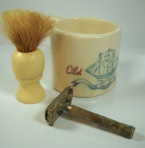
My earliest memories of watching my father shave consisted of me standing quietly by the door of our small bathroom, knowing not to say a word or else risk banishment. I was able to pretend that I was simply waiting for my turn to use the bathroom, the cub ceding to the protector of the pride. I watched with my big eyes, as my father moistened his shaving brush and whipped it around deftly in the yellow-white mug until I could see a creamy foam form on the bristles. I watched as he rubbed the foam all over his face, and then took a single-edged razor to his face. My father shaved up, against the grain of his stubble, causing that scraping sound which to my young mind only proved how tough and brave he really was. And when he was done, had rinsed whatever thin strips of soap remained, had patted his face with a towel, he poured some strange green liquid from a bottle into his hands, slapped it on his face (the sounds of the slaps further proof he could take it, take it all), and grimaced from what I surmised was the same sting I felt when my mother daubed my cuts with alcohol. I knew I was watching something ancient. Private. Sacred, even. He was our warrior putting on his game face. Risking cuts, and stings and sometimes having to paste on little pieces of tissue to stem the bleeding, all so he could go out to do what he had to do. I could feel the dread, wincing internally before I could even hear the scrape, scrape, scrape and the inevitable slapping, and smell the stinging green mystery tonic, whose only purpose seemed to signal the end of the ceremony. A sharp punctuation mark, accompanied on occasion by the intake of air through his clenched teeth, or, rarer still, offered for my benefit, to allay the solemn concern in my big eyes, the big and worried eyes of his most sensitive and soft-boiled daughter, a robust exhalation “Ahhh!”
When I was seven, we moved to a house in the suburbs. My parents suddenly had their own bathroom, and my sisters and I had ours. So, for a little while, no longer having a reason to invade the bathroom he was using or any excuse to stand and wait at the door, I forgot about my father’s shaving. But one day, seeking him out for some purpose, perhaps sent on an errand of information for my mother, I found him in his bathroom shaving, wearing his preferred sleeveless undershirt. And this is where our true ritual began. For though I had no pretext to remain, I did. I took my place sitting atop the closed toilet seat behind him and a little to one side, and silently began watching him once again. And my father looked at me in the mirror only long enough to catch my eye, to tell me without words that it was okay for me to remain in his bathroom, the place of his most private ablutions, grooming and thoughts, so that I could watch him shave. I was allowed into that private space. Because I was silent. Because I would know when it was time to leave. Because in my mute presence I commiserated with him about the unending source of stubble rising out of his face. Because I studied and took vicarious pride in his technique and acknowldeged how he persevered in his unflagging duty to shave, and, more than that, shave well. Because it reassured me. Because I left him alone in his thoughts.
Over the years, I would return frequently to my perch on the toilet, gliding in without a word, and gliding out again once the tonic was slapped on and the brush rinsed, squeezed and reshaped. Sometimes, very, very occasionally, I’d move closer to get a better vantage point, but only when I sensed he’d allow it. Regardless of my exact positioning, we both knew that his letting me watch was his way of saying he loved me, trusted me in this private space, this private occasion. Appreciated my solemnity and my softness. Would never intentionally try to toughen me up or pressure me to be hard boiled. And we both knew that my watching him was my way of saying that in those moments I was not afraid. I could see the man behind the rage. I could see and love my father. I never asked him if my sisters came to watch him. And I never talked with them about it or mentioned it to my mother. I wanted it to be something that belonged to my father and me alone. I wanted to be the only one he allowed in. The only one who knew how to be silent and appreciative of his daily commitment.
Eventually, of course, I stopped coming to watch him shave. I started growing into a woman, and could no longer be the adoring young girl. There was no one seminal event, no ceremonial last occasion. It just stopped somehow, and I didn’t actively think of it again for many years. I didn’t think of it again until almost 40 years later, when I had the opportunity to once again watch a grown man shave. You see, my husband of over 20 years kept a beard. Interestingly enough, his primary motivation for having one was so that he wouldn’t have to deal with the unrelenting tedium of shaving. I never had the opportunity to watch him shave, and I never even really thought about what I once so treasured… Except that having come across a display of men’s shaving items some years ago, I bought myself a bristle shaving brush on impulse, and told myself it would be great for my legs… And except that when I use my brush and get a head of lather, I feel a tinge of pride and silently think about how foolish all women are and most men, not to use one.
So, my husband and I no longer together, I fairly recently watched a new man shave. This man shaved down, with the grain, and he used cream out of a tube. But he also bragged with obvious relish about how he once let a barber of dubious reputation in a foreign country shave him with an old fashioned long-handled straight razor, so I sensed a true shaving enthusiast might lie within. And despite the cream out of the tube, which would require the far less elegant rubbing on with fingers, I felt the stirring of my delight and keen interest. I couldn’t tell if this was due to the fond memories I had of my father, or proof that here too, I was sharing in an exchange. Different, yes, but still admiring. Still loving and still unspoken.
My son told me recently about a driving “adventure” that he and his buddy went on. The rules of the adventure were this: you drive straight ahead until you reach a T intersection, and then you have to turn right. You continue on straight, or making right turns, until you can go no further. While I was digesting the idea that, only by pure dumb luck I didn’t get a call from Chicago, or Terre Haute, telling me not to worry, they’d be back the next day, my son related with relish and a bit of cackling glee how they ended up in what could be described as the slums of Danbury, CT, a mere 35 minutes away, in a dead end by some housing projects. “Why always a right turn?” I asked him.
“It’s easier,” he said, with a look that said, “D-uh!”
I had reason to think of this driving game again when my friend Diane told me about her current heartache. She had met a man on the west coast when she was out visiting her grown daughter, and their chemistry had been immediate. Apparently, they lit each other up, body and soul, like a generator plant on the New Jersey Turnpike. Because she’d go out 2 times a year to visit, she was able to spend extended time with this man, and they fell deeply and madly in love. Skype and phone calls carried them between visits. After a few years, the time had come when they began contemplating combining their lives, but because both of them had strong family, social, professional, even soulful ties to their own communities 3000 miles apart, they faced some tricky obstacles. They had started talking happily and dreamily about splitting their time on each coast, assuming they could find the way to make their professional activities more portable. While Diane had no friends or community connections on the west, her daughter was there, and she looked forward to the adventure of gaining new friends and activities there. And she would still be spending plenty of time with her family and friends on the east. Her man had both family and siblings on the east, and his kids on the west were virtually grown, ready for their own adventures. Nevertheless, this great love of her life seemed to be balking, talking with anxiety and dread about the huge changes necessary for them to be together on a day-to-day basis. He thought he’d be able to carry most of his work with him, but what if he couldn’t? What if he missed his much larger social circle on the west too much? What if he hated living on the east coast, with its gray cities and variable weather? What if, to accommodate him, she ended up spending more time on the west and began resenting him? What if their projected net worth as a pair really wouldn’t be enough to sustain the kind of lives to which they were accustomed or the resulting travel costs? Diane began feeling hurt. Based on what she understood, these possibilities did not seem likely. And wasn’t their love worth the changes? Wouldn’t the day-to day-joy of being together make everything else seem manageable? Fun, even? She wondered if he had just been indulging in a dream of love, one that evaporated when compromise became necessary, while she had been committing her heart.
“It’s not that,” I told her. “He’s just afraid to make a left turn.”
“Huh?” was her response, but I saw from her face that she could already sort of grasp where I was going.
“Diane,” I said, “this is probably the first left turn this guy has made in about 25 or 30 years.”
Dick Grossberg – CD Clocks
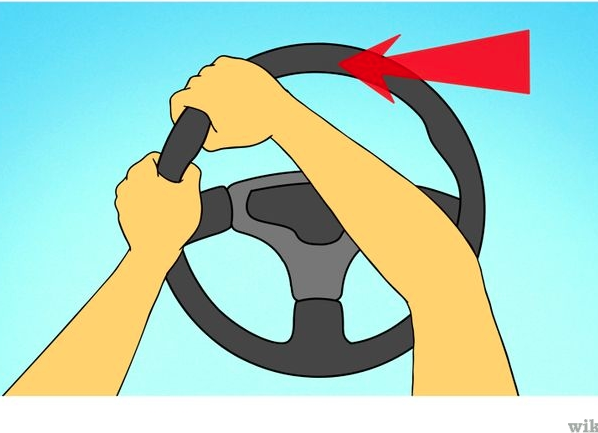
Despite the rules of my son’s driving game, young people make left turns all the time at the craziest intersections. They deliberately put on their left signal, having possibly decided at the last minute that’s where they want to go. They move out in the middle of the intersection with all the attendant risks, and nimbly or not so nimbly make it happen. Sometimes with bravado and confidence, sometimes with elevated heart rate, drawing in breath through clenched teeth or muttering “fuck” under their breath, but they make it. They follow a college sweetheart to a new city, a new country even, with no real plan for their future. They quit a job they realize is making them sick or just not leading anywhere they particularly wanted to go, and begin an entirely new career or profession from nothing. They decide they will go to Bhutan before they settle down into a routine life, and suddenly discover a burning desire to become a Buddhist monk. Why can they do this? Is it just because young people are braver? Do they take more risks because they don’t have the life experience to think through all the possible negative consequences? In other words, are they blissfully ignorant?
I think that is definitely so, but instead of worrying on their behalf, which they never appreciate and indeed chafe against, I think we should take a few lessons from them. I used to be one of those mothers who always offered a nervous litany of concerns and fears about her kids’ choices. Offered the litany without solicitation, of course. It just bubbled up out of me, like a compulsion, and I convinced myself I was doing the right thing, counseling my naïve and judgment-impaired children, throwing water on their fires. It started when they were very young, and became so ingrained in me as a protective impulse, that at some point I couldn’t be any other way. I immediately went to that place where everything that could go wrong would, and into the dread, of course, I factored in the weighty heartache and fresh worrying I would personally experience when things inevitable turned sour. What a drag! How did I get so negative and fearful? And I’m not even remotely as negative as most people I know!
What saved me? I started noticing, finally, that there were some people who, when I mentioned something my kid was going to do, something that I felt okay about, would start going through all the things that could go wrong. They set forth all the reasons I should discourage my child. I started noticing that these were the same people who plan out every detail of their vacations, and always find it necessary to proudly point out how they were able to get a spot close by to an event because they charted out their course days earlier and made sure to arrive an hour early. All risk is managed away to provide as smooth a ride as possible. No supporting a kid’s dream, because a dream isn’t practical and almost certainly will fail. No pursuing their own dreams for the same reason. And certainly no left turns! So many of us will continue down a path that really isn’t suited to us, that is leading us astray or to a dead end, rather than make a left.
But perhaps it isn’t just the ever-spreading tumor of worry that drags us down, away from the risk and the rightly earned delight from successfully making a left. After all, when we are older, our vehicles are longer. Instead of a zippy little car or jet ski built for one, maybe two, they are freakin’ tractor-trailers, or huge tankers that carry all the people, responsibilities and ties we’ve accumulated. They don’t turn easily. They take up the entire intersection as they swing round, creating a disturbance, and threatening to upset our cargo. It makes sense to avoid that left! But is it sense or fear that keeps us from taking it? Is it our forgotten skills or long buried sense of adventure?
I know of people whose lifestyles involve changing locales every 5 or 7 years for professional reasons. Their craft never seems to get too big to turn. They find fun and adventure in every new place, and remain nimble, flexible, daring. Sure, moving is a pain, but they do it with good cheer and make the best of it. They have many friends all over the country with whom they keep up contact and visit. They have safe ports all over. But for those of us who stay in one port for too long, our crafts just seem to get bigger and bigger, maybe even stuck, and other ports begin to seem foreign, scary, hard to navigate, not worth the effort.
Maybe our crafts are not as big as we think. Maybe we just haven’t made a left in some time and we’ve lost the stout heart for it. I think even a person who once led an adventurous life for many years can lose heart if they’ve been settled for a while. They might even still make the occasional right, which isn’t nearly as scary, and tell themselves they’ve been making lefts.
No question, the left turn is far more challenging, even dangerous at times. And yes, being parked, or going straight, or even turning right is much safer. And maybe the surroundings we’ve been in for such an extended period of time are wonderful in many ways that we are loath to give up. But maybe what lies to the left is the promised land, the incredible place we never found because we just wanted to avoid that left. Maybe, if we go for it, we will discover that our craft, while indeed carrying a load, isn’t really that huge and heavy after all, and that we can in fact travel back and forth, keeping the delights of our old port while discovering even greater enchantments at a new one. And in the process, maybe we might realize that the young do not have the market on adventure and exploration, and that there is something to be said for venturing forth without a clear sense of what could happen. Maybe it keeps us young, and what’s wrong with that?
I told Diane, “Tell him to turn on his signal, take a deep breath and get ready for the adventure of a lifetime. Or get on board and remind him how.”