The four million plus views this video has had is proof that a playful, open heart and the ability to experience joy are just as vital for the betterment of humankind, and require just as much genius, albeit of a different kind, as the talents of intellects, philosophers, mathematicians, artists and scientists.
I recently realized that my lifetime struggles with singing mirror exactly my lifetime struggles with self-acceptance and self-expression. What a cliché.
saved from my-diy-crafts-tuts/.blogspot.com
From the age of 5 or 6, singing was a source of joy, of wings for me. Apparently, my rendition at the age of 6 of My Favorite Things, from The Sound of Music was notable enough that my camp counselor pulled over some of her counselor friends for a repeat performance. But just as I was always scanning my family, friends and peers for cues that I wasn’t quite up to par, I was also always very sensitive to any negative criticism about my singing, and it always trumped whatever genuine smiles I also sometimes elicited. At my Bat Mitzvah, one of my 13 year old guests told me after the ceremony that the Kiddush was not meant to be sung with vibrato. Not ever having had a voice lesson, (or even really understanding what vibrato was) whatever vibrato I had was naturally present, but apparently that was a bad thing. It didn’t help that during my high school years the choral director was an ornery old man with a bad temper and no business working with students. He called me out once in front of the entire choir for singing nasally. He had me sing the phrase “Christe eleison” over and over, slamming his baton each time while he mocked me with an excessively nasal rendition, but never bothering to explain to me how to open the sound. Mercifully, after the third time, I magically, and without any understanding of what I was doing differently, landed on an a clear resonant sound, and he actually raised his arms and proclaimed “Hallelujah!” I understood, of course, that everyone’s mortification was not due to my nasal singing, but due to the dreadful awareness that this could have just as easily been them being humiliated. But I also understood that there was something pathetic, inferior, about my singing. I doubted it constantly.
The problem was, of course, I cared too much. Singing made me soar. It gave me a means to express my heart, my understanding of pain, love, sauciness, peace, and confusion. And somehow, it also became an offering of myself, so that any shortcomings or rejections were a dagger into my own breast.
borzui.tumblr.com Alireza Borzui
I sought voice lessons with extremely unqualified people, who taught me no technique whatsoever, and was consistently placed in the second soprano or even alto sections of choirs, due to the vocal strain I’d exhibit whenever I tried to go into the soprano range. The problem with this was that I had no strength in the alto range either, and so, with a weak sound, limited range and no understanding of my abilities, I lamely persisted, trying to achieve flight, still sensing just out of reach a joy like no other, and yet also feeling clipped, inadequate, and confused as well. In other words, singing became a very emotionally fraught activity for me. A minefield. I was as sensitive and wounded as I was determined.
For a few years, I seemed to find my place. I sang with an a cappella group in college, doing standards with complex harmonies. My group, The Chattertocks, had an old-fashioned sound, and provided a home for my particular kind of singing, gentle and sweet. As my confidence grew, a few friends of mine noticed and actually told me that I had a beautiful voice, making me happier than they could ever imagine. But once I graduated from college and went into the larger world, my singing tapered off dramatically. I had none of the training or technique for classical singing, the only kind I found available for amateurs, and a short stint with a chamber choir was nothing but a continual fight for my life. In one strange moment, the conductor pointed out to the entire group how I was the only one on my part who consistently came in at the proper time, and how this should shame them all since I the weakest at sight reading and had the least musicianship of the bunch. Yikes.
Then two developments occurred that contributed to my shutting down. One was that my new husband didn’t seem to enjoy my singing very much. He told me fairly early on in our relationship that when I dreamily sang standards to myself in the car in his presence it was a presumptuous imposition and he’d prefer it if I stopped. The other was that my daughter began singing at the age of 4 and had the voice of an angel. Many years later she told me that it was my singing to her at night that instilled a love of singing in her own heart, but all I could see was that she was a young and vulnerable little girl whose only area of unquestionable confidence was her lovely voice. My focus shifted almost completely to celebration of her unfettered expression. As she grew and faced the painful challenges from being a wonderfully peculiar outlier on the bell curve of uniformity, her singing was something that called to everyone, awkward outliers and popular middlings alike. Even the most scornful peers and parents were moved and had to grant her this acknowledgment – she had a beautiful instrument and naturally knew how to play it like a master. I was so happy for her; she got everything I ever wanted for myself–people to feel something when she sang – and it made her happy as well. I encouraged immediately her interest in private voice lessons, and to this day cannot recall whether that interest generated from a seed planted by her middle school chorus teacher, came to my daughter on its own out of her love of singing, or was all but assured by my constant praise of her voice, and the beaming smile on my face only and barely kept in check by my desire to ensure that my dear girl wouldn’t forget how to remain humble. I never risked diminishing her by conveying that I thought my voice came anywhere near hers, and indeed I never believed that it did. And I daresay, she grew to become as confident in her sound as she was in her face, the other possession of hers that stopped people in their tracks. Which is to say, she became vain. And I was helpless to curb it because I knew she was right. Her own high opinion of her voice was the truth. She was that good. But her vanity and her impatience with lesser practitioners led her to criticize my occasional forays into song and to point out where she could do a better job. It was a one-two punch: Keep your own bird’s song quiet so as not to detract from your child’s, and then hear her chide you for your failings in voice. The vulnerability and honesty in my voice – the expression woven into the notes of my love for her, or whatever particular emotion I dared offer- did not seem to affect her. She heard only the uneven support, the slight wobbling, the occasional sharp or the collapse of the palette.
So, with my less than enthusiastic husband and virtuoso daughter, I stayed more or less silent for over 20 years.
found at http://goingoutsidethebox.tumblr.com/post/14320430113/shyness Endless Downstairs
Then about 5 years ago things began to change. One night at synagogue services I was approached by the conductor of the choir and the lead cantorial soloist. To my secret delight, the conductor told me that the soloist had heard my voice, having been standing close to where I sat, and had gone to directly to her afterward to tell her that the choir should recruit me. I was all at once happy beyond reasoning and also humbled, for the soloist who pronounced this had a beautiful voice indeed. The next thing I knew, with my children grown enough for me to make the time for rehearsals and services, I was in the choir. That led me to me sitting at one of the choir services near a woman I knew loosely from various activities at the synagogue. When we talked about what led each of us to the choir this woman mentioned she was getting voice lessons from someone she recommended highly, and she encouraged me to think about getting lessons as well, if I were seriously interested in reviving my singing. And so I called the voice teacher and began private lessons. These things don’t happen by accident. I must have really wanted to sing.
Over 5 years later, I am still studying with the same teacher. This wonderful woman, a professional singer and cantor, trained at the best music schools in the country, immediately understood things about my voice that no one else seemed to: I didn’t know how to use it and I was blocked. She helped me unlock an entire additional octave in the soprano range, where I actually belonged, simply by patiently and kindly showing me how to let go of my tightened tensed throat and jaw and my deep-rooted fear. At first, at recitals, I was so afraid to sing in front of others that my heart palpitated and I grew white as a sheet. But I persevered. I persevered without little more than an extracted and somewhat strained compliment from my husband or a careful remark from my daughter, encouraging but with the spectre of all the things she wasn’t saying (and let me know without words that she wasn’t). I stopped asking them to attend my recitals and chose to believe my teacher’s insistence that I had a gift to give others. I just needed to accept it for what it was and use it how it was meant to be used, instead of trying to emulate or compare myself to other singers and believing always that I fell short. My dear sisters would occasionally come to hear me sing, smiling and silent but always nodding, fully present and encouraging for the earnest and clearly important struggle, even while they perhaps wished I wasn’t quite so invested and therefore so easily crushed, and even though they might have been hard-pressed, if someone asked them, why it was so painfully important to me. And over the years, little by little I could sing with less and less of the constriction I had always brought. I began asking for, and receiving parts in choir songs. I was asked to sing at my friend’s occasional religious celebrations in her home for the Jewish holidays of Sukkot, Chanukah and Shavuot, and listeners would approach me afterward to tell my how lovely my singing was. The conductor of the synagogue choir invited me to join an elite women’s choir she directed, and the next thing I knew, I was challenging myself and enjoying the stretch for works by Handel, Thompson, and Rachmaninoff. And slowly, ever so slowly, I grew to appreciate that I did have something others enjoyed. A sweetness, an old-fashioned yearning that carried my heart across, and they began telling me that I moved them. They did not focus on the technical failures, the occasional dropped support or forward sounding note. They focused on what I could do for them, and, sure enough, that’s what I began to focus on as well.
The final breakthrough came to me about a year ago. It dawned on me that when I let go completely of the fear, I indeed connected – both with my voice and with the audience. When it became about them instead of about me, I was freed. I was able to stop worrying about all that I couldn’t do, all that my mistakes revealed about my inadequacies, and just feel that sense of joy that comes from laying it all out there and, becoming a vessel for the listeners to willingly sip from. I could see them clutch at their hearts or mist up. And the more I saw their honest and receiving reactions, the more comfortable I was revealing my voice. The emotion, the vulnerability, the aching. It wasn’t a frightened plea for acceptance anymore; it was a brave gift. People enjoy singers and songs because they express baldly and without abashment all the emotions we feel constrained from expressing ourselves. When listening to a singer communicate a broken heart, or confusion, or flirtation, or over the moon love, people lose themselves and allow themselves to feel what they otherwise might disguise during actual communication. Once I understood that, once I understood that most people are just as constricted and afraid as I had always been, I could feel more at ease revealing not just my voice but who I am.
borzui.tumblr.com Alireza Borzui
For this opening up of my voice paralleled in time my slow but insistent opening up (or perhaps reopening) of my nature. And the more I relaxed and revealed without embarrassment that true nature –my giggling, my honest appraisals of what was being said or what I was observing, my desire for friendship or my off-beat sensibilities – the more it seemed that people reacted favorably. More favorably, it turns out, than they did when I tried to blend, tried to remain unseen, smooth and flawless. I discovered that far from being alone in my pained self-thwarting, I was in a sea of people who stay muted because they, too, are afraid to be found wanting. They hang back not because they don’t like warmth and playfulness, but because they don’t want to be branded foolish or undignified or weak. And when I offer myself without nervousness, without dread of rejection, without standing there like a mirror that calls attention to the fears in all of us, it puts them at ease and they respond.
I’ve heard time and again that singing is one of the most vulnerable activities one can do, and, for me at least, that is true. So is being one’s self. And though this journey to my true voice was very long and painful, I don’t regret the time it took or all the misgivings.
pinterest.com, pinned by Anne Krüger
I am instead just so happy to take a deep breath and know that I’ve found it.
My father announced this at the dinner table one day, after one discussion led to another, and ultimately to Aunt Betty and Uncle Gene. My father, Stanley, was a man of few words, except when he was telling a story. When he was telling a story, he was always animated and dramatic. Enthralling, really. But when it came to matters of personal relations, he spoke in short sentences. Sentences that weren’t always direct, but were simple and gruff, and contained all of his otherwise unexpressed heart. “I was the tortoise,” was all we’d get, but it was enough. Everything I had observed growing up told me that Aunt Betty, Uncle Gene and their offspring were hares, and we were tortoises.
Aunt Betty had been a beauty in her youth, and was pampered and adorned just enough to fetch a prize husband, which she did. Uncle Gene had piercing good looks and an animal air, and was a college graduate poised to “climb the ladder.” When I became consistently conscious of him, he had already become an extremely successful executive, a “six figure man” in the late nineteen sixties, of what company or in what business my little six or seven year old self never understood, but all the rewards of which were easy enough for me to grasp. Aunt Betty wore furs, large gemstones and outfits no one else wore, except in glamour magazines or on television. Uncle Gene wore polo shirts, checked blazers, and pinkie rings. He had the trapped energy of someone with some place more important to be. He spoke even less than my father, and, when he did, with far more menace. His yellow eyes, black hair, which was all over his arms, at the opening of his collar, even in his ears, and his rumbling voice, used so rarely and always in short bursts, made him seem always ready to pounce, like some kind of hairy, full-bodied raptor. I had as little to do with him as possible, and he seemed glad of it.
My father, though moody and sometimes brusque, was, I was later to understand, the softest member in his family growing up. This, and his lackluster energy to make something remarkable of himself were the two strikes against him. Since he “wasn’t college material,” the next best thing was a job with a handsome uniform, authority and a pension. He became a cop. And as he was an extremely good looking and a jaunty, Bogart-esque fellow, that handsome uniform served him well when he approached a pretty, caring, demure and capable woman, my mother, who, to her discredit, was the daughter of immigrants. My father’s mother, Gussie, or “Gus” for short, was herself an immigrant, but it didn’t count somehow because she was born on the boat coming over. She had not a lick of an Eastern European accent and fancied herself a woman of the times. And while her first husband (an immigrant) killed himself during the Depression and left her a struggling widow with two young kids to feed, within 2 years time she was remarried to a successful dentist, living in a splendid Grand Concourse apartment, with sunken living room, dining room, eat in kitchen, and two large bedrooms. Her second husband Seymour was born in this country, the son of furriers. Gus and Seymour lived a very comfortable life, a steep rise from the small Harlem tenement where Gus lived with her two children, and Betty and Gene surpassed them. So when my father brought home the soft spoken and unassuming daughter of an immigrant seamstress, Gus looked her up and down, told her that she would be joining a family of a certain caliber and said “I hope you can live up to it.”
Aunt Betty and Uncle Gene invited us to attend a couple of the swank parties they threw at the Spindle Top, a private club and restaurant at the top of a New York City building. My sisters and I were always dressed in our best clothes, and warned to behave like little ladies. What this meant for me was that for the 3 hours or so that we were there I said hardly a word, and just stayed to the outer edges of the scene taking it in with big eyes. I remember, once, Uncle Gene, loosened by whiskey and the satisfaction of success, gave some kind of short toast with wide sweeping gestures, and Aunt Betty floated from guest to guest wearing a white turban that matched her striking white dress. I don’t know if she ever spoke to my sisters, who were older and suitable playmates for my cousins, but she never said a word to me in those years. We would visit them at their homes in Morris Plains, New Jersey and Natick, Massachusetts, often greeted by the barking and highly temperamental “Thor,” a snarling German Short-haired Pointer, usually on a chain just short enough to keep him from actually reaching us but long enough to make it frightfully questionable every time, and then ushered into custom homes with chic décor and noticeable amounts of purple and navy blue. By contrast, we lived in a development where all the homes were virtually identical. Our downstairs floors were pressed linoleum, and something that wasn’t quite wood paneled our family room walls. And yet, we all felt like it was a palace. Our wonderful claim to membership in a thriving suburban town and a huge change from the compact Bronx apartment where we had lived before. It was a home of our own, warm and familiar, just large enough for my sisters and I each to have our own bedrooms, and to find, inside and out, places of absolute solitude to dream.
Though my parents never said as much, I understood that we were the humble cousins in the story. I don’t know if my aunt and uncle saw my mother and father’s quiet nodding and expressions of interest as proper humility, but I saw them for what they were: acts of graciousness. For I was pretty sure that Aunt Betty and Uncle Gene weren’t very nice. They’d peer at me as though I was something to be tolerated, as though the entire visit was something to be tolerated, and, somehow, I felt that my parents knew it, knew that Betty and Gene weren’t very nice and believed they were better than Betty’s uncultured and underachieving brother and his quaint but suitable wife. But my parents pretended otherwise. Everyone was pretending. Aunt Betty and Uncle Gene pretended that that were happy to be there, and my parents pretended they were happy to host them. I watched my parents, who had no use for luxury, who would have just like to have had more breathing space financially, and perhaps a safer and less soul depleting job for my father, attend to any and all of Betty’s commentary, opinions and narratives about good connections, good taste, sophisticated circles and exotic cruises with patience, and kind, if feigned interest. I listened as my mother punctuated Betty’s narrative with the required utterances.
One day, we learned the bad news that Uncle Gene had lost his job in the economic recession. As a man in his 50’s so high on the ladder, we were told, he was having difficulty finding anything remotely like his previous position. It seemed inconceivable to me that anyone would have had the nerve to turn Uncle Gene down; he was that scary. My sisters and I listened solemnly to our mother’s updates: Aunt Betty had to sell this and that piece of jewelry, and Uncle Gene had to take a job beneath him, selling cheap merchandise from China. On a couple of occasions, Aunt Betty came to our house, bringing with her Benetton sweaters, French perfumes and other items, and I watched as she lay things out for my mother’s inspection, explaining the quality and assuring her that $25 for this or that was a bargain. I was older then, and sat in on the proceedings as an additional prospective buyer, gauging my mother’s assessment of whether something was worth buying or would actually be useful, even though we had little cash to spare, and taking my cues from her. And so, after stealing a glance at my mom, and seeing the, “Yes, that would be all right” face, I’d say, “I’d like that, Mom.” And the deal would be struck.
In the many, many years that followed, my father would occasionally give his sister money outright, as any loving and decent sibling would do. Even if he had been disinclined, and I’m pretty sure he wasn’t, my grandmother made sure to remind him, “That’s what a brother does!” A man who at his retirement age never cleared 30,000 dollars salary, and who never received one generous gesture from his sister when she and her husband were living large, gave his sister money to get by, and they never spoke of it. Nor did any of us, for my mother explained the humiliation for my aunt and uncle, to be the poor, dependent relations – a humiliation that did nothing to soften them up or make them take much interest in us. Betty referred to me as Little Lisa, and I was pretty sure she had forgotten my actual, name, Elisa, if she ever knew it. Gene never addressed me, except once at the lunch following my grandfather’s funeral when he saw me watching him put his napkin on his coffee saucer and explained to me that it was a technique to absorb any possible spillage and thereby prevent any drips of coffee on his shirt. No, wait, there was also the time when I was five and he drove my mother and me to a local clinic after I split my chin open falling on the hard cement in their basement during a visit. As the doctor stuck me with the anesthetizing needle and I screamed and wailed, Gene burst out with “Oh come on! Act like a big girl!” (I remember thinking in response, “I’m five.”) Aunt Betty’s comments to me were limited to those absolutely required by circumstance. We ran into trouble when a specific utterance wasn’t indicated, and where, for others, some ease or warmth would have normally filled the space. On one occasion where we found ourselves together at the sinks in the ladies’ room of a restaurant, she said, “You shouldn’t wear your hair long like that. Your face is too big for it.” Then she dried her hands and left.
Our relationships with Betty and Gene’s offspring were also less than ideal. In the early years, Janice and Glenn seemed to enjoy my older sisters, with whom they could play games and have adventures roaming the neighborhood. I was too young to be of interest, and, worse, I was ridiculed and excluded by Janice and Glenn wherever possible- a quiet, sensitive mouse of a little girl who was a tag-along, detracted from their cool and needed looking after. My sisters, each a bit younger than Janice and Glen, respectively, were relieved to be considered worthy and I envied them, wanting to be worthy as well. As the years went by, however, whatever connection there was between the four older cousins waned, and once Gene lost his job the full family visits ceased altogether. Betty came by herself, when she did come, and we were never invited to their home again. My mother explained this was because Betty would not be able to afford to host us in the way she would have liked.
Still, the past had its hold on me. I wanted so badly to have an aunt who actually cared about me, and with whom I could find some common ground. In my mid-twenties, I called her up and asked if I could drive out to visit with her. She accepted, and out to New Jersey I went. For hours we chatted, drank coffee and even shared her cigarettes, something I did in a desperate attempt to connect with her, and which was particularly bizarre seeing as how she had recently been diagnosed with emphysema. I put on my best impression of a hard-boiled person, making small talk peppered with cynical observations. It must have worked because she actually expressed some surprise that I turned out to be so interesting, and she insisted I stay for dinner. The elation I felt at her acknowledgment was short-lived, and in retrospect stung as pathetic. I had achieved a false stamp of acceptance, without my aunt having any idea of who I actually was. I never saw her again. She did not want to be seen at my wedding with a portable oxygen tank and died not long after.
Misfortune in that family continued. My cousin Glen had once been a handsome little devil, who knew how to charm my grandma, and get away with everything, until Gene sent him off to a military school to teach him discipline. It was a failed experiment. Glen had the misfortune of being a soft-hearted boy trying to disguise himself as a hard-ass to survive in his own family, and military school only worsened his hell. He did manage to marry someone he loved deeply, and work as an electrician for many years. My parents, with the happy hope that Glen at least would be close with us, even hired him whenever they needed an electrician. But Glen carried his own demons. He smoked like a furnace and put impulse purchases and drugs before his lovely wife and children. His wife left him, and he left us, after my father had to turn down his request for money. My father turned Glen down, not because he refused to support Glen, but because he had already exhausted his small savings helping Glen out once before. And so we lost Glen, who after that had nothing further to do with us, whether through indignation or shame, and who died alone from emphysema and lung cancer a few years later.”
Betty was gone, Glen was gone, Janice was gone, to California to start a new life, and Gene was living with a woman whom we’d never meet and only vaguely knew of. My grandmother had died shortly after Betty’s death, which was such a heavy blow to her, and was not alive to see Glenn follow too soon. We had no contact with Gene after that, and learned of his passing after the fact, each of us filled with a wordless sorrow.
So, when my dad declared, “I was the tortoise” and then glanced around the table to see if we got it, we quietly nodded. He had reached the finish line, without fanfare, and, yes, with a small measure of satisfaction but, more importantly, with good will and a soft heart. We had all won, really. We were all tortoises. We had family, love, hard work, steady, modest achievement, and gratitude. Everything that could be good about people I learned from my watching my parents make that slow and ultimately far-reaching journey together. But, now, some 25 or so years later, I think that maybe my father wasn’t talking about a race against his sister’s family or even about a race at all. Maybe he was finally free to reject out loud the voices in his head telling him that anyone who wasn’t a go-getter, anyone who delighted in simple things, who wasted time daydreaming about fantastic adventures he didn’t actually want for himself, who didn’t “climb the ladder” and who was content to end each day at home with his family and his books, was a bit of a stooge. Maybe he was trying to tell us that it’s not even about whether fast and flashy are better. It’s about where you’re heading that matters.
There have been a few things about raising my children I have been a genius at, though, to be honest, these were more of the my-god-they-are-such-gullible-newbies variety and not so much of the I-must-get-them-to-understand-this variety. My most genius invention was the surprise plate. Even more so than the secret cameras I convinced them I had set up at their elementary and middle schools (achieving this through minutely detailed and accurate reportage of tiny incidents that happened in school which I had either witnessed unbeknownst to them or had related to me by other parents who were there). The surprise plate was sheer beauty: so simple but so incredibly effective.
Now, I wouldn’t be surprised if millions of other mothers out there have all come upon the surprise plate as well, because mothers are indeed a clever bunch, but it sure felt like my own genius magic, whipping it up one day almost out of thin air, and getting instant results. It happened on a day when the kids were not hungry enough to start whining about the exact meal they would require, down to each ridiculously innutritious item (with extra frosting!), if they were to be expected to mellow out and not escalate to a tantrum, but still were invested enough to inquire with some interest as to what I intended to present as “lunch.” I hesitated in my response, having been thrown by the fact that it was nowhere near close to lunch, and the kids, thinking they were sniffing disaster, instantly became alarmed. Didn’t my hesitation mean I was planning a bad, awful, disgusting lunch? But like a highly tuned instrument of bio-feedback making a thousand tiny adjustments every moment to prevent the otherwise oncoming meltdown, my scrambling brain made a sudden leap. I turned serenely toward them with wide grin, and, sweeping my arm out in a servile and unctuous arc, I told them, “I didn’t want to tell you, but I’m making you surprise plates.”
“What’s on a surprise plate?” they nervously asked. And with the suavity of a practiced TV host, and the beatific smile and manner of a magical fairy, I answered, “Well, it’s a surprise!”
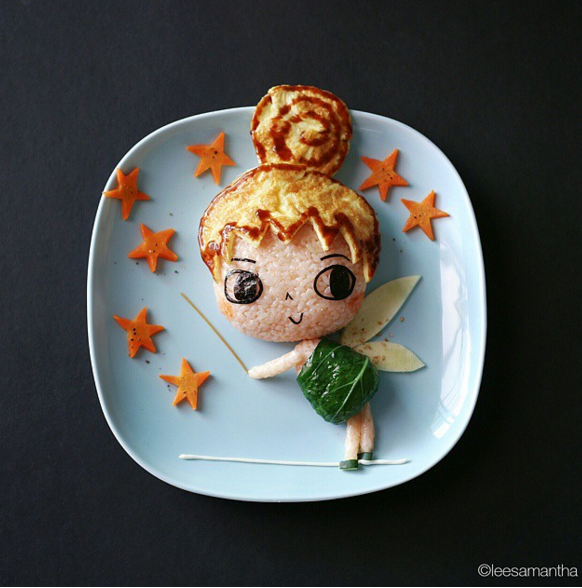
by Samantha Lee, found at http://blogs.disney.com/oh-my-disney/2015/10/14/13-pieces-of-disney-food-art-cute-enough-to-eat/
And they nodded in this information, with a half-understanding, a bit of game curiosity and a good dose of skepticism. I felt that I had averted a storm, at least for the time being. As the time for lunch drew near, I had to figure out what would go on those damn plates. “Okay, there’s the Goldfish, and those grapes I had this morning didn’t have that bad aftertaste from the skin… but what else? What ELSE? And I rifled through the fridge till I found some bologna to roll up and some cooked broccoli left overs, and scouted the pantry till I lighted upon the canned sliced peaches. Sweet, but still marginally nutritious. And to seal the deal, Hostess yodels!
At lunch, I served them with great pomp and circumstance. “Here are your surprise plates!” The fun they had pointing out the various items, their relief in not be served something truly repugnant and, moreover, their delight also in getting not just canned peaches, but a yodel besides, rendered the bologna completely benign. And the broccoli! The broccoli was transformed! It was now merely a mildly confusing disappointment, no longer something to cause eruptions of yowls and hideous, grimacing expressions. “But Mom, there’s broccoli.”
I shrugged with raised upturned hands and philosophically said, “Well, it’s a surprise plate. You never know what you’re gonna get.” This, to my well hidden amazement, led to them affirming with a mix of glee and resignation, “You never know what you’re gonna get!” They ate the broccoli.
The next day, they pleaded in chorus for surprise plates. “Oh no,” I said, “that’s an only once in a while thing,” and I insisted on serving them an “ordinary” lunch of chicken nuggets, banana slices, some green beans and two oreos. After a few times of them asking when they’d get surprise plates again, I finally, and “begrudgingly” said, “Okay, okay! I’ll make surprise plates.” This time it was hardboiled eggs, a one-serving of Mott’s applesauce, some M & M’s, carrot sticks with a little puddle of ranch dressing and cooked zucchini. “Yay, M & M’s! Eww, zucchini!” but they ate it all. That was it! I felt like Dr. Frankenstein must have when he gave life to his monster. “I HAVE DONE IT!”
Those once in a while surprise plates helped me get all kinds of vegetables into my kids’ mouths, and the good-natured-oh-well ingestion of these veggies often led to their eventual acceptance onto both “ordinary” lunch and dinner plates. (Though I wasn’t fool enough try the really challenging ones, like collard greens or kale. Why risk spoiling a good thing?)
I kept up those surprise plates until the day finally came, sadly, when it occurred to one of them to say, “I’m not eating that, Ma.” And just like that, the magic of the surprise plate was gone. Oh well. It was good while it lasted. And thinking about it now, I recall that the idea wasn’t really mine, but actually was my mother’s. She had once told me about the surprise plates she had made for my nieces when they stayed with her, and the notion must have lodged in my brain, waiting for the perfect time to come out. Did she know about the power of the plate to induce the eating of vegetables? She must have. She was a mother, after all.
found at biblemoneymatters.com/how-to-create-a-decorated-handprint-plate/
The Harvard Business Review featured this article by Diane Musho Hamilton, about how to practice remaining calm during an emotional conflict, perhaps to help its readers regain reason and control in heated business arguments. But of course arguments that escalate to that place where we become seething cauldrons occur in personal relations all the time too, if not more so. Hamilton offers a method for keeping our higher intelligence available to restore order when our more primitive emotion centers hijack our communications.
“We’ll always keep in touch, no matter what happens.”
From buzz feed.com; 16 Pictures of Animals Holding Hands, February 14, 2012
“I’ll never betray you, no matter what happens.”
“I’ll always love you, no matter what happens.”
These are things we all say in a moment of raw, intense feeling. We really mean the first part; boy do we mean it! It floods us and makes our lungs expand and maybe even our nostrils flare and there is no doubt how sincere we are about that feeling. It is a beautiful, naked pledge about our intent at that moment, offered when we are so overcome with emotion that we willingly expose ourselves.
But that second part, “no matter what happens,”… isn’t it a bit of an escape clause? A ceding of responsibility? We expose ourselves, yes, but aren’t we clinging to just that little bit of a fig leaf? No, no, we say! We are just paying homage to the unpredictability of life in the architecture of our pledge, because let’s face it, life happens to us. If anything, that underscores our pledge, right? Makes it all the more sincere, because we will prevail no matter what unexpected things happen to us! And anyway, it’s true!, Things do “happen” to us! Don’t they?
There are undoubtedly times when circumstances are radically thrust upon us, not by choice. An example, of course, is death. Another is powerlessness, say, in the case of a young child, who does not have the means or know-how to overcome obstacles placed in her way by parents’ actions or choices. How about some sort of apocalypse? A contagion decimates our population, all technology breaks down and transportation and communication become virtually impossible. That would definitely be something that happens to us. What about a devastating illness to us or a loved one? What about being fired from your job (assuming it is not because you are an unbearable jerk or lazy ass)? What about an asteroid hitting the earth? Yes, there are indeed many ways in which life “happens.” And to be fair, far less dramatic but no less powerful turns of events also can “happen” to us. People who are dear to us suddenly have needs that conflict with ours or each other. Or our finances change, and that requires radical adjustments. The list is endless.
But what about choice? Our lives are not just left to free-floating chaos, are they? Every day, no matter what “happens,” we make choices that affect how we handle or navigate what has “happened.” Moreover, in many if not most cases, the very thing that “happened” happened precisely because of a choice, or a cumulation of choices. We made it happen. Or we let it.
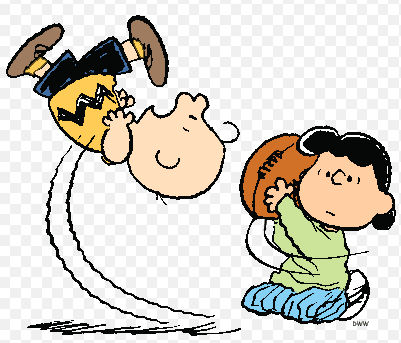
From Peanuts, by Charles Schultz
We make choices every day that direct our journeys on this little speck of rock. Thousands and thousands of choices. Little ones, big ones, easy ones, and excruciatingly hard ones. That last kind, many people avoid making, and they passively ride time for as long as they can without actually making a choice, until the choice is made for them. By waiting, we think we have absolved ourselves of the responsibility of choosing. But the truth is that’s a choice as well, and in most cases anyway we kind of know, deep down in our guts, which way things are more likely to go as a result of our not making the choice.
So, when friendships falter, it’s due to people deciding something. Perhaps it’s due to them deciding, in the midst of feeling overwhelmed by other things, that making the time for that phone call to that particular friend is a low priority. Whereas, calling some other friend to talk remains a high priority. Maybe it’s because that low priority friend has been making us feel bad more and more often, criticizing us or judging us. Maybe that low priority friend doesn’t seem as necessary to our well being as they used to. Regardless of the reason, it’s a choice. To give up reading fiction, because the demands of your job come first no matter how unreasonable or soul-destroying they have become; that’s a choice. To ignore exhortations from your spouse or your mother to stand up straight so you won’t fold in on yourself as you age; that’s a choice. And when it turns out, therefore, that you are indeed stooped over in your middle age, well, that was your choice, not really just genetics “happening” to you. To live with unhappiness because it is too difficult to rectify it, or because you believe making changes will shatter the happiness or stability of someone else; those are choices.
In many cases, the choices we make are the right ones for us. You could even say they are always the right ones, because they reflect what we really want or feel capable of at the time. But even when right for us, they come at a price, and so it’s easier to pretend we aren’t making them. Maybe they come with someone’s hurt feelings, or maybe with our own disappointment in having to let go of something that we did want, but not as much as the other thing we chose.
I just wish people admitted their choices as choices. I think it would empower them. That certainly has been the case for me. Realizing I had made choices and that not everything had just “happened,” led me to take a long hard look at why I had made those choices. I understood more about myself, and facing new, difficult choices became easier.
So I won’t use that formulation, “no matter what happens,” to drive home the truth of my pledges. Instead of saying “I will always [fill in the blank] no matter what happens” I will say “I feel with all my heart that I will always choose us.” Us as friends, lovers, colleagues, teammates, partners in crime, whatever. Unless, of course, I know I wouldn’t really make that choice. Unless, there is something or someone I know I would choose instead when really pressed about it.
Found at thetraveltester.com
Chances are our lives will never go exactly the way we want them to, because, well, things do happen. But the truth is, they’re going pretty damned close to where we want them to, because we make the choices everyday that lead us there.
These days, I reserve the word grateful for those things that bring a stab of pain to my heart as it overfills. If you find a pop tart left behind in your pantry by your ravenous kids you might feel a small rush of glee contemplating how you get to eat it, but that is not gratitude. If, however, you find that pop tart hidden behind some rubble in your post-apocalyptic home, where you have been starving for a week, you might instead experience that overwhelming tidal wave of joy, relief, thankfulness and humility that is gratitude.
photo by Gregory Mancuso; see gregorymancuso.com
I have many things in my life that blow me down with gratitude when I think about them. At 54, seeing all the disease and infirmities around me, I am practically in tears contemplating how I have thus far remained healthy and strong. And just a week ago, I was hanging out with both my kids, during their college winter breaks, when it dawned on me that they are my greatest accomplishment. I’ll happily share the glory for that accomplishment with their father, for there is more than enough to go around. It hit me, watching them riff jokes off something on the television, displaying their quick humor, their intelligence and warmth, their affection for each other and various other aspects of their personalities, that I really didn’t need to accomplish another single thing in my life in order to feel that my time on Earth served its purpose. For how could I achieve anything greater than creating these two extraordinarily wonderful people? Watching them there, I felt the gratitude coming along full bore, building and building, until it crashed over me, leaving me blubbering like a baby. They will tell you. I really was blubbering.
section from photo by Anton Jankovoy; see jankovoy.com
Standing here in the temporary desert of my own personal post-apocalyptic world, another thing that flattens me low with gratitude is the fact that I have loved with abandon, not once, but four times. Four times! That’s crazy! But true. This isn’t me mistaking for the real thing the times that I was merely infatuated or just out for sex or trying so hard to love someone I just couldn’t. I actually loved with abandon four times. I spoke uninhibited words to my lovers, purely, without agenda. I cared deeply how their family histories, their fears and triumphs, and their dreams shaped who they were. I wanted them to soar, and be everything they wanted to be. I looked right into their eyes and revealed myself. So, it matters not if I end up alone in my old age. I have seen the mountaintop. And in at least two of the cases, I actually stood on the mountaintop; I was loved with abandon in return. And the wave that tumbles me when I think about that is still a rush and a humbling.
Something happens to us adults as we maneuver the scary social complexities of society. We grow ever more hard-boiled, ever more guarded, every more cynical and ever more bitter. We forget all that we have to be dizzyingly grateful for. And we forget how to love with abandon. We sneer at it as folly. A recipe for disaster. And risking that much exposure and surrender often leads to terrible heartache, it’s true. It came to that for me in all four cases. So we hover nervously when we see our children take those risks, talking them out of it and predicting doom in our desire to protect them. But oh! That sublime feeling, when you surpass your boundaries, and lay yourself bare, there is nothing more thrilling, more alive, more beautiful. How could we not want that for our children? How is it that we focus on the downfall instead of the loft? I tell my daughter I am so, so happy for her that she has achieved love with abandon. For she has something for which she can be forever grateful, something she will always keep, no matter what happens. And you do. You keep it always.
photo by Andrea McChesney; found at iheartfaces.com
Beach spiral 1, by Dishtwiner, at dishtwiner.deviantart.com
You are so quiet,
and then
one day
it happens.
a sound,
the way the earth creeps,
a noticing.
how a pebble turning changes the beginning of what you will one day tell your grandchildren is
Your
Life.
a sound.
the heart’s murmur.
a felt sense renders you perfectly
helpless
and plentiful.
You larger than life
You as quiet and as tiny as
ever.
that pebble,
Your voice. the wind.
the wind calling you home,
the wind whistling you into arrival,
making it so you are never lost.
You are never lost.
You are so quiet.
You are so quiet.
And then,
it happens.
Your Life.
The generous, open
sea
grateful to your steady soul.
Over my life a particular memory visited me from time to time. Whenever it came, I always gave it its due attention. But it seemed to serve no purpose other than replaying a long ago hurt and, despite the gentler perspective granted with age and experience, always triggered the same painful mix of bio-chemicals that squirted forth when it actually happened so many years ago.
Of late, the memory began popping up more frequently.
At first, I wasn’t even wondering why. Then, when it finally dawned on me that the same episode was running again and again on my brain’s T.V. screen, I began to suspect that the constant replay was a demand to be noticed. Like a loud megaphone: Hey, dummy! Does this remind you of anything?
It was a time in my life when I was a real pain in the ass. Somewhere between the ages of 8 and 11, I was experiencing the fallout from being taken away from a life that worked for me. In that wonderful former life in the Bronx, my older sister Michele played with me more than she socialized with our eldest sister Renee. In that life, my best friend lived directly across the hall from me, and was available most of the time for companionship. In that life, my mother was home most of the time; and, when she did go out without me, I had the security of my best friend’s mom across the hall, or or my grandmother (who lived two floors below us) and never once felt alone. But in this new suburban life I was now in, I hadn’t made any real friends yet, my companionable sister had crossed over and was now a fellow traveler of our eldest sister, and my mother worked as a teacher. Little did I know that day when we were all so proud of her for graduating and huddled together, smiling for the camera to mark the occasion, that I should have been singing a dirge. For my mother of course did the next logical thing, which was to get a job as a teacher. Not that it affected me during school hours. But, after school, in place of my attentive, soft and patient mother, offering snacks and asking me about my day, there was a different mother. This one was stressed. A new teacher, preparing lessons for the next day. Working on her masters degree, and sometimes traveling into the city for evening classes, or spending yet more hours doing her assignments.
My father was also withdrawing. Not that he ever was the warm and cuddly type. He was a cop, and had to keep up his hard-boiled exterior. But when we lived in the Bronx, it was a few simple steps for him to come into the bedroom I shared with my sisters, to tell us some stories, make us laugh or sing to us. Now, we all inhabited our own separate rooms, up a flight of stairs, and my sisters were getting too old for that sort of thing anyway. And, too, he was facing his own wearying challenges. He was now commuting from the suburbs into a part of the Bronx that was getting scarier and more disassociated from that place where he grew up. The absence of any men who really could relate to him on any level in our upward striving suburban community, and the surreal and battering horror of traveling back and forth from dainty civilization to dystopia on a daily basis, caused him to retreat further into his world of books and pipe tobacco when he was home. And my sisters were off tittering about some shared secret knowledge or hanging out with their friends. I was no longer a cute diversion holding any interest for them, and my felt banishment filled me with resentment and longing.
From The Children’s Encyclopedia, by Arthur Mee. (London: The Education Company. Orig pub. as The Children’s Encyclopædia 1908), “Ideas” section, Volume I, p. 112.
The final loss, in a twisted turn of poor timing, I also was no longer my mother’s “warm little bundle.” This I learned when she started telling me all the time “Oh you used to be my warm little bundle!” As I was getting larger and losing what was left of my wide-eyed and sweet puppy features, it was not possible, had I even tried, to fool anyone into thinking I still needed slack for my hesitations and cluelessness. People expected me to get with the program, understand my responsibilities, stop expecting time made to soothe and redress my little hurts and disappointments.
One Sunday afternoon in particular I was sadder than usual. My sadness moved into broken-heartedness, and I felt strangely incapacitated, virtually listless. I became convinced that I had some sort of mysterious malady, which only a mother would understand, and certainly have the remedy for, if I could just muster up the energy to call for her, which I did. She was all the way downstairs, using up what free weekend time she had entertaining my Aunt Betty, and so I had to summon up quite a bit of energy for my call of “Mahhhhh-meeeeee!” to reach her. That I was in such a sorry state as to be required to use every last bit of my strength to make such an effort only made me that much more broken-hearted. Years later, I understood that what I wanted to see, what I ached to see, was my mother, coming up into the master bedroom (where my incapacitated little body lay), with a gentle reassuring face, soon to be stroking my hair and telling me that if only she could get ride of Aunt Betty she’d be there with me, taking care of me and making everything all right. What I got instead was a slightly exasperated mother, with firmly set lips, who was there to get to the bottom of why her then 9 year old thought she was incapable of walking down the stairs. When I told her that I wasn’t feeling well, she strode over, checked my forehead for heat and looked at me hard, trying to size up which reaction I deserved. I received the, “Well, just rest here and I’ll check on you later” response, which was far short of what I so desperately wanted. She went back down. I spent the next 15 to 20 minutes wondering what went wrong. Why didn’t I get the loving stroking of the hair and the reassurance that our bond remained intact despite all the demands on her time? And, convinced that I didn’t do a good enough job of conveying how broken-hearted I was, I decided as only a 9 year old can that the best way forward was to call her again, and this time really make sure she understood. Although this time I never got to say anything. As soon as I called out my even more plaintive “Mahhhhh-meeeeee!” I could hear Aunt Betty clucking her tongue about what a nuisance I was for my poor mother, and could almost see my mother’s face pained with exhaustion and embarrassment (for Aunt Betty made it clear always that she tolerated no such nonsense from her children). When she appeared at the bedroom door, having made the climb for the second time, someone even more removed from the mother I grieved for was there. I can’t remember what she said, but the words were irrelevant. Her angry expression and tone said it all. I was a burden, whiny, unreasonable and selfish. Something to deal with. Not a hurt little girl, her daughter, without words to express to her mother how alone she felt in her losses. In that moment, I understood fully and perhaps for the first time that my sweet childhood was truly over. I endured the moments of bitter reprimand that followed and said nothing more.
So why the increased frequency of replay? What was I hoping to find in that memory? As early as young adulthood, I had figured out that my mother was in an almost impossible situation, working full time, running our home and raising her girls all without much input or support from my father. I had already worked out that my father was steeling his soft and poetic nature every day for the work of a mercenary, patrolling an unsafe community that was no longer his own. I had already grown to understand that my sisters were just experiencing their own lives with all the complications and transitions that adolescence brings. I had nothing more to learn from that memory, or so I thought.
My own daughter, now 21, has had her own difficult journey. As the first born, she had no older sibling to shelter her when she first entered the world outside of her mother’s arms. She would return home from a difficult day at school to find me, formerly unflagging in my soothing attention, now preoccupied with her younger brother, or in the middle of house chores, or chafing against something gone wrong in my life that I hadn’t put to words or even understood but which only served to unnerve her all the more.
Dreamscape by wbsloan on Flickr
And at those times, when my daughter needed me, I’d deliver a sort of patched together, half-hearted exasperated offering of my own. Sometimes I even lost my patience with her, when all she really wanted was for me to scoop her up and tell her that she was loved, and special, and that I was glad to have her home. Instead, she knew that part of me wished she was still at school, so I could catch my breath, and have just that bit more peace, and maybe somehow get grounded back to who I was. When she came home from her own battles each day, she was greeted, not by the loving, tender mother she wanted, but by the same overwrought mother, with strained smile and limited patience, that I had greeted. The same mother who hoped to fix her daughter’s unhappiness by suggesting better ways to have handled something, as though that would stem the onslaught of painful experiences. The same mother who felt guilty and helpless whenever she witnessed her child’s pain, and never said the right thing. How is it that I determined to do things so differently from my mother, so that my children would not feel the same rejections and misunderstanding I had, but ended up failing so completely in that regard?
Brave and determined soul that she is, my daughter set herself to exorcising all causes for resentments from our relationship while she was still a teenager. After years of less effective confrontations, at 21 she finally developed the language to convey (and I finally refined my listening enough to receive) the simple truth that she had felt like a burden to me. She felt she was the problem child that made everything harder for me… for us. She confessed it to me one night, one night of wonderful, vulnerable, almost scary bonding and revelation. And there it was, at the ready, finally able to reveal why it had been plaguing me: that memory of my own mother, angry with me for needing her when she was barely hanging on herself, and resentful for not knowing how to fix it all, that aching in me and in herself. And I whispered to my darling daughter, “I’m so sorry, sweetheart. I’m so sorry that I didn’t simply hold you and tell you I loved you, that everything would be okay. That all of it mattered, yes, but that none of it mattered now that you were in my arms.” How long would that have taken? Ten minutes? Ten minutes to soothe a child facing the world without her mother. A child without sheltering siblings and with no trusted friends yet. Why couldn’t I just have simply hugged her, without judgment or the desperate wish that all her problems, that she, the way she was, would just change into something else that would make my life easier? Instead, I contributed to a pattern that would haunt us for years: the lonely and misfit daughter and the overwhelmed, worried and ineffectual mother. I’d come to pick her up from a birthday party, with a dreading expression, expecting before being told that there had been some pain for her in the proceedings, some conflict that all the other children and moms couldn’t understand, or prevent, and wished would magically disappear; and instead of scooping her up and being on her side, I’d wish it would all disappear too. I wished she would just be easier. For my sake as well as hers.
So here is my atonement. To my daughter, for doing exactly what my own mother did, and what her mother did before her. For not wanting to acknowledge the legitimacy, the normalcy, and even the inevitability of the hurts a sensitive child feels when weaned from her mother’s side. For not wanting to explore my part in those hurts, making them worse by adding my own frustration, resentment, guilt and feelings of inadequacy as insult to injury. But my atonement also is to my mother. I atone for having judged her as not up to the task of understanding and comforting an angry, sad, lost child. It is a very difficult task, maybe impossible; I know that now. I atone for my high-handed thinking, when I became an adult, that I was big enough and wise enough to forgive her. There was nothing to forgive. She loved me, and my pain pained her. She was a wonderful, wonderful mother, all the more so in light of all she carried. I atone whole-heartedly, seeking her forgiveness for assessing her and finding her wanting, now understanding finally that all the love and best intentions, all the experiences and memories we swear we will bring to our own child-rearing, may not be enough to overcome the limitations and distortions hammered into us by whatever stressors and unspoken resentments are plaguing us at any given time in our adult lives.
The cycle of hurt between parent and child will continue, I suppose. I pray that my daughter will be able to break it should she have an unhappy child. And I hope in any event that my daughter too comes to understand that I loved her always, and that her pain pained me, and that I wish more than anything that I could redo some of those moments she remembers, bringing the perspective I have now, and taking the hurt away.