Category: Formative

  • Close Shave

    Close Shave

    Screen Shot 2015-07-18 at 3.05.59 AMMy father and I had a secret ritual, which began before I can remember, and finally came to an end, as was right and necessary, when I was about 11 or 12. I stumbled upon the ritual; it was of my making, but my father was complicit, and I like to believe he valued it as much as I did. It was how he told me he loved me, other than his occasional grabbing of my upper arms and saying through clenched teeth “Flesh of my flesh! Blood of my blood! BONE OF MY BONE!” while shaking me with just enough force and with his eyes gleaming to let me know it was a game. It was indeed better than his parentally crazed shaking, because it also showed me that he trusted me to see his limitations. His vulnerabilities. His steady and sure plodding. His humanity. And it was how I told him that I adored him more than I feared him, which was plenty.

    I understood from about the age of 4 or 5 that my father was a cop. Not one of those college educated officers who now fill the ranks of New York’s Finest and put in just enough time to earn a pension and become a genuine part of the fraternity. He was a cop for 31 years, and saw all his peers disappear into the safety of department administration, building construction, or shop ownership, while he continued to walk his beat and the neighborhood around him continued to break down a little more each day. But as I had no real understanding until I was much older of what he did day in and day out, or that being a cop in the South Bronx required being some kind of always, thought just barely, restrained powerful force, I wasn’t afraid of my father because he was a tough cop. No, I was afraid of my father because, cop or no, he was indeed, for some reason I could not comprehend, a barely but always restrained powerful force, and that force was rage. He was a man of few words, and most of those were explosive, passionate, impatient, menacing, or, suddenly, unpredictably and almost unnervingly jolly. He was a man who took things in quietly, but let things out noisily. He was someone I had to watch closely to know whether he would be receptive to my approach, my question, my hand on his knee. He was someone, I learned early, who tolerated no inconvenience or any conversation that lasted more than a few sentences. I vaguely understood the way a 5 year old can that my father was in constant battle for his soul. His overbearing and vulgar parents, the streets, the dangers of his job, required him to be hard boiled. But he didn’t want to be hard boiled. He was Ferdinand the Bull. He wanted to sit under the cork tree and smell the flowers, or, in his case, read a book and smoke his pipe. He wanted to dance a rhumba with his wife or play his violin by ear, laugh at something silly or recite lines from Cyrano de Bergerac. And more than anything else, he wanted not to have to steel himself everyday for the bullfight.

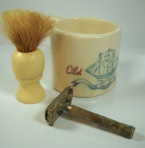
    My earliest memories of watching my father shave consisted of me standing quietly by the door of our small bathroom, knowing not to say a word or else risk banishment. I was able to pretend that I was simply waiting for my turn to use the bathroom, the cub ceding to the protector of the pride. I watched with my big eyes, as my father moistened his shaving brush and whipped it around deftly in the yellow-white mug until I could see a creamy foam form on the bristles. I watched as he rubbed the foam all over his face, and then took a single-edged razor to his face. My father shaved up, against the grain of his stubble, causing that scraping sound which to my young mind only proved how tough and brave he really was. And when he was done, had rinsed whatever thin strips of soap remained, had patted his face with a towel, he poured some strange green liquid from a bottle into his hands, slapped it on his face (the sounds of the slaps further proof he could take it, take it all), and grimaced from what I surmised was the same sting I felt when my mother daubed my cuts with alcohol. I knew I was watching something ancient. Private. Sacred, even. He was our warrior putting on his game face. Risking cuts, and stings and sometimes having to paste on little pieces of tissue to stem the bleeding, all so he could go out to do what he had to do.  I could feel the dread, wincing internally before I could even hear the scrape, scrape, scrape and the inevitable slapping, and smell the stinging green mystery tonic, whose only purpose seemed to signal the end of the ceremony. A sharp punctuation mark, accompanied on occasion by the intake of air through his clenched teeth, or, rarer still, offered for my benefit, to allay the solemn concern in my big eyes, the big and worried eyes of his most sensitive and soft-boiled daughter, a robust exhalation “Ahhh!”

    Screen Shot 2015-07-18 at 3.20.59 AM

    When I was seven, we moved to a house in the suburbs. My parents suddenly had their own bathroom, and my sisters and I had ours. So, for a little while, no longer having a reason to invade the bathroom he was using or any excuse to stand and wait at the door, I forgot about my father’s shaving. But one day, seeking him out for some purpose, perhaps sent on an errand of information for my mother, I found him in his bathroom shaving, wearing his preferred sleeveless undershirt. And this is where our true ritual began. For though I had no pretext to remain, I did. I took my place sitting atop the closed toilet seat behind him and a little to one side, and silently began watching him once again.  And my father looked at me in the mirror only long enough to catch my eye, to tell me without words that it was okay for me to remain in his bathroom, the place of his most private ablutions, grooming and thoughts, so that I could watch him shave. I was allowed into that private space. Because I was silent. Because I would know when it was time to leave. Because in my mute presence I commiserated with him about the unending source of stubble rising out of his face. Because I studied and took vicarious pride in his technique and acknowldeged how he persevered in his unflagging duty to shave, and, more than that, shave well. Because it reassured me. Because I left him alone in his thoughts.

    Over the years, I would return frequently to my perch on the toilet, gliding in without a word, and gliding out again once the tonic was slapped on and the brush rinsed, squeezed and reshaped. Sometimes, very, very occasionally, I’d move closer to get a better vantage point, but only when I sensed he’d allow it. Regardless of my exact positioning, we both knew that his letting me watch was his way of saying he loved me, trusted me in this private space, this private occasion. Appreciated my solemnity and my softness. Would never intentionally try to toughen me up or pressure me to be hard boiled. And we both knew that my watching him was my way of saying that in those moments I was not afraid. I could see the man behind the rage. I could see and love my father. I never asked him if my sisters came to watch him. And I never talked with them about it or mentioned it to my mother. I wanted it to be something that belonged to my father and me alone. I wanted to be the only one he allowed in. The only one who knew how to be silent and appreciative of his daily commitment.

    Eventually, of course, I stopped coming to watch him shave. I started growing into a woman, and could no longer be the adoring young girl. There was no one seminal event, no ceremonial last occasion. It just stopped somehow, and I didn’t actively think of it again for many years. I didn’t think of it again until almost 40 years later, when I had the opportunity to once again watch a grown man shave. You see, my husband of over 20 years kept a beard. Interestingly enough, his primary motivation for having one was so that he wouldn’t have to deal with the unrelenting tedium of shaving.  I never had the opportunity to watch him shave, and I never even really thought about what I once so treasured… Except that having come across a display of men’s shaving items some years ago, I bought myself a bristle shaving brush on impulse, and told myself it would be great for my legs… And except that when I use my brush and get a head of lather, I feel a tinge of pride and silently think about how foolish all women are and most men, not to use one.

    So, my husband and I no longer together, I fairly recently watched a new man shave. This man shaved down, with the grain, and he used cream out of a tube. But he also bragged with obvious relish about how he once let a barber of dubious reputation in a foreign country shave him with an old fashioned long-handled straight razor, so I sensed a true shaving enthusiast might lie within. And despite the cream out of the tube, which would require the far less elegant rubbing on with fingers, I felt the stirring of my delight and keen interest. I couldn’t tell if this was due to the fond memories I had of my father, or proof that here too, I was sharing in an exchange.  Different, yes, but still admiring. Still loving and still unspoken.

    I bought him a shaving brush.
  • The Loveys

    The Loveys

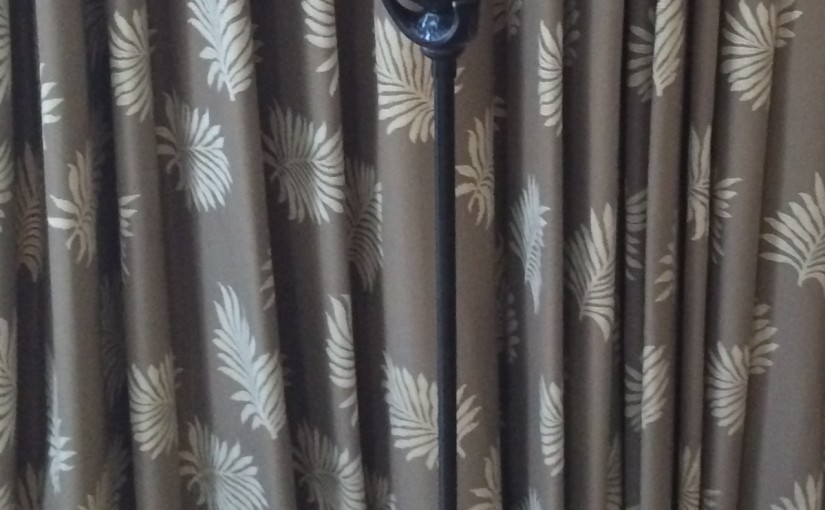
    lampFrom my kitchen table I can see that lamp. That floor lamp I finally came up with an excuse to get rid of (it really is far too puny for our oversized family room, and I had no other place to use it) and temporarily replaced with a bigger, more me kind of a lamp. Before the day went out, my son asked, with his panic barely contained, “What did you do with that lamp?”

    “What lamp?” I innocently asked, without any actual innocence.

    “That lamp that was in the family room? Did you get rid of it??”

    I told my son that I still had it. “But see how much better this lamp is for the space?” I sweetly suggested. He was not fooled. “Can you put it back?” he pleaded. He then dropped the cement. The fixative that would tie that fuggin’ lamp to me for all time. “I love that lamp. It’s been in every home we’ve ever lived in. I remember that lamp from forever.” And then the coup de grâce: “…It’s my childhood.” Just like that, I was doomed. Doomed to keep that lamp for all time, till I die.

    I understood the power of the lamp for my son. For I too had THE item, a small mass produced print, purchased at some such place like Alexander’s (in the Bronx) or Woolworth’s, of a Paris night scene by Maurille Prévost. This cheap replica, printed on swirl-embossed paper to suggest actual brushstrokes, and set in a common, 1960’s ready-to-hang frame of the sort found everywhere in tasteful or striving middle class homes across the country, was so dear to me that my eye would scan the wall for it virtually every time I was in our kitchen in Rockland County. Before that, when we lived in an apartment in the Bronx, I’d look up from my spot on the smooth-tiled foyer floor (the small sofa seemed reserved for my Dad or visiting adults) and find my familiar friend reassuringly in its place, my proof that I was in the right home. When my parents were preparing for a garage sale prior to moving from their Rockland home to a more suitable dwelling for retirement years, I quickly grabbed the print off the wall and held it close. “Were you thinking of getting rid of this? Cause I’d want it,” I whimpered. And moments later I was the happy owner of my childhood companion, which I promptly hung up in my home, to the confusion of my husband.

    So I knew that lamp, that damned lamp, was not just a lamp to my son. My 18 year old son, skilled in never appearing to break cool when it served him, actually voiced a plea for this unoriginal, this unremarkable, this you-should-be-ashamed-of-yourself-sorry-excuse-for-a-lamp lamp, with bond paper dyed and embossed to look like a genuine tanned-leather shade and dark-brown bronze pole complete with matching, hammered base which no lamp should ever have, ever again. He was desperate. Believe me, I knew this from recognizing that same imploring expression of poorly disguised anguish my mind’s eye recalled from my very own face. Worse, I was 35 at the time! But, I wasn’t going to let on just how well I knew. “Okay, sweetie,” I said with my inner Oscar winning actor’s most benevolent patience. “For you, I’ll switch them back.” And as I turned to go, when my face was safely “out of scene,” and out of sight, my inner actor, who is, actually, me, dropped the act and celebrated my coup in grasping the truth: “That’s his lovey.”

    Of course, I’m a smug dope cause my lovey is that dumb, cheap, embossed paper print with the cook arriving for work via bicycle and with his chef’s hat on already, while he’s still straddling the bike, at an establishment simply and humbly called “Restaurant.” And I remember the love I had, have, for my lovey. The joy that filled me as though I were a child again when my mother, in the manner of a carnival barker awarding a small kid a prize that was worth absolute crap all the while making the kid feel like she was getting gold, told me “It’s yours!” And I couldn’t bring myself to ruin my son’s not-so-secret, young child’s stab of joy and relief. So I said nothing to him. Nothing to let him know I was on to him. Knew his secret. And even more importantly, nothing to let him know that that very same lamp had been a prick at my heart every single time I looked at it.

    I had purchased that lamp during a New England style colonial antique furniture-browsing day with my mother-in-law and sister-in-law, about 4 years into my marriage. Why I was even in that particular browsing experience was a source of mystery to me, since I despise New England colonial antiques, and deep down always did, but my apparent inability to say, “no thanks, Mom, I hate the kind of antiques you love” when she brought up the idea to go browsing for the new home in the “country” that her son and I recently acquired (and so What better place for “country furniture” right?) had something to do with it.  I suppose it was tied to the very impulse that later led me to suggest out loud that I might buy the lamp. It was an obligatory outing with “the matrons.” Not that my mother-in-law or sister-in-law were particularly matronly or even were aware they were serving that function. We poor females don’t always know when we morph into a member of the matrons, those women who, among so many other stultifying suggestions and comments, imply to you that furniture shopping is something “the women” do to feather their family nests. And furthermore know how to do primly, and respectably, and for not too much cost because we want to be responsible in our spending after all. And being with the matrons, I didn’t say, couldn’t say, couldn’t admit, “I hate furniture shopping. I couldn’t give a shit about what my furniture looks like, really,” or say “Guys, I’ll shop for my furniture when I good and feel like it, and it won’t be this New England, stripped of all ornamentation or frivolity, and painted or stained only in muted shades that suitably convey puritan plainness, humility and purity shit. It’ll be something positively vulgar, like florid and overly carved Victorian pieces or something out of the 50’s version of the future,” or even “There’s really something messed up about the fact that women do this in groups, to help each other, right? Where are the men? I mean, HELLO! Don’t you realize that we are still doing the same shit our very hairy hundreds of thousands of years ago predecessors did?”

    So there I was, along on this activity. For some reason, probably just because it was along our path, we walked into a furniture store that was not filled with colonial antiques or reproductions, but with newer, somewhat everyday, tasteful furnishings. Maybe, understanding what felt like my only way out, I scanned around for something, anything that I could live with. Or maybe the selection just seemed so much better than it was because it appeared after a sea of items I couldn’t ever imagine owning, that I really thought I liked what was in the store. But for whatever reason, that’s when it happened. “What do you think of this lamp for our living room?” I asked.   BOOM. There it was. My surrender to the matrons. And one moment later, the fog cleared, and I understood that I had selected something that I really didn’t love or even want, but I held steady. I must have figured, better to get it over with, offer up the sacrifice, and then never have to go through this ceremonial joint furniture shopping ever again. Only I couldn’t have known then that it was the beginning of a long line of offerings that became second nature to me, and led me so far away from myself that I mourned my absence.

    To be fair, neither my in-laws, nor anyone else, required my offerings. Indeed, over the years my mother-in-law developed a love affair with expressionist and folk art, which she indulged in freely by altering many of her colonial pieces with paint and decals of bursting blooms, or wildly colored finishes, and by transforming her walls into galleries for some of her own very vivid, unabashed and often quite thrilling expressions of color, form and movement. She was feeling free to be herself. Why wasn’t I? Maybe, once you suspect deep down that you have entered a life that isn’t quite working for you, you do whatever you can to disguise your true impulses and desires. Maybe you do whatever you can to prevent yourself and others from knowing the truth: you do not feel yourself. You do not feel alive.

    And so I loathed that lamp. For 19 years I secretly loathed that lamp. But now, well past 50, I finally decided I could simply get rid of it. I no longer felt tied by some inexplicable, self-imposed obligation to temper everything in my style, my home, words that leave my mouth. Yet, here is my son. To him the lamp is his childhood, and he loves it. The strange thing is, that somehow rehabilitates the lamp for me. I can look at it and it no longer pulls up an unpleasant association just outside my conscious language.   It is my son’s lovey, … and that is… so cute. I love that lamp! That is the lamp my son looked up at and felt reassured by! How could I ever get rid of it? What was I thinking?! And so, that lamp is now among my favorite items in the house. The house we will be listing on the market this spring, now that my husband and I have separated. I will be sure to keep that lamp in every home I live in, so that my son will know he’s in the right place, or one of two right places of course.

    Back to here, from my seat at the kitchen table, I see the lamp. And shifting my eyes I see that I am also in perfect line with that print. THE print, my lovey. Suddenly the thought occurs to me, what if my mother or father had an unpleasant association with that print? What if it was an awful association? I call my mother immediately.

    “You remember that little print of the cook outside the restaurant on his bicycle?”

    “No.” That puts me on notice right there that I am probably on safe ground.

    “The one that used to hang in our foyer at Bronx Boulevard and then in our kitchen in Rockland?”

    “No, honey, I don’t remember it? Why?”

    At first, my lovey not having an anguished past that my mother would instantly recall and convey to me disappoints me. It made my lovey a bit more… prosaic. The possibilities had been endless. It could have been something that my mother’s wandering and ultimately abandoning father gave her that she couldn’t quite bring herself to throw out. Or it could have been an imposition by her mother-in-law, who firmly declared that it was fitting and expected to see it hanging there in the foyer every time she visited our apartment that was so much smaller and less glamorous than hers. I try to inject some drama.

    “Well, you gave it to me because I remembered it so dearly from my childhood, but I was wondering if it turned out that it had actually been a source of emotion for you. You know, like, maybe Grandma Gussie gave it to you and you secretly hated it?”

    My mother chuckles kindly as one does at a child with a wild imagination. “No, dear, I probably just picked it up somewhere. I would do that. I’d see something that would strike me, that I’d like, and I’d get it.”

    Touché.

    Well, it turns out that my lovey is really quite a layered symbol after all. Far from prosaic, it now serves not only as totem of  my youth, but also the ability to allow unabashed expression of myself that I once wielded and now wield again. And on top of that, while the materials used for the print and frame were inexpensive and unimaginative at the time of manufacture, they are “vintage” now, and the content, the lovely little scene by Prévost, is quite striking. I rise to wipe layers of dust and grime from the unprotected surface, it occurring to me that the dark colors I always assumed were part of the print might actually be forty years of accumulated film.  As the brighter colors burst from under the damp dusting cloth, I realize that the scene has always been a window into my mother’s tastes that I had not really ever looked through.

    Prevost


  • Melvin Beylis Died

    I heard from my mother that Melvin Beylis died.  I’m using fictitious names for privacy, so this man I remember with fondness is going to be named Melvin Beylis.    The last time I saw Melvin was close to 30 years ago, and, before that, was when I was a teenager. But my memories of him from that time, and indeed from my entire youth, are as vivid as the most intense memories can be. As vivid as memories are when they are of someone who epitomized a time and place for you. Melvin did that. He and his wife Myrna epitomized my life in the Bronx, in the 14 story building that seemed to my young eyes to tower above the shorter apartment buildings and townhouses lining Bronx Boulevard.

    Melvin always had a glint in his eye and a warm chuckling smile for me. His voice was barrelly and resonant, though he didn’t talk much. But when he did speak, his accent sounded vaguely exotic to me, a deep rumbling of a way of speaking that was so comforting and familiar, yet foreign in some way. I think his slightly darker skin tone and saucer sized brown eyes added to this notion that he was exotic. I couldn’t know then that what I was hearing was simply a mellifluous Bronx accent. A more sing song version of the hard pronunciations surrounding me on all sides, but flowing out of Melvin with their edges just ever so smoothed off, and sprinkled with his one of a kind giggle. His dark, caramel giggle.

    Melvin’s receding dark hair was slicked back with the natural hair oil most men allowed to accumulate back then, to the apparent approval, or at least with the toleration of their wives and girlfriends. He seemed big and tall, despite rounded, stooped shoulders, and enough extra weight and body hair to look a bit like a shuffling bear. Someone that you wanted to hug, especially when you saw that warm smile and heard that mirthful sound emanating through parted teeth. But my best friend, Laura, told me, by her face and body posture, that her father was not as warm as cuddly as he appeared. She seemed almost a little afraid of him, in a respectful way, the same way I felt about my own father. And so I didn’t hug him, or dissolve into unguarded affection, even though he seemed so inviting. And when I hung back, I could sense the affirmation from Melvin: yes, that’s the right distance.

    I could also sense but not articulate the ways Melvin was different from my father, Bernie, who had a jauntier and harder edge – who seemed more “hard-boiled” – or how Myrna was different from my mother Shirley. Myrna’s hair was a difficult to describe warm brass color, somewhat poufy if not bouffant, and highly sprayed – the kind of hairstyle that gave you no clue as to the wearer’s age, and which she could carry, and indeed did, for the rest of her life. Myrna spoke as someone with not a shred, not a hint, of any self-doubt. Someone who owns a space as soon as she walks into it. Someone whose voice modulates from sarcasm to authority to sly wit, but never falters or softens. She conveyed a confident, unassailable assessment of the facts at all times, never a gentle questioning or exploration. In contrast, my mother Shirley was less apt to offer a viewpoint or perspective, and only did so to be sociable. She spoke with the same accent, and with some measure of steadiness, but next to Myrna she seemed more understated.  Indeed, her two steps forward one step back way of making herself understood seemed practically genteel, and a bit at odds with Bernie’s gruff but good-natured swagger.

    It’s surprising to me to realize now that they all had the same Bronx accent. They all said “ar-right” instead of “all right” and “draww” instead of “drawer.” They all said, “prahhl-ly” instead of “probably” and “beeyoo-ti-fuhhl” instead of “beautiful.” But they all sounded so different from each other, anyway, merely from the added ingredient of their individual attitudes, their different handling of words and emphases. And perhaps because my own parents were too familiar to me, too much the norm, I never realized that they too spoke with the same dialect. The same rolling and pitching and dropping out letters and merging of syllables. The same accent I must have had, realize now I still have, when I’m spending long hours with my sisters and the conversation gets animated. If it weren’t for Melvin and Myrna, and the study of them that living across the hall allowed, if it weren’t for remembering their immutable and undeniable patterns and their warmth – for there was occasional warmth and mirth even in Myrna, behind the caustic surety – I might have never understood just how much I lost.

    We moved away when I was 7, and though I remained friends with Laura for many years (our parents making it as easy as they could for us to see each other regularly and for sustained periods), in my new surroundings I began a process of transformation, a washing out, that led me to the wider world, but at a price. In Rockland County, an increasingly settled area known as “upstate” but only 30 minutes from the Bronx, I mixed with kids who spoke differently. Their parents were from other parts of the city, or from New Jersey, or even farther afield, and they didn’t have the hard r’s I did or say “dawwg.” Many of their parents were professionals or college educated, not like my father the cop or my mother who went back to school to become a teacher only after we were all in school full time, and these adults spoke with a loftiness and expansiveness that seemed like a softer music to me. I wished I had understood then that it was blander.   It wasn’t as lively, or, indeed as alive as the way Melvin and Myrna spoke. And, without even realizing it, I softened my edges. In my little 7 year old brain, then 8, then 9, and so on, I mimicked and strained out the harsh sounds in my words before they slipped from my mouth.  I modified. I took two steps forward and one step back.

    By the time I was living and working in Boston, my exposure to people from all over the country, first at college and then at law school, had ensured that I spoke, if still recognizably from the mid-atlantic states, not at all the way I did when I left the Bronx. Not at all even the way I did when I first arrived at college and met a boy who wrote home about his new girlfriend’s New York accent. More muting, more conforming, more blending, more sophistication I thought, did me the service of rendering me unidentifiable as a Bronx native. In most conversations with my sisters, ones I have with them when others are around and I’m not completely unguarded, I speak differently from them. I even triumphantly noted a time or two in the past that I have come to lose much of the accent they still possess. The one disturbing blip occurred when I worked in a New York law firm my second summer in law school. I had some trouble figuring out the right poised and measured responses to give to partners when they asked me to take on more work, and this led to a coaching session with the partner looking out for the summer associates. He began his helpful, patiently condescending advice with the apparently sympathetic phrase “I, like you, came from a lower, middle class background.” This he apparently discerned from my inadvertent occasional slip back into harder more “Bronxonian” speech patterns while living in the city that summer, since I never discussed my heritage or socio-economic background with anyone at the firm. I remember my ears burning with outrage and humiliation, even as I dismissed him as a wannabe, a poseur.

    In my early adult life, I completely lost touch with Laura, and not just because I lived far away. I ensured the demise of that relationship, first having managed to make her feel increasingly bad whenever we got together by always pointing out all the ways in which our lives and styles had diverged, and then by becoming insufferably self-absorbed, as people who are actually insecure do. It is only now, thinking about Melvin’s large brown eyes and occasional baritone rumblings, and then Myrna’s brash and unflinching assertions, that I remember how I loved the patterns of my childhood. The charm of its familiarity and reliability.   At some point, just a few years ago, I came to understand that when I lost Laura’s friendship I lost something fine and rare, and that her giggling, no doubt a gift from her father, lit me up and made me smile, but it was too late. We had spent our entire adult lives apart, and there was no basis for friendship anymore. There was no longer any basis even 25 years ago, when I told her in an unwelcome phone call that I had heard she had stumbled on her way up the aisle at her wedding, a wedding I should have been at and indeed had been invited to. Far away as we were from each other even then, she could not have understood that I was not trying to point out her awkward moment with intent to diminish her, but was instead lamely trying to reach out, to tell her that I could well imagine her charming giggling at her misstep and the unspoiled and gorgeous and sweet, sweet joy of that moment I wished I could have seen, if only to remember all we shared as children. Even way back then, despite that vague awareness of what I had lost, and that fumbling attempt to reclaim it, I continued moving, if not entirely away from the cradle of the familiar, determinedly insensitive to it. This, I realize now, is a particular thread, a pattern, that repeats and repeats in my tapestry. A tapestry that consequently wasn’t as bold or as lively as I now wished it had been. As I now wish to weave it.

    I think of how Melvin and Myrna represented the Bronx to me, how over the years they and Laura grew more cordial and less warm toward me on those occasions when I did see them, and, in Myrna’s case, true to her tell-it-like-it-is nature, barely cordial. And I find myself so very relieved to discover that those hard r’s and stretched out diphthongs are not completely gone, if only I relax and become completely unselfconscious, and that instead of taking one step back after my two steps forward, I can look around, giggle, and simply wonder aloud good-naturedly if I’m out too far.